
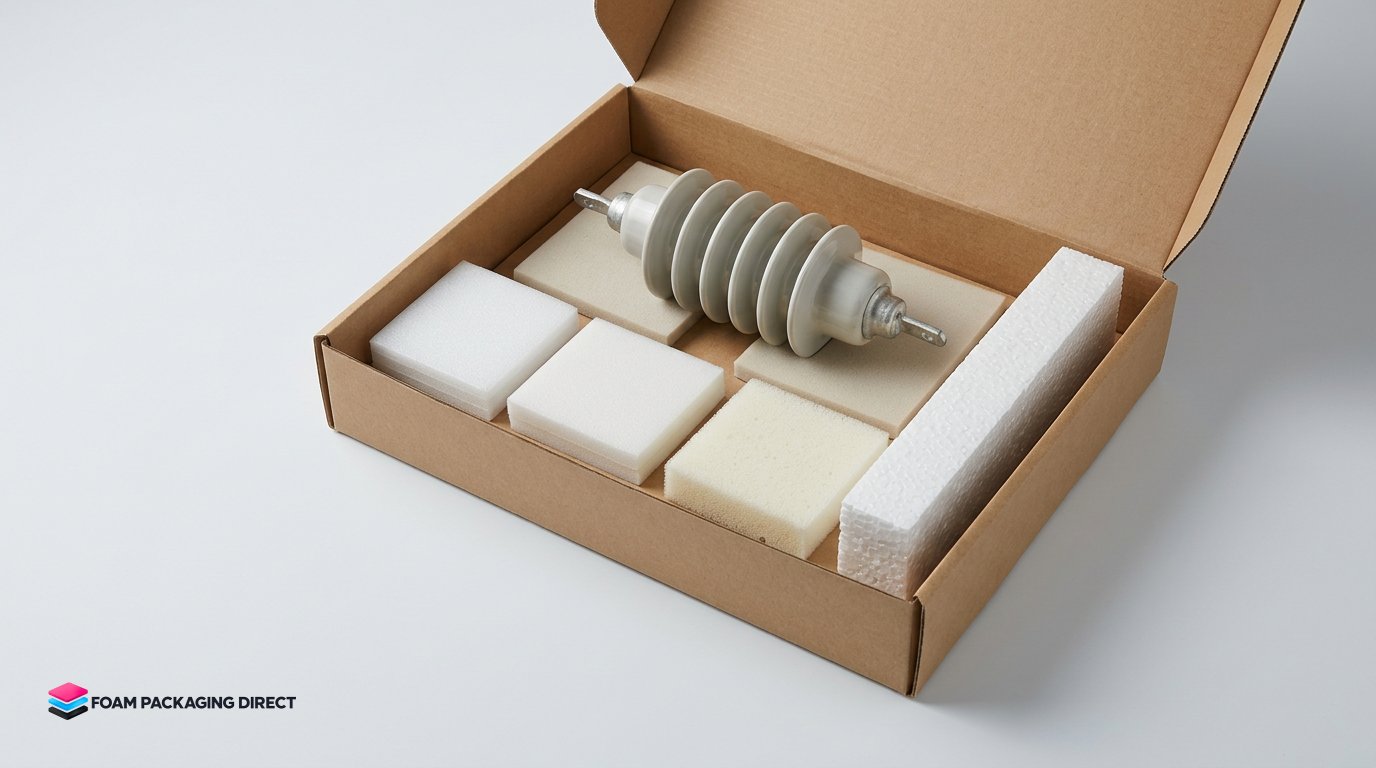
The air trapped inside packaging foam helps create its protective structure. Foam sheets for packaging are typically made from a polymer matrix with small air or gas bubbles formed using heat or pressure. Additives can give the material specific properties, such as anti-static performance.
Choosing foam involves more than thickness or softness. Material, density, firmness, and fit all affect how cushioning responds to a product’s weight, fragility, and shipping conditions. A sheet that cushions one item well may not suit another.
This guide explains how common packaging foams differ, how sheets, planks, and pads help limit movement and absorb impact, and what density and firmness tell you about cushioning. It also covers the product details to consider when choosing an option, so you can make an informed decision instead of treating all foam as interchangeable.
Key Takeaways
- Understand how foam’s cellular structure creates cushioning and why planks, sheets, and pads suit different packaging needs.
- Compare polyethylene, polyurethane, EPS, XLPE, and anti-static options based on the product and shipment requirements.
- Use product weight, fragility, dimensions, and shipping conditions to guide foam selection and reduce unwanted movement.
- See how custom inserts, end caps, sheets, and pads can help create a better-fitting protective package.
What is packing foam made of?
Packing foam starts with a polymer matrix that traps small air or gas bubbles. Heat or pressure forms this cellular structure into cushioning material. The polymer and any added ingredients affect how the foam behaves, so Polyethylene (PE) Foam, Polyurethane (PU) Foam, and Expanded Polystyrene (EPS) Foam are not interchangeable.
For a delicate product, foam sheets for packaging can separate surfaces or line a box, while thicker planks can create a protective base. Pads cushion broader contact areas, and custom-cut pieces fit around specific parts. Anti-static additives create specialty foam for electronics, but anti-static cushioning alone is not complete ESD protection.
Custom foam fabrication turns a material into a shape suited to its package. A rectangular sheet can be cut to match a box’s footprint, while a shaped insert holds a product in position and helps limit movement. Dimensions, product contours, surface sensitivity, and available box space all guide the design.
Where can I buy foam sheets for packaging near me? Choose a packaging supplier with nationwide supply, such as Foam Packaging Direct. Its nationwide production capabilities can help reduce freight costs and lead times for businesses across the country.
How do I cut and use foam sheets for packaging? Measure the box and product, mark the required shape, then cut the foam on a stable work surface with a suitable cutting tool. Place the product in the cutout and test the fit before packing the shipment.
What safety precautions apply when cutting or handling packaging foam sheets? Follow the cutting tool’s instructions, secure the sheet before cutting, and keep hands clear of the blade’s path. Clear scraps from the work area so they do not obstruct cutting or packing.
Before choosing a format, map the product’s contact points and measure the box’s interior. A flat pad may suit a broad base, while shaped foam can support corners or organize several components. This fit check helps match the material and shape to the actual packing task.
Foam materials for packaging and shipping
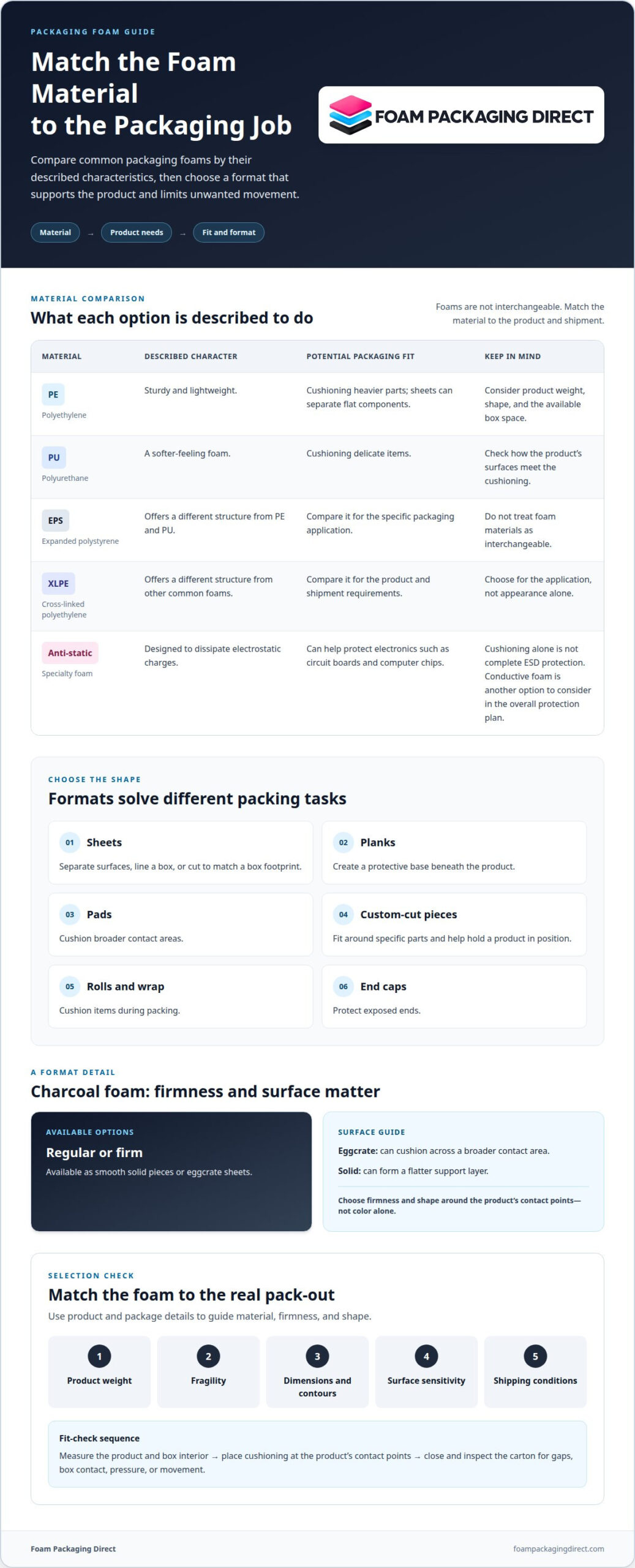
Choose foam by matching its response to the product and shipment. Polyethylene (PE) Foam is a sturdy, lightweight option for cushioning heavier parts. Polyurethane (PU) Foam offers a softer feel for cushioning delicate items. Expanded Polystyrene (EPS) Foam and Cross-linked Polyethylene (XLPE) Foam offer other structures for packaging, so compare them for the application rather than treating them as interchangeable.
Shipping conditions and product geometry help determine the material and format. A PE sheet can separate flat components, while a shaped insert can hold a mechanical part in place. Foam rolls and wrap cushion items during packing, and end caps protect exposed ends. Choose based on product weight, fragility, dimensions, surface sensitivity, and available box space. For help comparing roll width, thickness, and cushioning needs, see this guide to foam rolls for packaging.
Charcoal foam is available in regular and firm options, as smooth solid pieces or eggcrate sheets. Eggcrate surfaces can provide cushioning across a broader contact area, while solid pieces can form a flatter support layer. Custom cutting can adapt either format to a particular package layout. Select firmness and shape around the item’s contact points, not color alone.
For electronics, Anti-Static Foam is designed to dissipate electrostatic charges. It can help protect items such as circuit boards and computer chips, but anti-static cushioning alone does not make a complete package compliant with an ESD standard. Conductive Foam is another packaging option; consider its role as part of the device’s overall protection plan.
Before choosing a material, identify what the foam must do: support weight, limit movement, cushion impact, separate components, or address static concerns. Then compare PE, PU, XLPE, EPS, and specialty options against those needs. This step-by-step match is more useful than selecting a foam by appearance or a single property.
For a shipment that needs both cushioning and an outer container, explore foam and box packaging options.
Protecting fragile items during transit
Plan cushioning around the product’s contact points, position in the carton, and expected handling. A fitted layout should support the item, limit shifting, and avoid placing excessive pressure on delicate surfaces.
Shipping and Storage Protection
During transit, an item can move if the surrounding space is poorly supported. Map the product’s corners, edges, and broad surfaces, then position cushioning to help prevent them from striking the carton. For storage, use a consistent layout that separates components and makes their positions clear during packing and unpacking.
Check the foam and box packaging kit as a complete pack-out, not just the foam piece. Place the product in the carton, close it, and look for gaps, contact with the box, or pressure from the lid. If several parts share a package, arrange them so they cannot press against one another. Adjust the layout if the trial fit reveals movement or unsupported areas.
Foam for Electronics, Furniture, and Fragile Items
Which foam sheets are best for protecting electronics, furniture, and fragile items? Choose based on the item’s shape, weight, finish, and support needs. For a monitor, consider its corners and screen-facing surfaces; for a furniture component, focus on exposed edges and finished faces. The right layout depends on how each item meets its cushioning.
For electronics, separate physical cushioning from any static-control requirement. Keep components in defined positions so connectors, boards, or accessories do not press against one another. A furniture part may need broad, even support, while a small, delicate instrument may need a close-fitting cavity. Avoid a snug fit if it puts pressure on a sensitive feature.
Before shipping or storing the packed item, inspect the closed carton, then reopen it to confirm the product remains seated. Note any movement or contact marks, and revise the placement or cushioning shape for the next pack-out.
Packing foam density and firmness
Density describes how much material occupies a given volume; firmness describes how strongly foam resists compression. They measure different properties. Dense foam is not automatically firm, and firm foam is not automatically the best cushion for every product. Match both characteristics to the item’s weight, contact area, fragility, and shipping conditions.
Start with the load. A heavy metal component places more force on its support than a lightweight plastic housing. If cushioning compresses too much, the product may shift or touch the box. If it resists compression too strongly, it may not cushion delicate surfaces as intended. Shape matters too: a narrow edge concentrates pressure more than a broad, flat base.
Use a practical fit check when comparing foam samples. Place the product or a representative part on the foam, then assess how it compresses under load and whether it remains supported. Check the package layout too: a base pad, side supports, and top layer may each experience different pressure. The carton and the item’s position affect how those forces reach the foam.
Consider density and firmness alongside material type. Polyethylene and polyurethane foams can respond differently, so comparing firmness alone across materials can be misleading. For electronics, Anti-Static Foam may address static concerns, while the foam’s compression response addresses physical support. These are separate requirements, not substitutes for one another.
For a useful specification, record the product’s weight and dimensions, fragile areas, existing box size, and shipping conditions. Then identify where foam should compress and where it should hold its shape. These details help narrow down the material and firmness for the application, instead of relying on touch alone.
Request a quote for custom foam packaging with your product dimensions, weight, quantity, shipping ZIP code, and available drawings or photos.
Foam Packaging Direct: Custom Foam Inserts
Foam Packaging Direct helps businesses turn packaging requirements into protective layouts. Custom Foam Inserts hold products in place and organize components, while Foam End Caps protect exposed ends. Foam Sheets & Pads add separation or cushioning, and Foam Rolls and Foam Wrap help protect surfaces during packing.
Consider a custom insert when a product shifts in its box, has delicate contact points, or needs repeatable placement. For simpler layouts, sheets and pads can separate items or support a broad surface. Product dimensions, weight, quantity, shipping ZIP code, and available drawings or photos help shape a useful quote. Include existing box dimensions and any special protection requirements, too.
Request a quote from Foam Packaging Direct with these details to start planning your packaging solution.
Put Your Foam Specifications to Work
Use your packaging requirements to define a repeatable packing process. Record how the product should sit in the box, which surfaces need support, and what packers need to identify each component. A clear specification helps align the protective layout with day-to-day shipping needs.
Foam Packaging Direct offers Custom Foam Inserts, Foam End Caps, and Foam Sheets & Pads for different product and package layouts. To request a quote, provide your product dimensions, weight, quantity, shipping ZIP code, and any available drawings or photos. Include your existing box dimensions and special protection requirements if applicable.
Contact Foam Packaging Direct to request a quote and take the next step toward a packaging layout that fits your operation.
Frequently Asked Questions
What kind of foam is used for packaging?
Commercial packaging uses Polyethylene (PE) Foam, Cross-linked Polyethylene (XLPE) Foam, Polyurethane (PU) Foam, Expanded Polystyrene (EPS) Foam, and Expanded Polypropylene (EPP) Foam. Anti-Static Foam and Conductive Foam are also used for electronics applications. To narrow the options, document the product’s material, finish, shape, and packaging environment, then compare those needs with the foam’s intended role.
What types of foam sheets are used for packaging?
Packaging formats include flat sheets, thicker planks, cushioning pads, and specialty sheets such as Anti-Static Foam. Foam sheets, planks, and pads can be supplied with adhesive backing and a peel-away liner. This can help attach cushioning to a box or another surface. Choose a format based on whether you need a liner, separator, protective layer, or shaped component.
What are common foam sheet thicknesses and sizes for packaging?
Foam sheet dimensions and thicknesses vary by application rather than following one universal packaging size. Start by recording the box’s inside dimensions and the product’s footprint, then identify how much space the layout allows for cushioning. Custom-cut sheets can match those measurements, while planks suit layouts that need a thicker block.
What is the difference between polyethylene, polyurethane, and polystyrene foam sheets?
Polyethylene, polyurethane, and polystyrene are different foam materials, each with its own structure and packaging uses. Compare how each option fits the product’s shape and packing process. Check that the material can be cut to the required layout and that the finished package closes without the foam getting in the way.
How do I choose the right foam sheet density and thickness for packaging?
Use a sample pack-out to guide the choice. Place the product in the proposed foam layout and carton, close the package, then inspect for gaps, pressure points, or interference with closure. Record the material, sheet dimensions, and carton configuration that suit the application. This gives purchasing and packing teams a clear specification for consistent use.
Are foam packaging sheets recyclable or environmentally friendly?
Recycling options depend on the foam material and the collection programs available where the packaging is handled. Identify the foam type and keep different materials separate before checking local acceptance guidance. Reuse may also be an option when packaging returns to the shipper in usable condition. Consider disposal and reuse alongside protection needs when selecting a packaging format.