
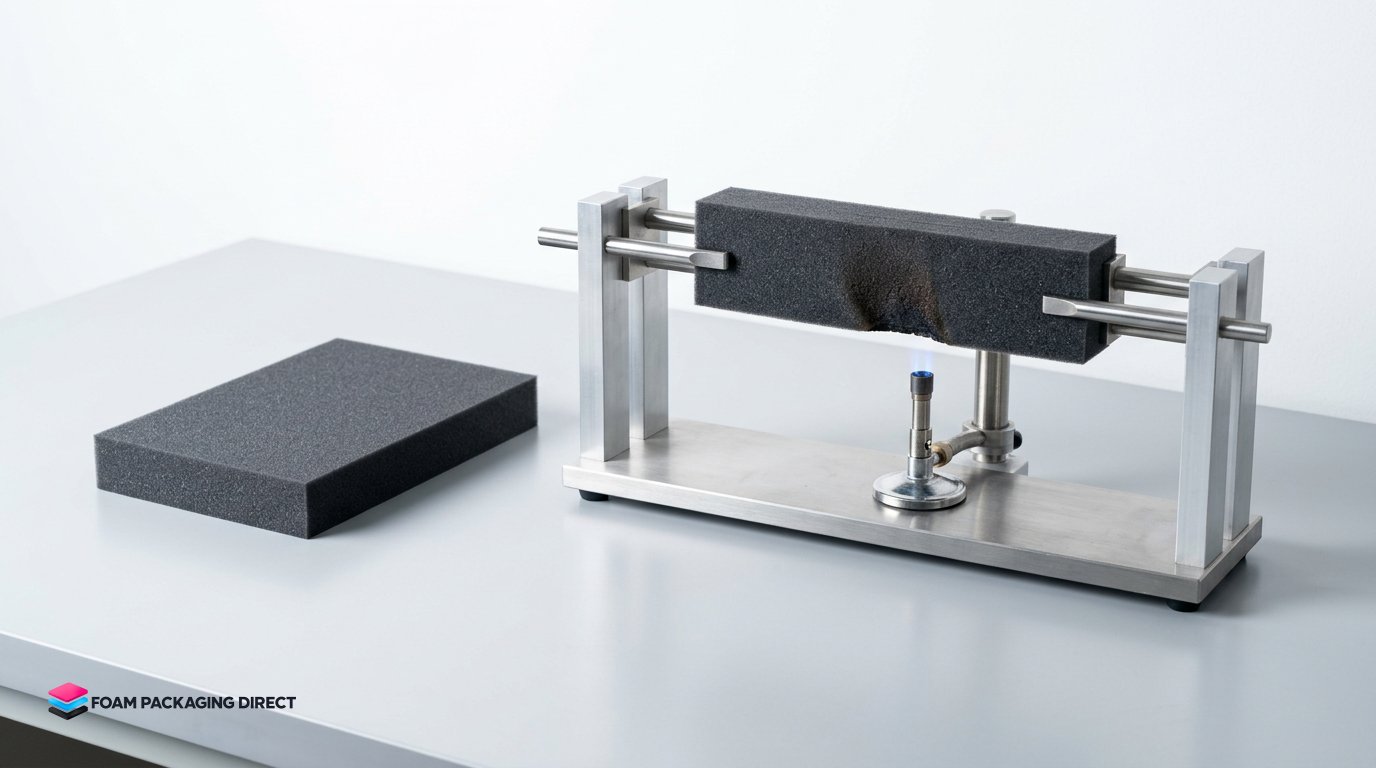
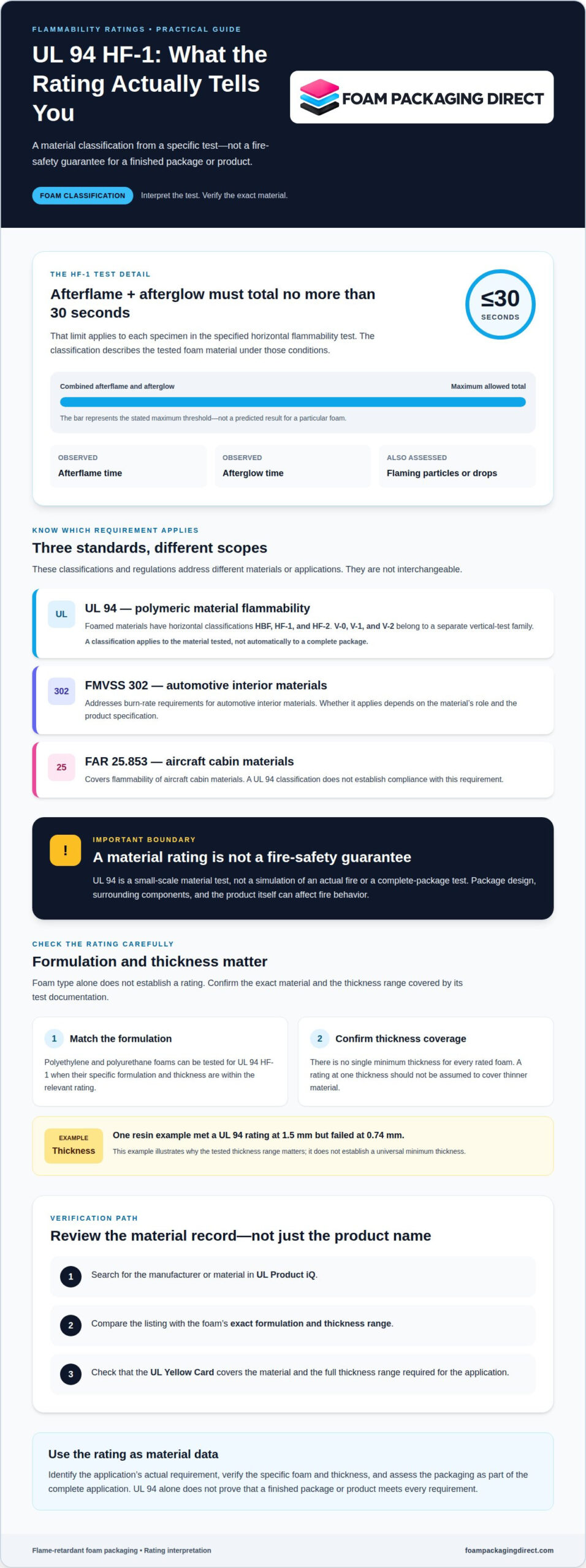
A flame-retardant rating is not a fire-safety guarantee. UL 94 HF-1 is a horizontal flammability classification for foam: each specimen’s afterflame and afterglow time must total no more than 30 seconds. Understanding how flame retardant foam packaging and UL 94 HF-1 standards relate helps you judge what the rating says, and what it doesn’t.
It’s reasonable to want packaging that protects a product and meets its application requirements. But a foam rating describes how a material performs in a specific test, not how a complete package or finished product will behave in an actual fire.
This guide explains what fire-retardant foam does, how HF-1 fits within UL 94, and why the foam’s formulation and thickness matter. It also explores flame-retardant polyethylene foam as one material option, so you can connect the test classification to practical packaging decisions.
Key Takeaways
- Understand how UL 94 classifications differ for foamed materials and why a rating describes a material test, not a complete package’s fire performance.
- Learn why a material’s formulation and tested thickness matter when reviewing a flammability rating.
- See what the HF-1 test evaluates, including afterflame, afterglow, and flaming particles or drops.
- Compare foam options for packaging needs by considering product weight, fragility, dimensions, surface sensitivity, shipping conditions, and order quantity.
Why Use Fire-Retardant Foam for Volatile Industries?
Fire-retardant foam can help address material flammability requirements in applications involving heat or ignition risks. UL 94 classifications describe results from specific tests; they don’t establish that a complete package is fire-safe.
UL 94 Flammability Classifications
UL 94 classifies how polymeric materials respond to specified small-scale flame tests, with separate ratings for foams. The rating matters because it helps buyers compare tested material performance against an application’s requirements. For foamed materials, the horizontal classifications include HBF, HF-1, and HF-2, while V-0, V-1, and V-2 belong to a separate vertical-test family.
Polyethylene and polyurethane foams can be tested for UL 94 HF-1 when their formulation and thickness are within the relevant rating. The foam type alone doesn’t establish a rating; the specific material must be tested.
Industry Flammability Standards
Industry flammability standards define test requirements for particular applications, rather than assigning one rating to every foam use. This distinction matters when packaging is intended for automotive or aircraft-related equipment. FMVSS 302 addresses burn-rate requirements for automotive interior materials, while FAR 25.853 covers flammability of aircraft cabin materials.
These standards aren’t interchangeable with UL 94. A packaging material’s UL 94 classification doesn’t establish compliance with FMVSS 302 or FAR 25.853. The applicable requirement depends on the material’s role and the product specification.
Testing and Rating Verification
UL 94 testing exposes material specimens to controlled flame conditions and assigns classifications from observed burning behavior. The result applies to the tested material, not automatically to different formulations or thicknesses. To verify a supplier’s HF-1 rating in UL Product iQ, search for the manufacturer or material, then compare the listing with the foam’s exact formulation and thickness range.
A UL Yellow Card should cover the material’s full formulation and required thickness range. This helps prevent a rating for one version of a material from being applied to another.
Regulations Beyond UL 94
There isn’t one additional U.S. flammability rule that applies to every foam package. FMVSS 302 concerns automotive interior materials, and FAR 25.853 concerns aircraft cabin materials. Their relevance depends on the product’s application and specification.
UL 94 is a material classification, not proof that a finished package or product meets every requirement. Match the requested standard to the material’s actual use, then assess the packaging as part of the complete application. UL 94 testing also isn’t intended to represent hazards under actual fire conditions.
What are flame retardant foams (FR)?
Flame-retardant foam is formulated to resist ignition, slow burning, or self-extinguish under specified test conditions. It is not fireproof. For packaging components, the practical question is whether the exact foam formulation and thickness meet the application’s required rating.
There is no single minimum thickness that applies to every rated foam. A UL Yellow Card should cover the material’s full formulation and required thickness range. Thickness matters: one resin example met a UL 94 rating at 1.5 mm but failed at 0.74 mm. A rating at one thickness shouldn’t be assumed to apply to thinner material.
Color does not establish flammability performance. RFR filter foam is available in black or natural, but color alone does not show whether a formulation meets a particular rating. With Alveobloc foam, as with any material, assess the specific formulation and the thickness covered by its rating rather than relying on the product name.
Polyether and polyester are distinct foam chemistries, and RFR filter foam is made from either. A product’s intended contact or operating conditions can guide material selection; for example, polyether UL 94 HF-1 foam is recommended for filters contacting liquid-based solutions. That example doesn’t make polyether and polyester interchangeable across packaging applications.
Choose material and thickness based on the product’s weight, fragility, dimensions, surface sensitivity, and shipping conditions. Thicker foam can affect fit and package dimensions, while insufficient thickness may leave components poorly supported. Cost depends on formulation, thickness, order quantity, and package design. Performance depends on the tested material and its suitability for the application. Recyclability depends on the foam’s composition and available recycling routes, not its flame-retardant label alone.
Flame-retardant compounds and testing
Flame-retardant additives can change how a plastic material responds to ignition and burning. Testing helps distinguish a rated foam material from assumptions based only on its chemistry.
UL 94 Testing Limitations
UL 94 is a small-scale flammability test, not a simulation of a real fire or a complete package test. Its result matters because it classifies a tested material under defined conditions, rather than predicting every fire-safety outcome.
For electronics packaging, a foam rating alone doesn’t establish how the packed equipment will perform. Package design, surrounding components, and the product itself can affect fire behavior. UL 94 classifications also distinguish test methods: vertical V ratings and horizontal foam ratings assess different responses. Treat a rating as material data, not proof that an end product meets every requirement.
Additional Fire Testing Methods
Additional fire tests assess different materials or conditions, helping determine whether UL 94 alone addresses an application’s needs. Glow-wire testing exposes a material or component to a heated wire, while end-product testing evaluates the assembled product rather than foam alone.
NFPA 701 addresses flame propagation in textiles and films, including some foam wraps or coverings. The UL 94 5VA and 5VB classifications use a 125 mm vertical burn test, with flame applications lasting five seconds and five seconds between applications. Burning must stop within 60 seconds under the described test; 5VA doesn’t permit burn-through, while 5VB does. These methods are not interchangeable, so use the test named in the application’s specification.
Specifying and Sourcing HF-1 Foam
Specify the exact foam formulation, thickness, requested HF-1 classification, and packaging application. These details help match the material to its intended use and keep testing tied to the specification.
To source suitable foam and request testing, give the supplier your requirements and ask for documentation covering the full formulation and thickness range. For packaging that protects electronics, also describe the product, package configuration, and any end-product testing requirements. Compare the documentation with the material that will be used, not just a similar foam or generic description.
Flame-retardant polyethylene foam products
Polyethylene foam is available in flame-retardant formulations, including material options tested to UL 94 HF-1. Cross-linked polyethylene, or XLPE, is a distinct polyethylene foam type, with UL 94 V-0 available as a separate rating option. These classifications describe different test outcomes, so HF-1 and V-0 shouldn’t be treated as interchangeable. For flame-retardant foam packaging, UL 94 HF-1 standards can help define the material rating required for an application.
A flame-retardant formulation is designed to resist ignition, slow flame spread, or self-extinguish under specified test conditions. It isn’t fireproof, and a foam rating alone doesn’t establish fire safety for a finished package or device. For automotive-related applications, distinguish a foam’s UL 94 classification from any separate material requirement in the product specification. The foam’s purpose and location matter.
Thickness is a key part of the rating. A material that passes a test at one thickness may not carry that rating at a thinner gauge; one resin example passed at 1.5 mm but failed at 0.74 mm. Check that the material documentation covers the formulation and thickness intended for the packaging design. This matters when fitted supports need thinner sections around components.
When selecting foam, compare the required rating with the product’s weight, fragility, dimensions, surface sensitivity, and shipping conditions. XLPE and other polyethylene foam options are not automatically suited to every cushioning task. For sensitive electronics, anti-static cushioning addresses static buildup, while conductive foam serves a different ESD function. Neither property replaces a flammability rating, so list each requirement separately in the material specification.
Document the required UL 94 rating, foam formulation, and intended thickness together. To request a quote, provide product dimensions and weight, quantity, shipping ZIP code, and available drawings or photos. Include existing box dimensions and special protection requirements so the packaging design can be matched to the application.
Foam Packaging Direct: Custom Foam Inserts
Foam Packaging Direct helps businesses protect and organize products with custom foam inserts, foam end caps, sheets and pads, and foam rolls and wrap. These formats suit different packaging needs, from cushioning a fragile product to separating components inside a box.
For a project with a specified flammability requirement, include the required rating, material documentation, and intended foam thickness in your packaging details. This helps align the design with the material requirements without treating the rating as proof of complete-package compliance.
Request a quote with your product dimensions, weight, order quantity, and shipping ZIP code. Include drawings or photos, existing box dimensions, and any special protection requirements. Contact Foam Packaging Direct to discuss your packaging needs.
Turn the Rating Into a Packaging Specification
A practical specification for flame-retardant foam packaging under UL 94 HF-1 standards should connect the material requirement to the way your product is packed. Decide how the foam must support, separate, or protect the item, then share the required rating and any material documentation with your packaging team. This keeps the fire-related requirement visible alongside everyday needs such as fit and product protection.
The package format can guide your next decision. Custom foam inserts can hold items in place, foam end caps can protect product edges, and foam sheets and pads can add separation or cushioning. The right configuration depends on your product and packing setup.
For a quote, provide product dimensions, weight, order quantity, shipping ZIP code, and available drawings or photos. Include your existing box dimensions and special protection requirements, too. Contact Foam Packaging Direct to discuss a packaging approach that fits your requirements and move the project forward with clear specifications.
Frequently Asked Questions
What Is UL 94?
UL 94 is a flammability classification system for plastic materials, including foams, based on controlled flame tests. Its ratings help distinguish how samples behave under specific test conditions. For example, UL 94 includes horizontal foam classifications and separate vertical ratings. A purchasing specification should name the classification it requires, rather than simply asking for “fire-retardant foam,” which doesn’t identify a test result.
What does UL 94 HF-1 mean for foam materials?
HF-1 is a horizontal-burn classification for foamed materials. In the test criteria, at least four of five specimens must have afterflame times of no more than 2 seconds; the remaining specimen may reach 10 seconds. Afterglow is limited to 30 seconds, flaming particles must not ignite cotton, and damaged length must be less than 60 mm. The designation applies to the tested material and thickness.
How does UL 94 HF-1 differ from HF-2, HBF, and V-0 ratings?
HF-1, HF-2, and HBF belong to UL 94’s horizontal foamed-material classifications; V-0 is a vertical-burning rating. V-0 is the highest classification among V-0, V-1, and V-2, but that doesn’t make it directly comparable to HF-1. These ratings use different test families and criteria, so match the classification named in the product or packaging specification instead of treating ratings as interchangeable.
What are the UL 94 HF-1 test methods, specimen dimensions, and pass criteria?
The horizontal foamed-material test applies a 38 mm flame for 60 seconds. HF-1 pass criteria include afterflame limits of 2 seconds for at least four of five specimens and 10 seconds for the remaining specimen, plus afterglow no longer than 30 seconds. Flaming particles cannot ignite cotton, and damage must be under 60 mm. Specimen dimensions depend on the classification being tested, so check the applicable requirements for HF-1.
Does UL 94 HF-1 certification apply to finished foam packaging or only to the tested material?
UL 94 HF-1 applies to the tested foam material under the conditions represented by its classification, not automatically to a finished package. For example, cutting a rated sheet into a package insert doesn’t establish that the complete package has been tested as an assembly. Keep the material’s formulation and rated thickness tied to the specification, and assess any separate finished-product requirements independently.
What are the fire-safety risks and limitations of relying on UL 94 HF-1 for packaging?
Relying on HF-1 alone can leave important fire-safety questions unanswered. UL 94 is a small-scale material test and isn’t intended to represent hazards under actual fire conditions. A package’s construction, contents, and use environment also matter. For instance, electronics packaging may have product-level requirements beyond the foam’s classification, so use HF-1 as one material criterion, not as proof of complete-package fire safety.