
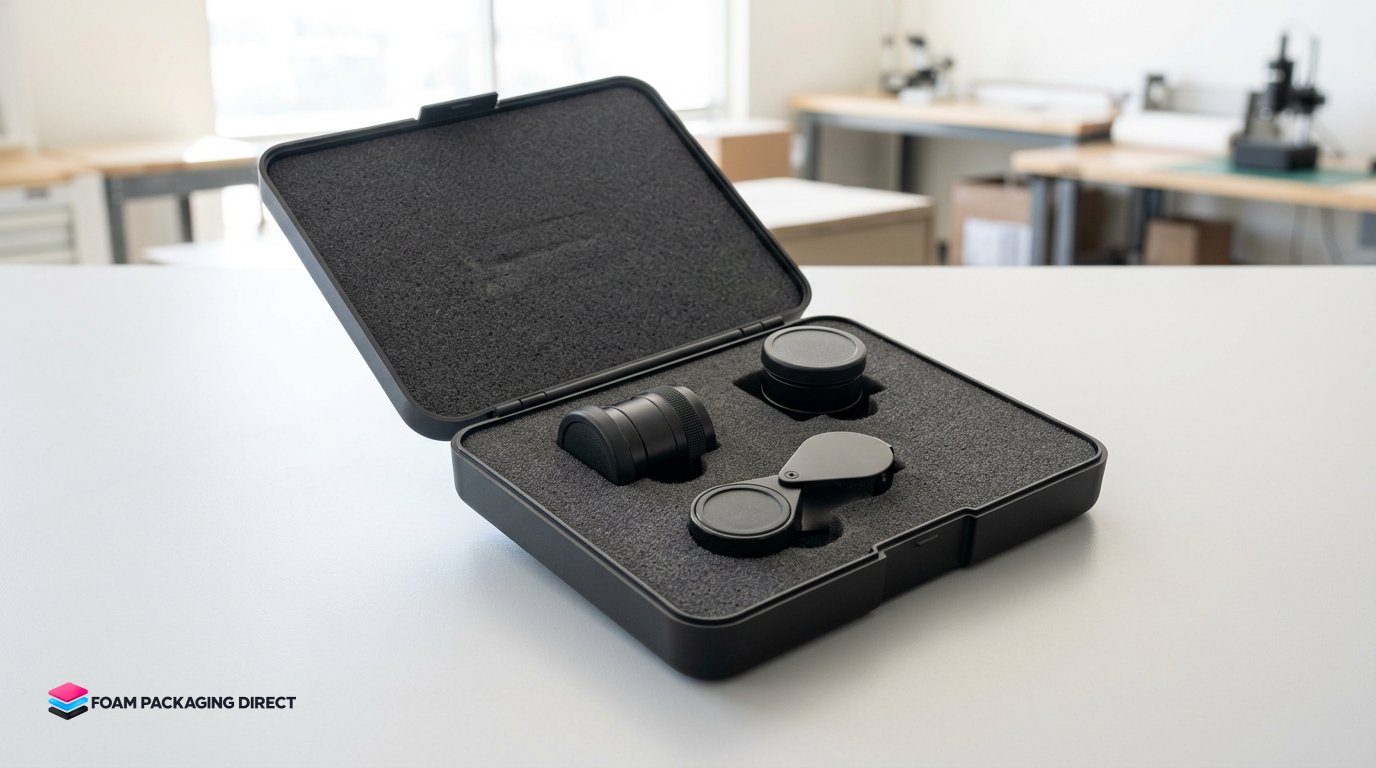
A presentation insert has to look orderly and keep the product settled in place. Charcoal polyurethane foam for presentation packaging is available in regular and firm options, with 1/2-inch sheets among the listed choices. The right fit depends on the product’s shape, how much cushioning it needs, and whether the package is for display, protection, storage, or a mix of uses.
Appearance and fit both matter when choosing foam, especially when products need to stay organized and remain easy to remove. This guide explains how regular and firm foam differ, what to consider when selecting thickness, and how charcoal foam can support presentation, protection, and storage. Product dimensions, weight, surface sensitivity, shipping conditions, and order quantity all help shape the packaging design.
Key Takeaways
- Compare regular and firm charcoal foam by the support your product needs, then match thickness to its shape and presentation requirements.
- Plan inserts around product dimensions and how items will be presented, protected in transit, or organized in storage.
- Choose between polyurethane, polyethylene, and EVA by weighing cushioning needs, product weight, fragility, and surface sensitivity.
- For electronics, distinguish anti-static cushioning from broader ESD protection; foam alone doesn’t make a complete package compliant with an industry standard.
Regular and firm charcoal foam options
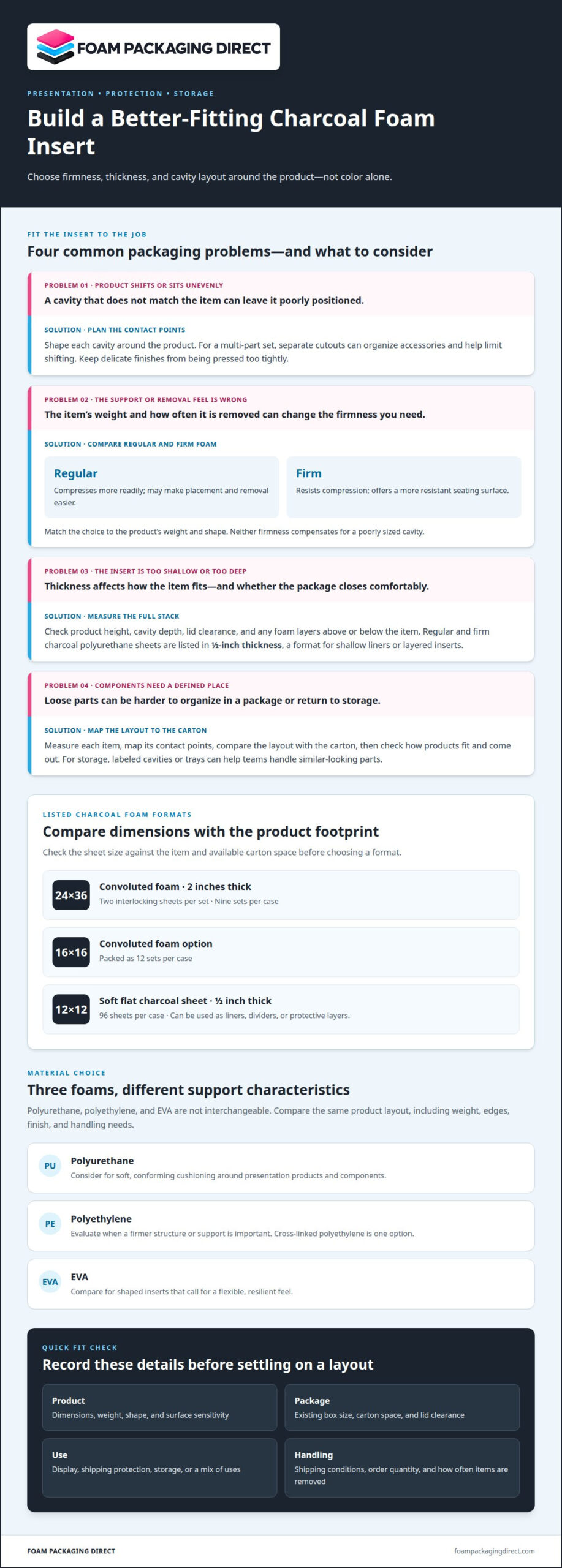
Regular and firm charcoal polyurethane foam provide different levels of support for presentation packaging. Regular foam compresses more readily; firm foam resists compression. This affects how an item sits in its cavity and how easily it can be lifted out. An insert for several lightweight components may need a different feel from one supporting a heavier display piece. Match firmness to the product’s weight and shape, and consider how often it will be removed.
Thickness shapes the fit as much as firmness. Regular and firm charcoal foam sheets are available in 1/2-inch thickness, a useful format for shallow liners or layered inserts. A thin layer may suit a flat product, while a deeper cavity may need more foam depth to surround its edges. Consider the full stack: product height, cavity depth, lid clearance, and any layers above or below the item. Measure the product and existing box before settling on a layout.
For a polished presentation, plan each cavity around the product’s contact points. A multi-part set, for example, can have separate cutouts to organize accessories and limit shifting. Firm foam offers a more resistant seating surface, while regular foam may make placement and removal easier. Neither option makes up for a poorly sized cavity. For delicate finishes, account for surface sensitivity and avoid pressing exposed surfaces too tightly.
Does charcoal polyurethane foam meet any fire-retardancy or safety standards? Charcoal color and regular or firm designation don’t establish fire-retardancy compliance. Match product-specific documentation to the standard required for the application. For chemical safety, review the foam’s safety data sheet for handling guidance. Exposure to isocyanates can cause asthma at 0.02 ppm, according to the U.S. National Library of Medicine. Chemical exposure concerns depend on the material and process; a finished foam insert and foam manufacturing are not the same exposure situation. Don’t infer safety from color or firmness alone.
Charcoal foam for protective packaging and storage
Charcoal foam can position products inside a package and keep related components organized. A fitted cavity gives each item a defined place, such as a device in one recess and accessories in separate cutouts. For shipping, match the insert to the product and box to limit movement. For storage, consistent cavities make it easier to return products and parts to their assigned positions.
Convoluted foam offers a shaped surface for cushioning items placed between foam layers. A listed charcoal option measures 24 by 36 inches and 2 inches thick, with two interlocking sheets per set and nine sets per case. A 16-by-16-inch option is packed as 12 sets per case. These formats suit different packing layouts, so compare the sheet dimensions with the product footprint and available carton space before choosing.
Flat sheets can serve as liners, dividers, or protective layers between packed items. One listed soft charcoal sheet measures 12 by 12 inches and 1/2 inch thick, with 96 sheets per case. That format may suit smaller components or repeatable layer placement. Before packing, check whether the sheet covers the contact area, stays in position, and allows the package to close without pressing against the product.
For storage, label cavities or trays when teams handle similar-looking parts. Keep delicate finishes from rubbing against loose accessories, and place heavier items where the package can support them. A practical selection sequence is simple: measure each item, map its contact points, compare the layout with the carton, then test how products fit and come out. For a coordinated protective layout, explore foam-lined packaging options and share the product dimensions, weight, quantity, and existing box size when requesting a quote.
How do charcoal polyurethane foam inserts compare with polyethylene and EVA foam?
Polyurethane, polyethylene, and EVA serve different insert needs and are not interchangeable. Charcoal describes the color, not the cushioning behavior. Polyurethane foam is often selected for soft, conforming support around presentation items. Polyethylene foam generally feels firmer and provides a more structured seat. EVA combines flexibility with a resilient feel, making it another option for shaped inserts. Formulation and density affect how each material responds under load.
Consider a presentation case for a lightweight instrument and its accessories. Polyurethane can cushion delicate surfaces, while well-sized cavities keep the parts organized. A heavier component may need firmer material that resists compression and holds its shape. Polyethylene, including cross-linked polyethylene, is often considered for this more supportive role. EVA may suit applications that call for a smooth, resilient insert. Compare weight, edges, finish, and handling needs rather than choosing by color alone.
- Polyurethane: consider it for conforming cushioning around presentation products and components.
- Polyethylene: evaluate it when a firmer structure or support is important.
- EVA: compare it for shaped inserts requiring a flexible, resilient feel.
Assess material options using the same product and package layout. Measure the item and mark its contact points, then identify where the insert must support weight and where it should cushion edges. Compare cavity fit, removal effort, and how the material contacts the product’s finish. A snug cavity can limit movement, but too much pressure can make removal awkward or affect a sensitive surface.
For a repeatable selection, record product dimensions, weight, box size, and shipping conditions. Include a drawing or photograph if the product has unusual contours. Material, thickness, and cavity geometry work together, so changing one can affect fit and support. For electronics, assess static-control needs separately: ordinary cushioning material does not automatically provide ESD protection.
Is charcoal polyurethane foam anti-static or suitable for protecting electronics?
Charcoal color alone does not indicate a foam’s electrical properties. Do not assume a charcoal polyurethane insert is anti-static because of its appearance or material name. For an electronic device, identify whether the requirement is physical cushioning, static control, or both. A handheld meter, circuit board, and cable assembly may each need different cavity support and packaging controls.
Anti-static cushioning is designed to reduce static charge buildup on the material. Conductive foam is a separate option that conducts electrical charge. Neither description means the foam alone makes a complete package compliant with an industry standard. Static-sensitive electronics may need a coordinated packaging approach based on the device, handling process, and shipping conditions. Consider cushioning, enclosure, and handling controls together.
- For physical cushioning: size cavities to support the device without pressing buttons, connectors, or exposed components.
- For static concerns: select material by its stated electrical function, not its charcoal color.
- For package design: assess the insert alongside other packaging and handling controls.
For example, a circuit board in a fitted insert needs a stable position and protection from loose accessories. Measure the board and note exposed components before planning its cavity. A handheld instrument may need cushioning around its housing, with separate spaces for its cable and removable probes. These details help distinguish cushioning needs from static-control requirements.
Document the product dimensions, weight, sensitive surfaces, and shipping conditions. Then specify whether the priority is cushioning, static control, or both. That information helps guide material selection and insert geometry. A polyurethane foam insert can address physical fit, while anti-static foam is an option when static control matters. Request a quote for electronics foam packaging with product details, box dimensions, quantity, and drawings or photos.
Foam Packaging Direct: Custom Foam Inserts
Foam Packaging Direct turns product measurements into custom foam inserts for presentation, protection, and organized storage. Choose a fitted insert when products or components need defined positions inside a package. Foam end caps, sheets and pads, rolls, and wrap can address other protective packaging needs.
For a quote, share the product dimensions, weight, order quantity, shipping ZIP code, and existing box dimensions. Drawings or photos can clarify unusual shapes, contact points, or surface protection requirements. These details help match the foam layout to the product and package. Request a quote from Foam Packaging Direct to discuss your charcoal foam packaging requirements.
Move from material choice to a workable package
The next step is to plan a layout that fits the product and its packaging. For charcoal polyurethane foam for presentation packaging, note where the product needs support, which surfaces require careful contact, and how the insert will be used during packing and storage.
Foam Packaging Direct offers custom foam inserts, foam end caps, and foam sheets and pads to address different protective packaging needs. Share your product dimensions, weight, quantity, shipping ZIP code, and existing box dimensions. Drawings or photos can help show contours and areas requiring added protection. These details make it easier to discuss a practical design for your application.
Contact Foam Packaging Direct to discuss your needs and request a quote. A clear set of requirements is a useful starting point for packaging that fits the product and your workflow.
Frequently Asked Questions
What is charcoal polyurethane foam used for in presentation packaging?
A presentation insert holds products and related components in an intentional arrangement for display, handoff, or storage. For example, a case for a handheld instrument can position the instrument, cable, and accessories separately, helping recipients see what is included. Charcoal polyurethane foam for presentation packaging also creates a consistent interior appearance. Design cavities around the actual contents so every piece has a defined place.
What types and densities of charcoal polyurethane foam are available for packaging inserts?
Regular and firm polyurethane foam are two insert design options. Firmness helps determine how a product sits and is handled; density is a separate material specification, not another word for firmness. Choose foam according to the item’s weight, fragility, dimensions, and handling needs. For a mixed kit, consider whether heavier components need more support than lightweight accessories before choosing an insert material.
How is charcoal polyurethane foam cut and customized for presentation packaging?
Custom foam is cut to the product’s exact dimensions, pocket shapes, and required depths. Precision cutting, routing, die-cutting, laminating, and bonding are used to form inserts and components. A drawing can show the product outline and cavity layout, while a physical sample confirms fit for approval before production. For a multi-piece kit, map each item’s position and orientation so contents can be packed consistently.
Where can businesses buy custom charcoal polyurethane foam inserts in the United States?
Foam Packaging Direct supplies custom inserts to businesses nationwide. For a quote, provide product dimensions, weight, box or container size, quantity, and any drawings or photos. A prototype or sample is prepared for approval before production, and designs are kept on file for consistent reorders. This approach can help businesses standardize presentation packs across repeat orders or product batches. Exact pricing is provided only after a quote is issued.