
Find straight answers to the questions buyers ask us most about Foam Packaging Direct, ordering and quotes, custom foam packaging products, foam materials, fabrication, kitting, and sustainability. If you do not see your question here, send it to our team and we will answer it directly.
Experience behind every answer
Foam, fabrication, boxes, and kitting
PE, XLPE, PU, EPS, EPP, and ESD
You approve the fit before production
Ready to pack at your door
These answers explain who we are, what we offer, and where we ship.
Foam Packaging Direct supplies foam packaging materials and custom foam packaging that protect products in storage, transit, and presentation. We offer custom foam inserts, end caps, sheets, rolls, tote dunnage, and complete foam and box packaging, and our team brings more than 20 years of packaging and foam packaging experience to designing, cutting, and shipping each order direct to you.
It means you get foam materials, fabrication, boxes, and kitting from one supplier instead of coordinating several vendors. We handle the foam selection, the cutting, the matching box, and the packing program, so you receive one complete, ready to pack solution.
We serve aerospace and defense, medical devices, electronics and optics, industrial and automotive, and retail and presentation. We also build packaging for businesses outside those industries whenever their products need custom foam protection.
We ship foam packaging nationwide across the United States. Our team packs every order to arrive clean and ready to use.
These answers walk you through quotes, files, prototypes, and reorders.
Submit our Request a Quote form or contact our team with details about your product and how it ships. Our packaging specialists review your request, recommend the right foam and design, and send you a written quote for your project.
Send your product dimensions, weight, quantity, and shipping method, plus photos and any packaging requirements your customer sets. Tell us what went wrong with past packaging so we can fix it the first time.
No. Our team works from photos, measurements, sample parts, or a sketch when you do not have a formal drawing. When you do have one, we build directly from it.
We accept PDF, DWG, DXF, STEP, JPG, and PNG files. CAD files such as DXF, DWG, and STEP let us cut precise cavities fastest, while photos and PDFs work well for early planning.
Yes. We prototype new designs so you can test the fit and protection before production, and we quote small and large orders alike. We set order terms with each customer based on the project.
We keep your approved design and material on file, so you can reorder by sending us your part or project reference and quantity. Every reorder matches the original packaging you approved.
These answers help you choose the right foam packaging product for what you ship.
Custom foam inserts hold your product in a cavity cut to its exact shape, preventing the item from shifting, rubbing, or bouncing, which stops shipping damage. Foam sheets and pads give you flat cushioning layers that line boxes, separate stacked items, and fill space. Choose inserts for precise fit and sheets for flexible, general protection.
Use foam end caps when you ship long, heavy, or framed items that take impact at their ends and corners. End caps grip each end of the product, suspend it inside the box, and absorb the shock from drops and bumps.
Foam rolls and wrap protect finished surfaces from scratches, scuffs, and light impact on the packing line. Your team wraps or interleaves products quickly, and you cut only the length each item needs.
Tote dunnage is a foam insert that fits inside a reusable tote, bin, or tray and holds parts in fixed positions. It protects parts as they move between workstations, plants, and suppliers, and it keeps counts visible at a glance.
Yes. Our foam and box packaging pairs custom foam with a corrugated or rigid box sized to it, so you receive one complete package. You avoid fit problems between foam and container.
Choose standard foam products when your items vary in shape or you need general cushioning across many products. Choose custom foam packaging when you ship the same product repeatedly or need a precise fit that prevents movement.
These answers compare the foams we offer so you can match the material to your product.
Packaging companies most often rely on polyethylene (PE), cross linked polyethylene (XLPE), polyurethane (PU), expanded polystyrene (EPS), and expanded polypropylene (EPP) foams. Anti static and conductive versions protect electronics from static.
The best foam depends on your product weight, fragility, surface finish, and how many times the packaging travels. Firm PE suits heavier parts, soft PU cradles delicate items, and XLPE delivers a smooth, clean look. Our Foam Selection Guide compares each option.
PE foam is a firm, closed cell foam that resists moisture and supports heavier items with strong, repeat protection. PU foam is a soft, open cell foam that compresses easily and cushions lightweight, delicate products. Many inserts combine both, using PE for structure and PU for a gentle contact layer.
XLPE is cross linked polyethylene, a closed cell foam with a finer, smoother cell structure than standard PE. It cuts cleanly into crisp cavities and presents a polished surface, which makes it a strong choice for medical kits, instruments, and presentation packaging.
EPS is a rigid, lightweight bead foam that absorbs impact well at a low cost, which suits single use shipping. EPP is a resilient bead foam that recovers its shape after impact and survives repeated use, which suits returnable packaging.
Anti static foam limits the static charge that builds up when foam rubs against a part. Conductive foam carries charge away and shields sensitive components from electrostatic discharge. We match the grade to your components and your ESD requirements.
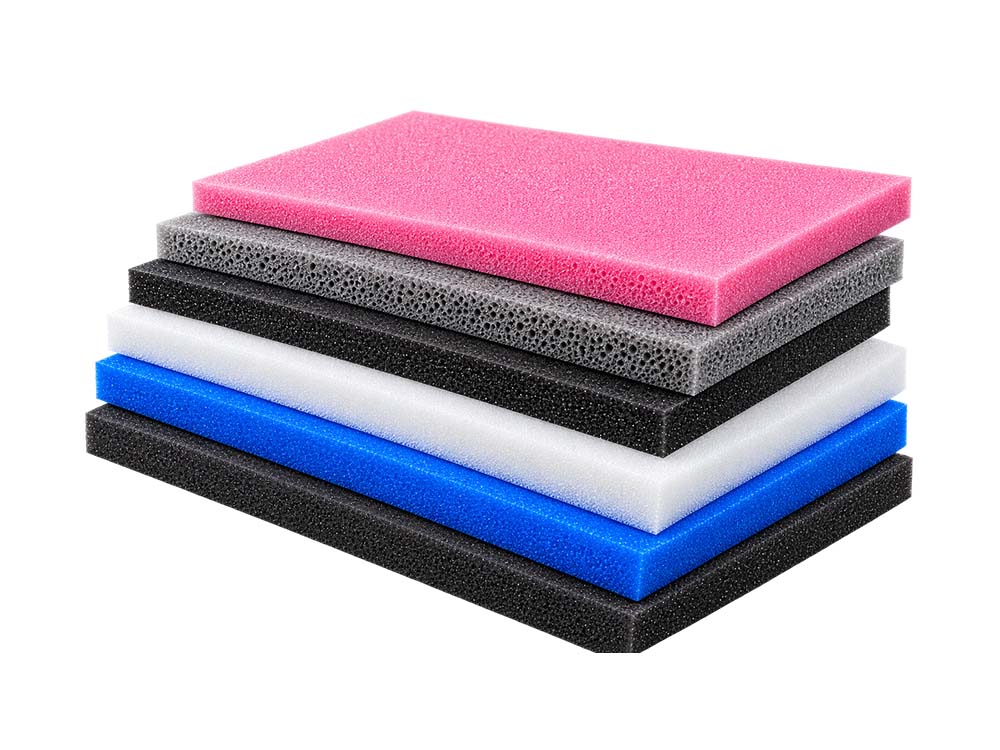
We offer each foam family in a range of densities, from softer grades that cushion fragile items to firmer grades that support heavy parts. Colors vary by material, and we confirm the density and color options for your project when we quote it.
These answers explain how our team designs, cuts, laminates, and builds custom foam.
Our team measures your product, designs a cavity layout, and cuts the foam with die cutting or CNC routing, laminating layers when the insert needs depth. We prototype the insert for your approval, then run production. See finished examples in our Project Gallery.
We cut packaging foam with production equipment that produces clean, repeatable edges, including die cutting presses and CNC routers. For a one time fix at home, a sharp, long blade and a straightedge give the cleanest hand cut, though hand cutting rarely matches machine precision.
Die cutting stamps a shape through foam with a custom steel rule die, which delivers fast, consistent parts for higher volume runs. CNC routing follows a digital file to mill cavities and pockets of varying depth without a die, which suits prototypes, complex shapes, and smaller runs.
Yes. Send us a sample of your current packaging and we will match its shape, foam type, and fit, or improve it where it falls short.
These answers cover programs that simplify recurring packaging orders.
Kitting means we assemble your foam, boxes, and other packaging components into ready to use sets before they ship to you. Your team opens one kit and packs immediately, saving labor and storage space on your floor.
Yes. We set up supply programs that deliver your packaging on a schedule that matches your production, so you avoid running short or overstocking. We set program terms with each customer based on volume and timing.
These answers address recycling, reuse, and how to ship with less material.
Many packaging foams are recyclable, but recycling depends on the foam type and the programs in your area. Specialty drop off sites and recycling programs accept polyethylene and EPS foams in many areas, though most curbside programs do not. Check with your local recycler before you dispose of foam packaging.
Yes, in many cases, though usually not through curbside bins, because most municipal programs do not accept foam. You can often take clean polyethylene and EPS foam to a specialty drop off location or a mail back program.
Reusable foam packaging pays off when products travel on a closed loop between your facility, suppliers, and customers. Durable PE and EPP foam inserts survive trip after trip, lowering your cost per cycle and cutting packaging waste.
Our team designs foam packaging that protects your product with the least material possible, sizing cavities and wall thickness to your item. A right sized design reduces foam volume, shrinks your box, and lowers your shipping weight.
Foam usually protects better for fragile, heavy, or high value items, while bubble wrap works well for lightweight items and general void fill. Custom foam holds a product in a fixed position and keeps cushioning consistent, while bubble wrap can lose air and let items shift. Foam inserts also survive repeated use, which makes them the stronger choice for products you ship often.
Our team answers foam packaging questions every day and will help you choose the right product, foam, and design for what you ship. Send us your details and we will respond with a recommendation and a quote built for your project.