
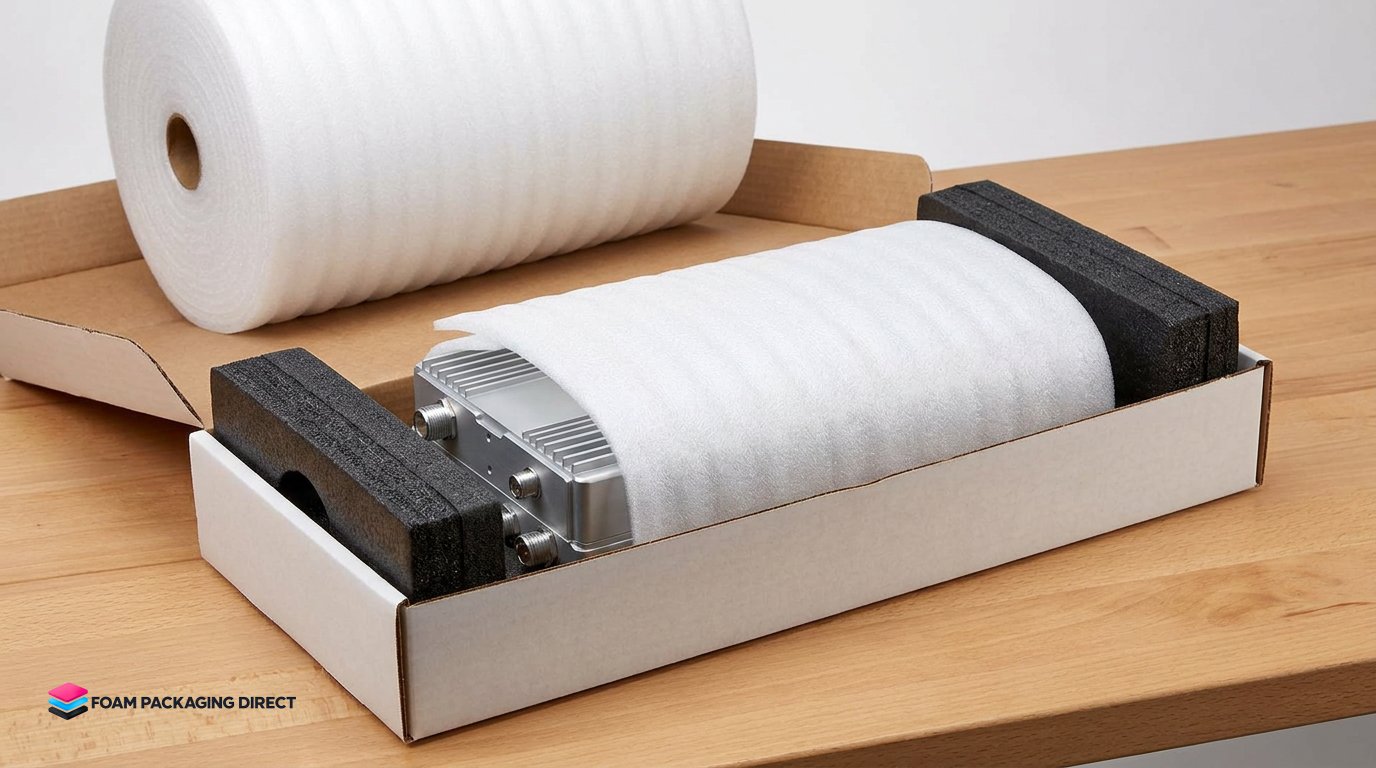
The right foam rolls for packaging depend on the item’s size, fragility, surface sensitivity, and shipping conditions. A useful starting point is to match the roll’s width and thickness to the product and the cushioning it needs. Available roll examples range from 12 to 48 inches wide, with listed thicknesses of 1/16 inch and 1/8 inch.
Choosing foam rolls for packaging can seem like a small decision until products shift, rub, or take up too much room in the box. Foam wrap adds a flexible cushioning and surface-separation layer, but the item still needs to be held securely in its outer packaging. This guide explains how to compare roll dimensions and foam types, and when sheets, pads, or a fitted insert may suit the job better. Use these criteria to narrow the options around your product and packing process.
Key Takeaways
- Match roll width and cushioning thickness to the item’s dimensions, fragility, and surface sensitivity.
- Use foam wrap to cushion and separate products, while ensuring the packed item stays secure inside its box.
- Consider how weight, shipping conditions, and packing needs affect material choice and the amount of protection required.
- For products that need a more controlled fit, compare roll wrap with foam sheets, pads, end caps, or custom inserts.
Foam rolls for packaging
Foam wrap forms a flexible layer around products, helping cushion contact and keep surfaces separated during packing. Choose a roll based on the item’s dimensions, weight, fragility, surface, and shipping conditions. A narrow roll can work for small components; a wider roll can cover larger faces with fewer overlaps. Consider thickness too, since it affects how much space the wrap occupies inside the box.
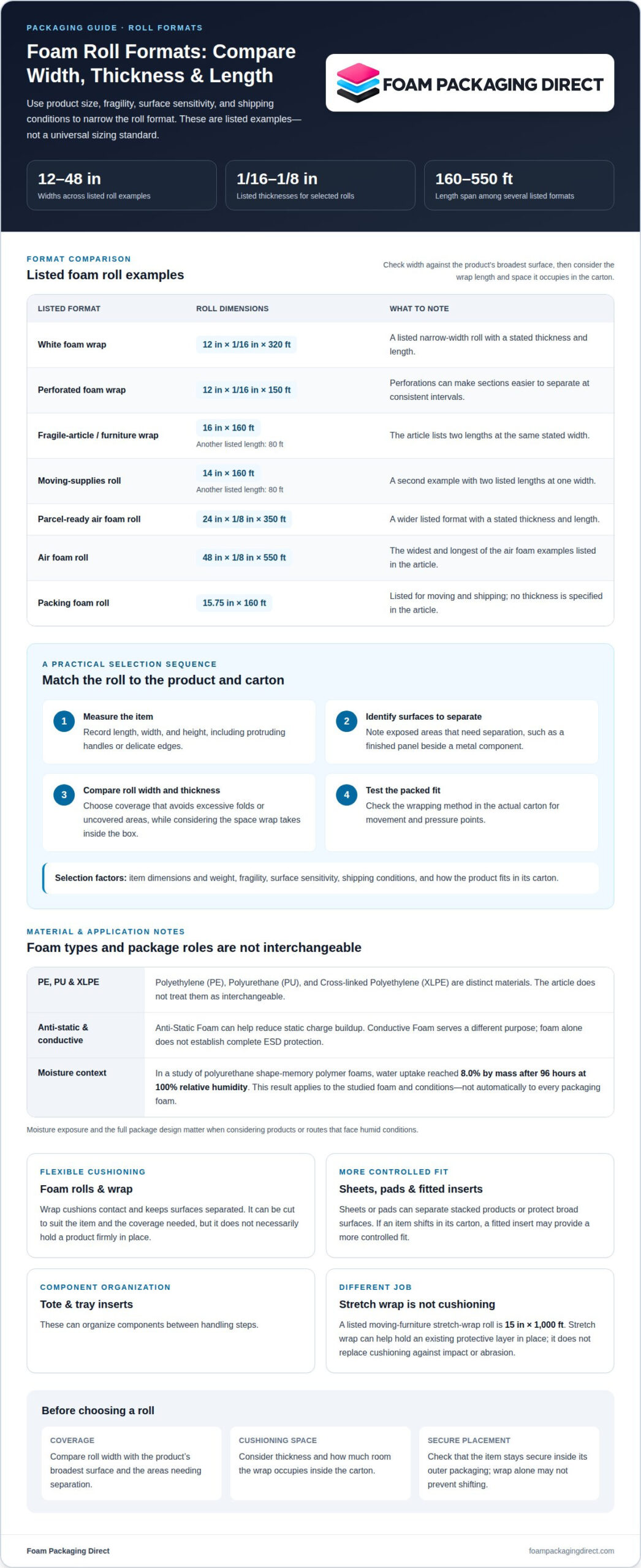
Compare the roll dimensions with the products and cartons used on your packing line. Listed examples include a white foam wrap roll measuring 12 inches wide, 1/16 inch thick, and 320 feet long. A perforated version measures 12 inches wide, 1/16 inch thick, and 150 feet long. Perforations can make it easier to separate sections at consistent intervals, while a continuous roll allows the packer to choose the cut length.
Other listed formats show how width and length vary by use. Fragile-article and furniture wrap is listed at 16 inches wide and 160 feet long, with another option listed at 16 inches wide and 80 feet long. Moving-supplies rolls are listed at 14 inches wide and 160 feet long, or 14 inches wide and 80 feet long. These are examples of market listings, not a universal sizing standard.
For larger items, a parcel-ready air foam roll is listed as 24 inches wide, 1/8 inch thick, and 350 feet long. Another air foam roll is listed at 48 inches wide, 1/8 inch thick, and 550 feet long. A separate packing foam roll for moving and shipping measures 15.75 inches wide and 160 feet long. Check the roll width against the product’s broadest surface, then consider how much material each wrap needs.
Use this practical sequence to compare formats:
- Measure the product’s length, width, and height, including protruding handles or delicate edges.
- Identify exposed surfaces that need separation, such as a finished panel beside a metal component.
- Choose a roll width that covers those surfaces without excessive folds or uncovered areas.
- Test the wrapping method inside the actual carton, checking for movement and pressure points.
Material choice matters as much as roll size. Polyethylene (PE) Foam is a common packaging option, while Polyurethane (PU) Foam has a different structure and feel. Cross-linked Polyethylene (XLPE) Foam is another distinct material, not simply interchangeable with every PE foam. For electronics, Anti-Static Foam can help reduce static charge buildup. Conductive Foam serves a different purpose, and foam alone does not establish complete ESD protection.
Moisture exposure also deserves attention when products or routes face humid conditions. In a study of polyurethane shape-memory polymer foams, water uptake reached 8.0% by mass after 96 hours at 100% relative humidity, according to the National Library of Medicine. That finding applies to the studied foam and conditions, not automatically to every packaging foam. Consider the product’s environment and the full package design rather than assuming one material suits every shipment.
Foam rolls can be cut to suit the item and the coverage needed. For example, a business packing compact parts can cut separate pieces, while a broad, delicate panel may need a longer wrap section. A roll cushions and separates, but does not necessarily hold an item firmly in place. If the product shifts inside its carton, a fitted insert may provide a more controlled fit than adding wrap alone.
Finally, distinguish foam wrap from stretch wrap. A listed stretch-wrap roll for moving furniture measures 15 inches wide and 1,000 feet long, but stretch wrap is not foam cushioning. It can help keep an existing protective layer in place; it does not replace cushioning against impact or abrasion. Select each packaging layer for its job, then check the assembled package for a secure fit.
Foam Packaging Direct: Custom Foam Inserts
Foam Packaging Direct serves businesses throughout the United States, with manufacturing locations across the country. Regional production can help reduce freight costs and turnaround times. Foam Rolls & Wrap suit items that need a flexible cushioning layer; Foam Sheets & Pads can separate stacked products or protect broad surfaces. When a product shifts inside its carton, Custom Foam Inserts can create a more controlled fit. Tote & Tray Inserts can organize components between handling steps.
Share the product dimensions, weight, order quantity, and shipping ZIP code when requesting a quote. Existing box dimensions, drawings, photos, and special protection requirements can also help clarify the application. These details describe the product and shipping setup.
Contact Foam Packaging Direct to request a quote for your packaging needs.
Set Up Your Next Shipment with the Right Protection
Use each shipment to make the packing process more consistent. When the cushioning and carton work together, your team has a clearer packing method to follow. If the current setup allows products to shift, review how the item fits before choosing the next format.
A packaging change can start with one product or packing workflow. Compare how the current package holds the item, then decide what needs to change for the next shipment.
Explore a quote request with Foam Packaging Direct and take a practical next step toward a packaging setup that fits your operation.