
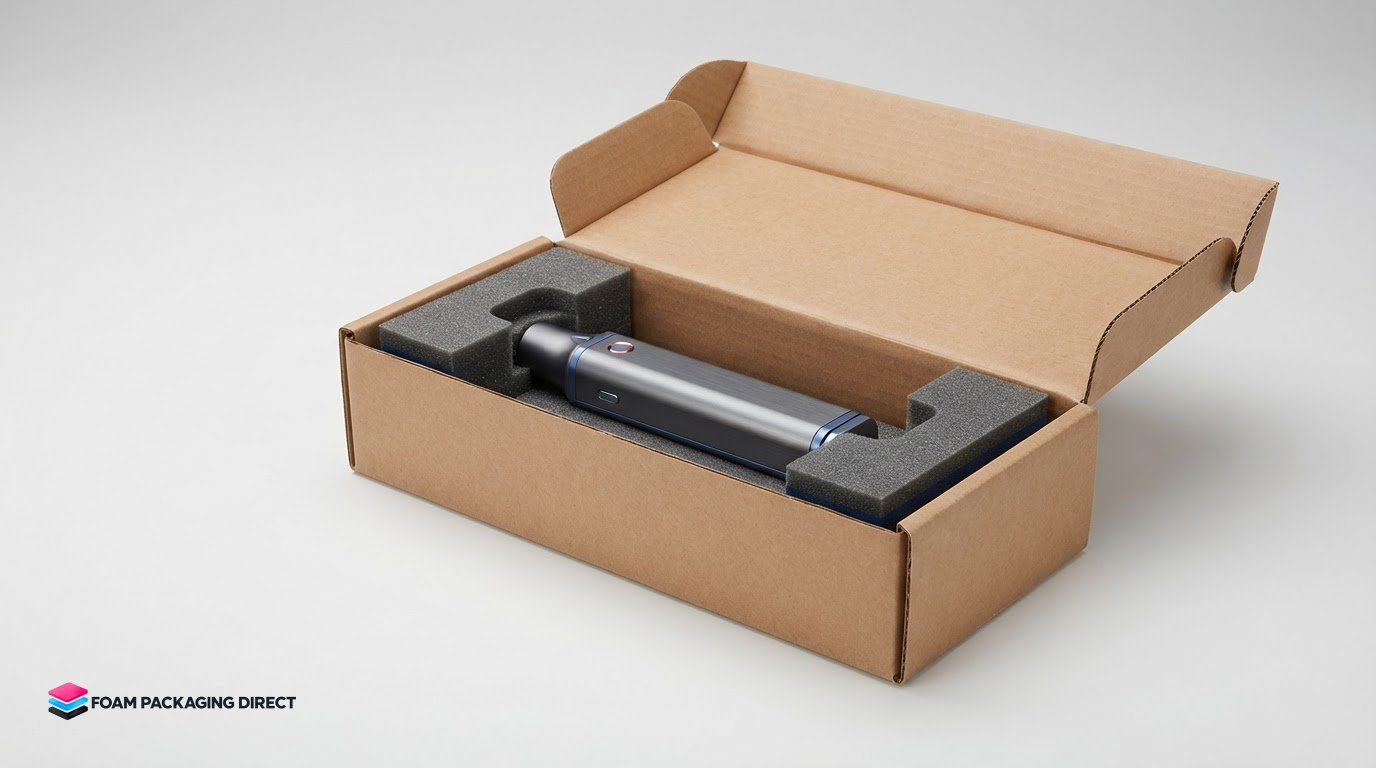
The right foam is only half the fit. Custom foam end caps are commonly made from polyethylene, with polyurethane, cross-linked polyethylene, EPS, and other options suited to different packaging needs. They can be shaped for an existing corrugated box to cushion a product at its ends or corners.
You may not need to replace your current box to improve product support. Match the end caps to the product’s dimensions and weight, then check how the protected product sits inside the box. The material, fit, and clearance all matter: caps should hold the product securely without making the carton difficult to close.
Key Takeaways
- Compare the protected product’s size with the box’s usable interior space to see whether end caps can fit without forcing the box closed.
- Choose foam based on the product’s weight, fragility, surface sensitivity, and shipping conditions, rather than treating all foam types as interchangeable.
- Review where the foam will contact and support the product to limit movement while keeping it clear of the box walls.
- Use your existing box dimensions, product details, and drawings or photos to help shape a practical packaging design.
Will these fit my existing boxes?
Yes. Foam end caps can be made for existing corrugated packaging or Correx® boxes. Fit depends on the box’s usable interior dimensions, the product’s size, and the space the caps occupy. Measure the inside length, width, and depth, then check the total space needed with both caps fitted. The box should close without compressing the product or foam.
The wrong cap size creates two risks: a loose fit can let the product shift, while a tight fit can press against sensitive areas or make packing difficult. Check contact points, fragile components, and how the product sits once packed. These details help determine where cushioning and clearance are needed.
Lightweight foam can cushion against shock, impact, and handling without adding unnecessary package weight. End caps place foam at the product’s ends or corners instead of filling the entire box. Using less material may reduce packaging bulk and shipping weight, though the effect depends on the product and packed box.
Also consider dimensional weight. Depending on the carrier and service, shipping charges may reflect package size as well as actual weight. A bulky cap design can increase the outer carton’s dimensions, even when the foam is light. Compare the packed box’s exterior dimensions and weight, not just the foam by itself.
- Check storage: Hinged end caps can be supplied and stored flat, then assembled for packing. This can use less shelf space before assembly.
- Check shipping method: Parcel shipments and palletized loads may call for different box layouts. The method affects carton dimensions and how packages are arranged.
- Check parts per box: Packing one product or several components changes the required interior space. Confirm the count and arrangement before setting cap dimensions.
For a fit check, record the box’s interior dimensions, product dimensions, packed weight, and shipping method. Then compare a sample arrangement or drawing. Custom foam end caps should protect the product while allowing the existing box to close normally.
What are foam end caps manufactured from?
Foam end caps are available in several materials, including Polyethylene (PE) Foam, Cross-linked Polyethylene (XLPE) Foam, Polyurethane (PU) Foam, Expanded Polystyrene (EPS) Foam, and Expanded Polypropylene (EPP) Foam. PE and XLPE are common protective packaging options. Match the material to the product’s weight, fragility, surface sensitivity, and shipping conditions. For example, PE suits heavy or sharp-edged parts, while PU can suit delicate, lightweight items.
Customization covers more than the end-cap outline. A design can follow a product’s end profile, support selected edges, and leave clearance around delicate parts. Foam grades, density, color, and anti-static options can also vary by application. Anti-static cushioning helps reduce static buildup around sensitive electronics, but it doesn’t replace other ESD protection measures. Custom foam end caps should reflect both the item’s shape and the handling it will face.
- Share product geometry: Provide maximum length, width, and height, plus contact points and fragile components.
- Send a CAD file: A 3D CAD file gives the clearest representation of the product for designing a precise fit.
- Review a prototype: A physical sample can help assess how the foam meets the product, supports edges, and fits the intended box.
- Refine the design: Adjust support areas and clearance based on the product’s weight and the points requiring cushioning.
Manufacturing begins with the product information and protection requirements, then translates those details into a foam shape and material choice. For example, a smooth-sided instrument may need broad, gentle contact, while a component with delicate connectors needs clearance around those features. Die-cutting can follow the item’s end profile. The finished caps should support the intended contact areas without pressing on fragile parts.
To order, provide product dimensions, total weight, quantity, and shipping ZIP code. Include a 3D CAD file when available, or send clear photos and drawings with contact points marked. Add the existing box’s inside dimensions and any special protection needs. These details help define the material, shape, and cushioning design for a quote.
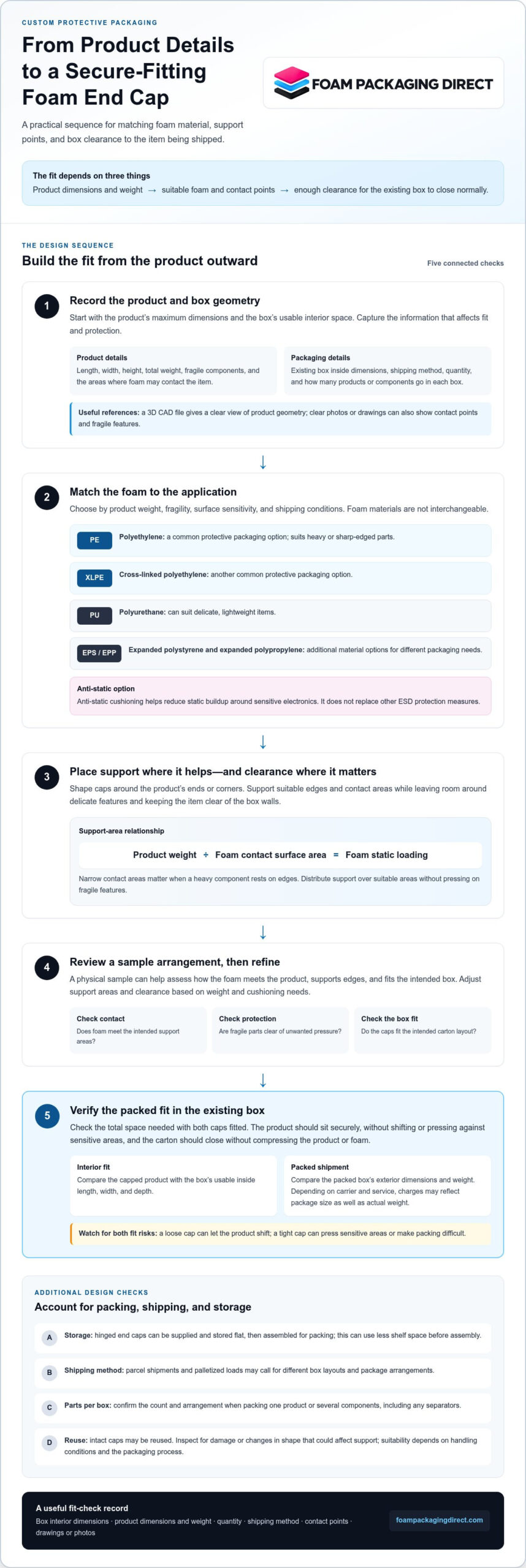
End caps as structural supports in protective packaging
End caps do more than cushion edges. They hold a product in position inside its shipping container, helping keep it away from corrugated walls during handling. The caps fit over the product’s ends, and the protected item sits inside the outer box. A well-matched carton limits movement around the foam supports.
Support depends on where the foam contacts the product and how much weight those areas carry. Foam static loading is calculated by dividing product weight by the surface area of its foam contact points. If a heavy component rests on narrow edges, the contact area matters. The design should distribute support across suitable areas without pressing on delicate features.
Foam end caps can be paired with corrugated packaging as a complete protective setup. You can source caps and boxes together or use caps with cartons already in production. For existing cartons, compare their inside dimensions with the capped product. For a new setup, coordinate the cap shape and box interior so components remain secure after packing.
Order volume and storage needs also shape the design. Match the number of caps to the products you pack and your planned packaging supply. If a line packs multiple components in one carton, account for their positions and any separators. Hinged caps can store flat before assembly, which may help manage storage space.
Foam end caps can be used for single-trip packaging, and intact caps may also be reused. Before reuse, inspect the foam for damage or changes in shape that could affect support. Whether reuse is suitable depends on handling conditions and the packaging process.
Do they meet shipping or industry packaging requirements? End caps can be designed to support a product in its shipping box, but foam alone doesn’t establish that the complete package meets a particular requirement. The full package design and its intended use matter.
Where can you buy them near you? Foam Packaging Direct supplies custom protective foam packaging nationwide. Share your product and packaging requirements to start designing end caps for your application.
Compatibility with existing boxes
Start with the existing carton, not the dimensions on its outside label. Measure the usable interior length, width, and depth, then compare them with the product and both end caps in place. Leave enough room for the box flaps to close without forcing the product or foam out of position. A drawing of the packed layout can help reveal tight spots.
Next, check the product’s contact surfaces. Mark the edges that can bear pressure and any delicate areas that need clearance, such as a connector or finished panel. The cap profile should meet stable support points while keeping sensitive surfaces from rubbing against the carton or foam. For an irregular product, a CAD drawing or marked-up photo can show those areas clearly.
Foam density and thickness affect how a cap supports the product. Selection depends on the product’s weight, fragility, surface sensitivity, and shipping conditions. Dense foam is not automatically the right choice for every item. Match the material and contact area to the load and protection needed, then check whether the capped product sits securely inside the existing box.
- Measure the carton: Record interior dimensions and note seams, flaps, or other features that reduce usable space.
- Measure the packed product: Include the caps in the overall dimensions, not only the uncovered item.
- Check closure: Place the product and caps in the box, then confirm the flaps meet without compression.
- Review movement: Check whether the product shifts inside the closed carton and identify where support needs adjustment.
For example, a long component may fit the carton’s length but leave too little depth for caps at both ends. Recheck the product’s orientation before changing the box. If the existing carton cannot accommodate the product and protective foam while closing correctly, a different layout or box size may be needed.
Prepare the box’s interior dimensions, product measurements, weight, quantity, and shipping ZIP code. Add drawings or photos that show contact points and special protection needs. Request a quote for a box-compatible foam design using those details.
Foam Packaging Direct: Custom Foam Inserts
Foam Packaging Direct helps businesses choose protective foam for products that need stable support inside existing boxes. If end caps don’t suit the product’s shape or packing process, custom foam inserts can organize and cushion it within the carton. Foam sheets and pads can protect specific contact points, while foam rolls and wrap can cushion products with varied shapes.
Share the product dimensions and weight, order quantity, shipping ZIP code, and existing box measurements. Drawings or photos can show contact points and special protection needs. This information helps Foam Packaging Direct prepare a quote based on your application.
Put the box fit into your packaging plan
Before changing a packout, run a trial with the actual product and carton. Have the packing team confirm that the product seats correctly, the box closes cleanly, and the process is practical for daily use. Note any adjustments needed before approving the final design.
To request a quote for custom foam end caps, share the product dimensions, weight, quantity, shipping ZIP code, and available drawings or photos. Include the existing box dimensions and any specific protection needs. Exact pricing is provided only after a quote is issued.
Contact Foam Packaging Direct to request a quote. A well-documented trial gives your team a clear starting point for the next packaging decision.
Frequently Asked Questions
How do I measure my product to ensure a precision fit for the end caps?
Measure the product in the same configuration it will have during packing. Include attached parts or accessories; if they ship separately, measure them separately. Use a consistent measuring tool and record dimensions in one unit system. For products with irregular profiles, label each view on a drawing so the measurements correspond to the correct face.
What is the typical lead time for custom foam prototypes?
Prototype timing depends on how ready the design information is and how much review the shape requires. A complete drawing can help define the work, while an irregular product may need more design refinement. The prototype stage includes sample review and approval before production. Share any design changes promptly, since revisions can affect the overall project schedule.
What are custom foam end caps used for?
End caps provide focused cushioning at a product’s ends when a full foam enclosure isn’t needed. For example, a long industrial housing may need protection at its terminal edges while its central section remains accessible for inspection or handling. The end-cap format can also simplify packing when the product’s shape allows stable support at the ends.
What types of foam are used for custom end caps?
Options include polyethylene, XLPE, polyurethane, EPS, and EPP. EPP can suit returnable packaging that is handled repeatedly, while EPS provides rigid protection. XLPE may be selected for a clean finish, and polyurethane can suit delicate, lightweight items. The choice depends on the application, including whether the package is single-use or part of a return cycle.
How do I measure an item for custom foam end caps?
Make a measurement sheet and label each dimension by face, such as front, side, and end. Note whether the figures describe the product alone or an assembled configuration. If a drawing includes multiple views, use matching labels on each view and on the measurement sheet. This clear format helps prevent confusion when product details are translated into a cap design.
What is the typical lead time for custom foam end caps?
The fabrication approach depends on the approved design, selected material, order quantity, and required processes. Foam components may be made using precision cutting, routing, die-cutting, laminating, or bonding. Include the required quantity and any finishing details when requesting a quote. A prototype or sample is reviewed and approved before full production.