
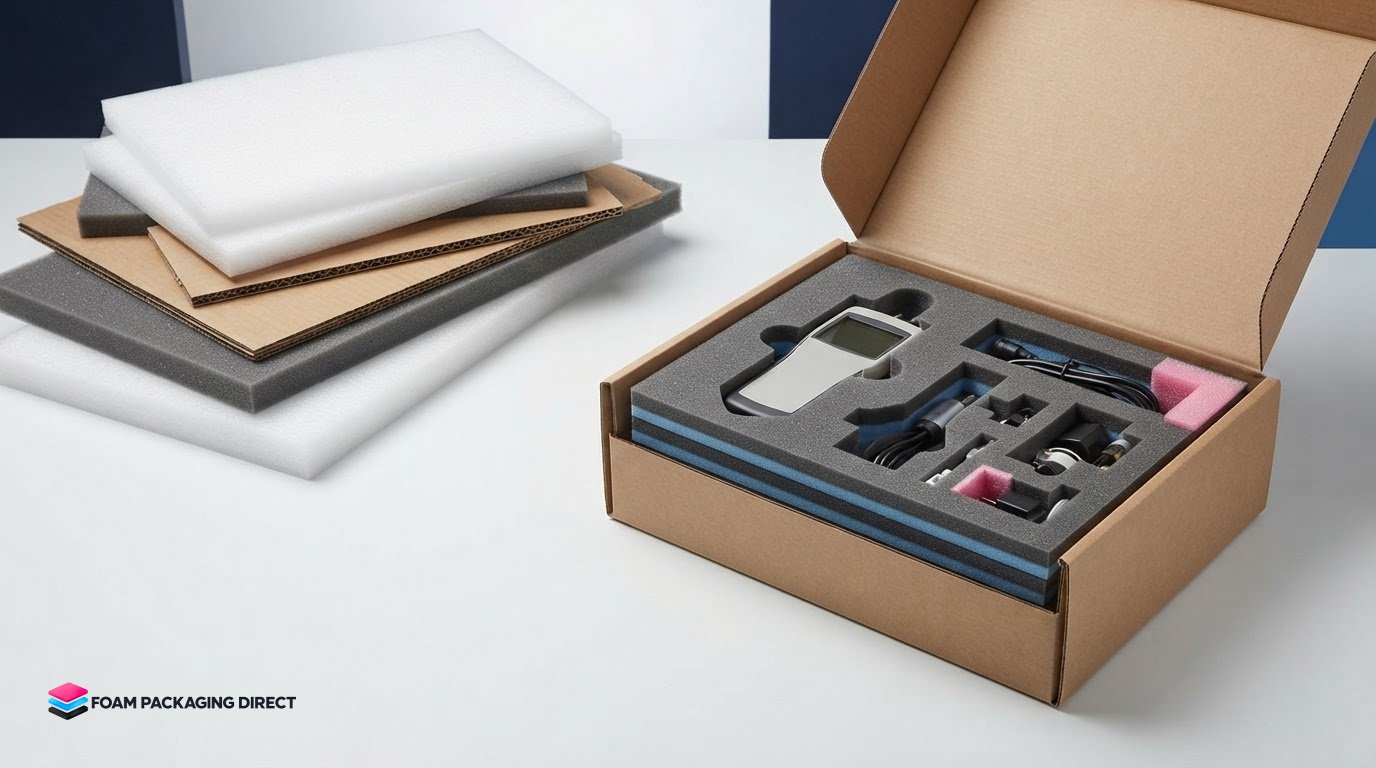
Stock foam is a practical fit for standard protection and repeat orders; custom fabrication suits products that need a precise shape, material, or internal layout. In the Uline packaging foam vs. a custom foam fabricator decision, order size matters, but so do fit and structure. Foam molding is considered worthwhile for production volumes of 10,000 or more pieces because aluminum molds are expensive.
Ready-made packaging is a practical choice when standard formats protect the product and fit the packing process. But stock foam may not hold a product securely or protect vulnerable surfaces. This comparison explains how order quantity, material, product weight and fragility, and fabrication methods shape the decision.
You’ll also see when custom inserts, end caps, and foam-and-box packaging can address needs that standard foam may not meet, and when stock foam is enough. The goal is to match the packaging to the product and shipping task.
Key Takeaways
- For standard shapes and straightforward protection, stock foam may be a practical fit; custom fabrication becomes more useful when products need precise cavities or organized layouts.
- Foam molding is generally considered worthwhile at production volumes of 10,000 or more pieces, since aluminum molds are expensive.
- Match the foam to the product: weight, fragility, surface sensitivity, and shipping conditions all affect the material and structure that will work best.
- Cutting methods suit different designs. Consider the shape you need and how the method affects tooling, cut quality, and production speed.
Small production runs and high-volume orders
Minimum order quantities and lead times vary by fabricator, design, material, and production method. A quote sets out the quantity and schedule for the specific insert, rather than applying one rule to every product. A simple foam pad and a detailed insert with separate cavities have different production requirements.
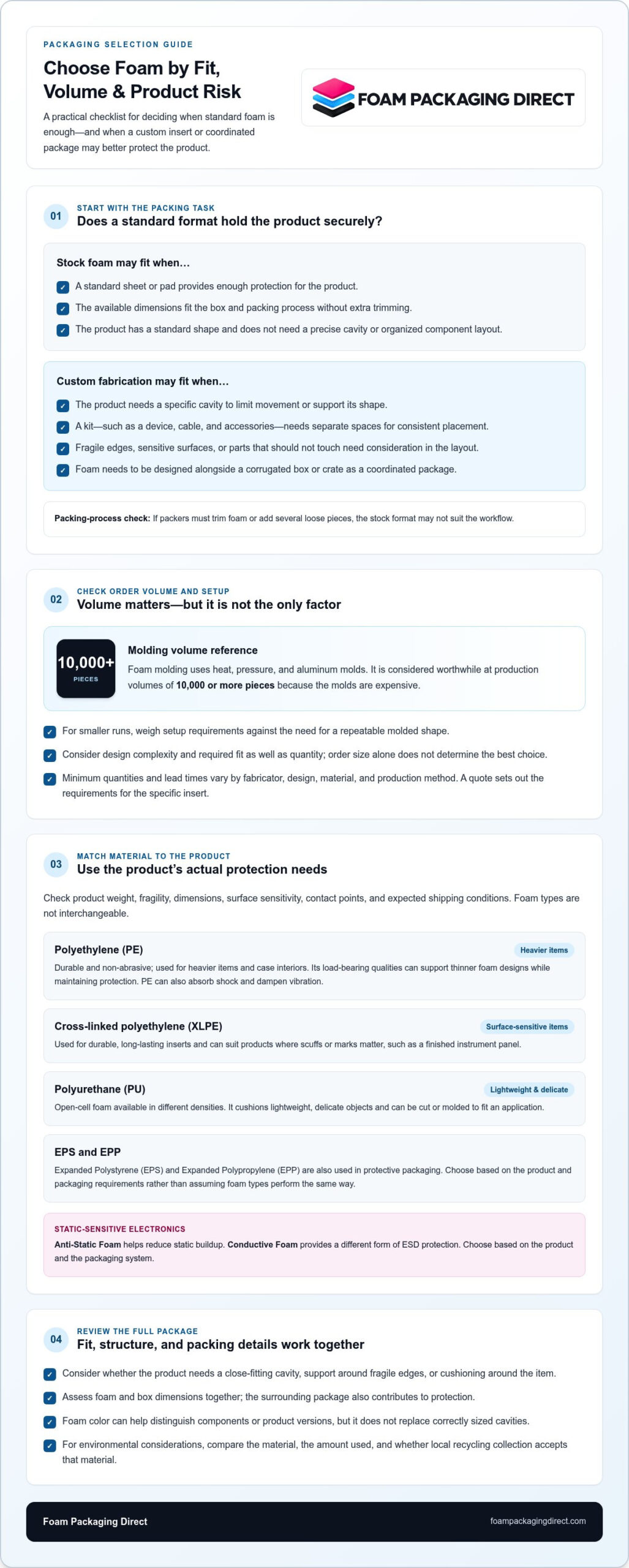
For large volumes, tooling can change the economics. Foam molding uses heat, pressure, and aluminum molds; it is considered worthwhile at production volumes of 10,000 or more pieces because the molds are expensive. For smaller runs, weigh the setup involved against the need for a repeatable, molded shape. The order quantity alone does not determine the best choice: design complexity and required fit also matter.
Stock foam may suit a short run when standard dimensions provide enough protection. A custom insert is more useful when a product needs a specific cavity or several components must stay organized together. For example, a kit with a device, cable, and accessories can have separate cutouts that limit movement and make packing more consistent.
Foam color can help organize products. Custom inserts are available in a variety of colors, which can distinguish components or product versions. Treat color as a visual aid, not a replacement for correctly sized cavities. A labeled layout and consistent placement can help packers see where each component belongs.
To assess environmental considerations, compare the foam material, the amount used, and whether local recycling collection accepts that material. A right-sized design can avoid unnecessary foam, but recyclability depends on the material and available local processing.
For a small production run, prioritize a design that protects the product without unnecessary tooling or excess material. For repeat, high-volume orders, weigh setup requirements against the benefit of consistent shapes and packing. In the Uline packaging foam versus custom foam fabricator decision, the practical choice is the one that fits order volume, product layout, and protection needs.
There is no single minimum quantity or lead time for every custom insert. The quote reflects the design, material, production method, and order requirements. Simple pads and detailed inserts can have different production schedules.
Packaging material breadth and structural performance
Foam type affects how an insert supports a product, absorbs impact, and manages vibration. Polyethylene (PE) is durable and non-abrasive, making it a practical option for heavier items and case interiors. Its load-bearing qualities can support thinner foam designs while maintaining protection. Product weight, fragility, dimensions, and shipping conditions help determine the structure required.
Cross-linked Polyethylene (XLPE) Foam is used for durable, long-lasting inserts and can suit products with surfaces where scuffs or marks matter, such as a finished instrument panel. Polyurethane (PU) Foam is open-cell and available in different densities. It cushions lightweight, delicate objects and can be cut or molded to fit an application.
Expanded Polystyrene (EPS) Foam and Expanded Polypropylene (EPP) Foam are also used in protective packaging, but foam types are not interchangeable. A material that supports a heavy part may not suit a delicate product with a sensitive surface. Compare the product’s shape, contact points, and expected handling conditions, then consider whether the package needs a close-fitting cavity, end support, or cushioning around the item.
Which foam is best for impact, vibration, or static electricity? PE can absorb shock and dampen vibration, while PU can cushion lightweight, delicate products. For static-sensitive electronics, Anti-Static Foam helps reduce static buildup; Conductive Foam provides a different form of ESD protection. Choose based on the product and packaging system.
Foam geometry matters as much as material. A snug cavity can limit movement, while supports around fragile edges can reduce contact with the box. For example, an instrument with a delicate finish may need a surface-protective insert, while a heavy component may need load-bearing support beneath it. The surrounding package also contributes to protection, so assess the foam and box dimensions together. Match the material to the product’s actual risks, not just its category.
Stock distributors versus custom packaging manufacturers
A stock distributor can be a good fit when standard foam sizes suit the product and packing process. A team shipping the same part in a standard box may use a suitable sheet or pad without designing a new insert. When comparing Uline with a custom foam fabricator, ask whether the available format holds the product securely and consistently. If packers must trim foam or add several loose pieces, stock may not suit the workflow.
A custom foam fabricator designs around the product’s dimensions and protection needs. An insert can position a device, cable, and accessories in separate cavities, helping packers place each item consistently. The layout can also account for fragile edges, sensitive surfaces, or components that should not touch. The trade-off is a design and production process tailored to the application instead of choosing from standard formats.
Packaging can involve more than foam alone. A manufacturer able to combine foam with a corrugated box or crate can develop the protective components as a coordinated package. For example, a heavy instrument may need shaped foam supports and a box sized around the product and its cushioning. Considering these parts together helps avoid a mismatch between the insert and the outer package.
Compare the two supply models against the actual packing task:
- Standard fit: Choose stock when a standard sheet or pad protects the product without extra trimming.
- Product-specific layout: Consider custom fabrication when a device and its accessories need distinct, stable positions.
- Packaging coordination: Consider a combined foam-and-box solution when the insert and outer container need to work as one package.
Consider how the choice affects repeat packing, too. If one standard foam format works across a product line, stocking it may simplify replenishment. If models differ in shape or contact points, model-specific inserts can help prevent packing mix-ups. The better fit depends on product dimensions, protection requirements, and how the team handles each shipment.
Choosing a foam fabrication method
Shipping costs and delivery times depend on the shipment’s size, destination, carrier, and production schedule. A local fabricator may shorten the distance products travel, while a distributor may offer standard stock formats; compare the complete route and order requirements.
For flat parts or repeatable profiles, die-cutting uses a steel rule die to stamp foam shapes. Compression during cutting can create concavity, an inward curve along the cut. CAD table cutting holds a foam plank in place with vacuum and uses programmed blades. It avoids tooling costs and concavity, but machine speed can make the process slower.
CNC wire cutting runs a wire horizontally or vertically through a foam bun. It can form a cavity or shape only when the wire has an entry point. Water jet cutting can produce nonstandard shapes with a five-axis head, but parts need to dry after water exposure. The design and material help determine which method fits.
To specify an insert for a product or shipping case, provide the product’s dimensions and weight, along with the existing box dimensions. Mark fragile edges, sensitive surfaces, and components that need separate cavities. A drawing or clear photos can show orientation and contact points. Include the quantity and shipping destination so design and delivery requirements can be considered together.
The fabrication method depends on the shape. A simple flat pad may suit die-cutting, while a complex outline may call for water jet cutting. A recessed cavity may need a method that can reach the cut area. Foam molding uses heat, pressure, and aluminum molds to form parts. Each process has different setup and production considerations, so match the required geometry with order quantity and timing.
For a custom insert quote, share product dimensions, weight, quantity, box dimensions, shipping ZIP code, and any available drawings or photos. Include special protection needs to help define the package.
Costs and delivery times vary with shipment size, destination, carrier, and production schedule. A local fabricator may reduce transit distance, while Uline or another distributor may offer standard stock formats; compare the full route and order requirements.
Foam Packaging Direct: Custom Foam Inserts
Foam Packaging Direct supplies businesses throughout the United States, with manufacturing facilities across the country. Regional production can help reduce freight expenses and turnaround times. Custom foam inserts can hold products in defined positions, reduce movement, and organize components for packing. Foam sheets and pads or foam rolls and wrap may suit products needing broader cushioning.
For shipments that need an insert and outer container, Foam Packaging Direct provides foam-and-box packaging. To request a quote, share product dimensions, weight, quantity, shipping ZIP code, and available drawings or photos. Include existing box dimensions and any special protection requirements.
Contact Foam Packaging Direct to discuss packaging designed around your products and packing process. Start with the product dimensions, weight, and protection requirements.
Turn your packaging requirements into a clear next step
Use the Uline packaging foam versus custom foam fabricator decision to define what your packaging needs to do in daily operations. Note which products share a package, where packers need clear component placement, and which surfaces require careful handling. These details help shape a solution around the product and the way your team packs it.
Foam Packaging Direct supplies custom foam inserts, foam end caps, and foam sheets and pads for protective packaging. To request a quote, share product dimensions, weight, order quantity, shipping ZIP code, and available drawings or photos. Include existing box dimensions and any special protection requirements.
Contact Foam Packaging Direct to discuss packaging that fits your products and packing process. A clear set of requirements is a practical place to begin.
Frequently Asked Questions
Is switching from a catalog supplier to a custom packaging manufacturer complicated?
No. Share product dimensions, weight, box size, quantity, and any drawings or photos to define the packaging requirements. If drawings aren’t available, the product can be shipped for measurement. A sample is cut for approval before production, so your team can review the fit. Once approved, the design is kept on file for consistent reorders.
What foam materials and custom fabrication services do packaging foam fabricators offer?
Material options include Polyethylene (PE) Foam, Cross-linked Polyethylene (XLPE) Foam, Polyurethane (PU) Foam, Expanded Polystyrene (EPS) Foam, Expanded Polypropylene (EPP) Foam, Anti-Static Foam, and Conductive Foam. Fabrication may include precision cutting, routing, die-cutting, laminating, and bonding. Anti-Static Foam helps reduce static buildup; Conductive Foam offers a different ESD-related option. The right material and process depend on the product and package design.
What should businesses consider when choosing between stock foam and custom foam?
Choose based on how well the packaging works in your packing operation. Check whether stock foam fits the product and container without extra trimming or added pieces. Custom foam suits products with unusual shapes, several components, or an existing tote, bin, or tray that needs a fitted insert. Also consider product variations, reorder needs, and the protection each item requires.
Ready to price a packaging solution? Request a quote from Foam Packaging Direct with your product dimensions, weight, quantity, shipping ZIP code, and any available drawings or photos.