
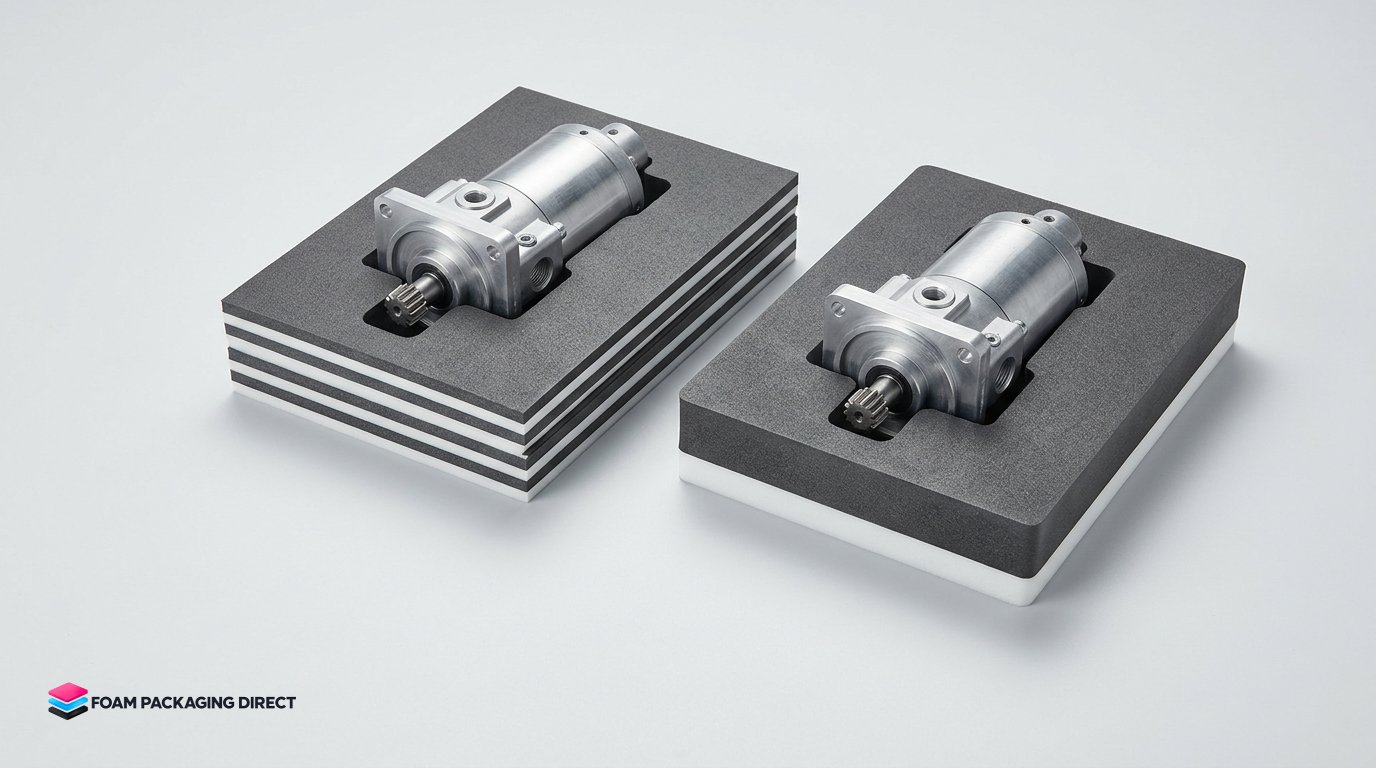
A Sealed Air Stratocell vs. Ethafoam comparison shows these foams aren’t automatic substitutes. Stratocell is made by bonding thin polyethylene foam layers, while Ethafoam is extruded polyethylene foam. Jiffy is another trade name, so the name alone doesn’t establish an equivalent replacement.
It’s understandable to group them together: all are used to cushion and protect products, and they may look similar in a finished package. But a replacement needs to match the job, not just the label or color.
This comparison explains how construction affects weight, flexibility, and support, and why those differences matter in packaging. You’ll also see how to assess material requirements, including surface protection and sensitive electronics, before choosing foam for an existing package or a new design.
Key Takeaways
- Compare the packaging job and required performance, not just foam names, color, or appearance.
- Account for moisture exposure and surface or chemical concerns, and treat fire resistance as a separate material requirement.
- Match cushioning and support to the product: foam weight, flexibility, and rigidity affect how it fits and protects.
- For sensitive electronics, consider whether the application calls for anti-static, static-dissipative, or conductive packaging.
Ethafoam, Stratocell, and Jiffy foam as trade names
Ethafoam, Stratocell, and Jiffy are trade names, not universal material specifications. A name alone doesn’t identify density, firmness, format, or cushioning performance. Those details matter when matching foam to a product and its shipping conditions.
Stratocell is a laminated polyethylene foam made by heat-bonding thin layers of extruded low-density polyethylene. Ethafoam is a range of closed-cell, expanded, uncrosslinked polyethylene foams. The two names therefore describe different product constructions, even though both refer to polyethylene foam.
Jiffy is another trade name used for protective foam products. Don’t assume it matches a particular Stratocell or Ethafoam grade based on appearance. Compare the material specification, physical format, and protection requirements instead. A roll used to separate surfaces, for example, serves a different purpose from a plank shaped to support a heavy component.
In the United States, price depends on the requested format, dimensions, specification, quantity, and any fabrication. Pricing is provided after a quote request, while availability depends on the specified product and required form.
Ethafoam products can be recycled at facilities that process rigid LDPE foam. Disposal options include local recycling collection or drop-off programs that accept this material. Acceptance varies by program, so follow local disposal guidance for the specific foam.
For replacement decisions, start with the existing drawing, approved package, or customer specification. If it names Ethafoam, Stratocell, or Jiffy, treat that name as a requirement to investigate, not proof that another foam is equivalent. Compare the intended support, fit, surface contact, and shipping conditions before changing materials.
For example, a protective insert that must hold a product in a defined position needs more than similar-looking foam. Its shape and support must suit the product. For sensitive electronics, also consider whether the application needs anti-static, static-dissipative, or conductive packaging. These properties aren’t interchangeable, and the trade name alone doesn’t establish them.
Moisture, chemical, and fire considerations
Stratocell and Ethafoam are closed-cell polyethylene foams. Their structure generally absorbs less water than open-cell polyurethane foam. This can matter around condensation, damp warehouses, or wet handling. It doesn’t make either material waterproof or replace a sealed package.
Chemical exposure needs separate review. Identify the substance, contact time, and whether the foam touches liquid directly. For example, a package exposed to cleaning fluids needs a different assessment from one shipped in a dry carton. Don’t assume similar polyethylene foams respond identically to every chemical. Match the foam to the actual handling environment and product-contact conditions.
Fire performance is another distinct requirement. Industrial use alone doesn’t mean a polyethylene foam is flame retardant. Some Ethafoam products have flame-resistance properties, but the trade name alone doesn’t identify that option. For Stratocell or Ethafoam, the specified grade and its required fire properties matter. Keep fire needs separate from cushioning, moisture, and chemical requirements.
How do Stratocell and Ethafoam compare in temperature limits and extreme conditions? Neither trade name alone sets a usable temperature limit. Performance depends on the exact grade, exposure duration, temperature changes, and load on the foam, so evaluate those conditions together.
For cold storage, heated transport, or outdoor staging, describe the full route. Include where the package will sit, how long exposure lasts, and whether products press against the foam. A short temperature excursion differs from prolonged exposure under compression. These details help define the right material specification without assuming all PE foam behaves alike.
For sensitive electronics, also consider whether the package needs anti-static cushioning. That property addresses static concerns; it doesn’t replace other ESD controls in the complete package. Explore foam packaging options with the product, shipping conditions, and protection requirements in mind.
Relative weight, flexibility, and rigidity
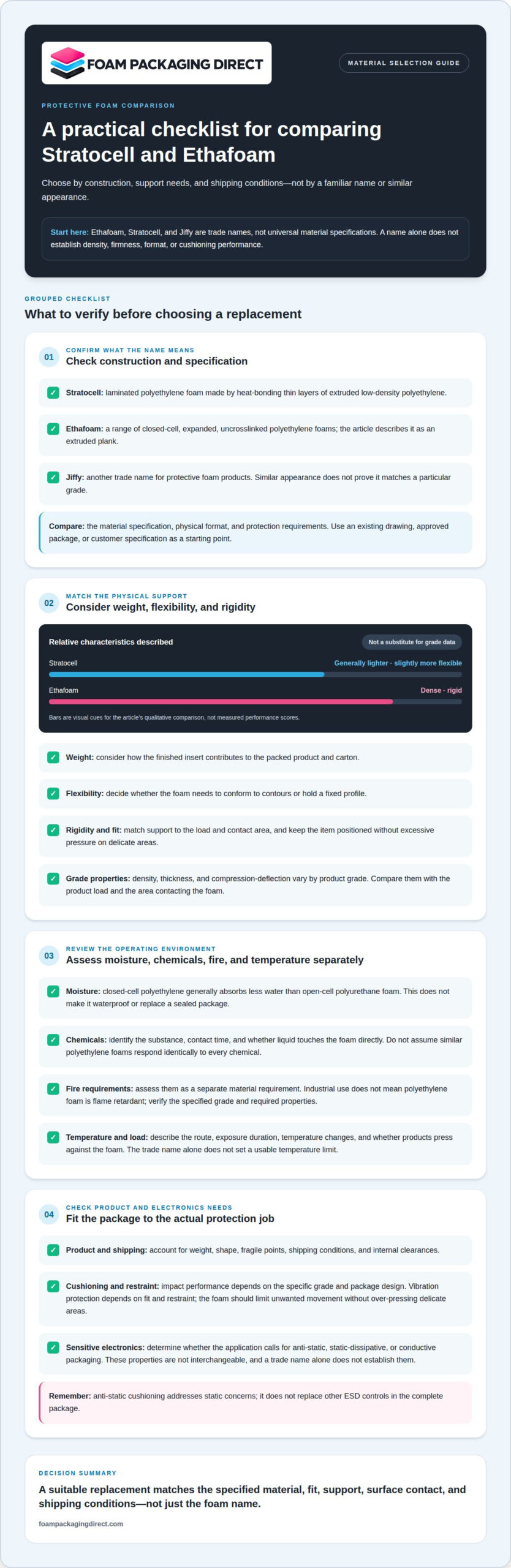
Stratocell is generally lighter and slightly more flexible than Ethafoam. Its bonded layers can suit packaging shapes that need some give during fabrication or handling. Ethafoam is an extruded plank described as dense and rigid. These construction differences influence how a support fits around a product and holds its position inside a carton.
A rigid support may work well for a heavy component that needs firm positioning. A more flexible foam structure can be useful around contours or broad contact areas. Neither trait alone determines protection. Product weight, shape, fragile points, shipping conditions, and the package’s internal clearances all affect the material choice.
Both polyethylene foams can cushion products, but impact performance depends on the specific grade and package design. Vibration protection also depends on fit and restraint. Foam must limit unwanted movement without placing excessive pressure on delicate areas.
Density, thickness, and compression-deflection vary by product grade. Compression-deflection describes the force needed to compress foam by a stated amount. Compare these properties with the product’s load and the area contacting the foam. A broad support and a narrow contact point can load the same foam differently.
For selection, separate the decision into practical requirements:
- Weight: Consider the finished insert’s contribution to the packed product and carton.
- Flexibility: Decide whether the material must conform to contours or hold a fixed profile.
- Rigidity: Match support to the load and contact area, while keeping the item securely positioned.
Ethafoam planks are designed to withstand multiple drops and support package reuse. Repeated use still depends on how the whole package is designed and handled. For a returnable container, assess whether the insert keeps components organized and supported between trips. Choose foam by its role in the complete package, not by stiffness alone.
Stratocell and Ethafoam construction differences
Stratocell and Ethafoam are closed-cell polyethylene foams. Their shared polymer doesn’t mean identical construction. Stratocell begins as thin layers of extruded low-density polyethylene, which are heat-bonded into a laminated structure. Ethafoam begins with polyethylene resin and forms as non-crosslinked expanded foam. One construction joins layers; the other creates an extruded foam plank.
This difference can affect how each material is converted into packaging. Stratocell’s laminated structure suits fabrication into protective shapes and commercial inserts. Ethafoam planks can be cut to fit a specific product shape. Laminating thinner foam layers can also create thicker planks for shaped packaging. For example, a package may use shaped supports to hold a component apart from the carton walls.
Cell structure offers another point of comparison. Cross-linked polyethylene foams generally have cells smaller than 1 millimeter in diameter. Uncrosslinked polyethylene foams generally have cells about 1 to 3 millimeters in diameter. Ethafoam is non-crosslinked. These general cell-size ranges help explain why foam families can differ in feel and finish, but they don’t specify every grade.
Stratocell uses low-density polyethylene, identified by resin code 4. It can be recycled at facilities that accept LDPE. That code identifies the resin type, not a guarantee of local collection. Ethafoam recycling likewise depends on facilities that process rigid LDPE foam. Construction and disposal are separate considerations.
For a packaging design, compare the foam’s construction with the job. A layered Stratocell piece may suit a broad separator, while a cut Ethafoam plank can form a fitted support. Product geometry, contact points, and required cushioning guide that choice. An existing drawing or approved package can help identify where each support sits and what shape it must hold. A material substitution should preserve those functional details, not just the original foam’s appearance.
Foam Packaging Direct: Custom Foam Inserts
Foam Packaging Direct designs and fabricates custom foam inserts to hold products in place and help protect them during shipping. This is a practical next step when an existing design needs a material change or a product needs a fitted protective layout.
Share the product’s dimensions, weight, fragility, surface sensitivity, and shipping conditions. These details help guide the choice between inserts, foam sheets and pads, or foam rolls and wrap. Tote and tray inserts can organize components for handling and storage, while foam and box packaging combines cushioning with a carton. For electronic components, conductive foam packaging may suit applications that require conductive material.
Request a quote with product dimensions, weight, order quantity, shipping ZIP code, and any drawings or photos. Include existing box dimensions and special protection requirements if available.
Turn the Comparison Into a Packaging Decision
Focus on what the package must do, rather than relying on material names. Record the support, fit, and handling requirements that matter for your product, then use them to guide the packaging specification. This gives purchasing and packaging teams a clearer basis for evaluating a proposed material change.
Foam Packaging Direct can help translate those requirements into a custom packaging solution. Include the product dimensions, weight, order quantity, shipping ZIP code, and any available drawings or photos with your quote request. Existing box dimensions and special protection requirements can help clarify the application.
Contact Foam Packaging Direct for help with your packaging decision and take the next step with a clear set of requirements.
Frequently Asked Questions
Are Ethafoam, Stratocell and Jiffy foam interchangeable?
No, not by name alone. A replacement needs to match the product’s support, fit, and handling requirements. For example, changing foam in an approved package could alter how a component sits or how its weight is supported. Compare the existing packaging specification with the replacement’s material properties and intended use. Similar color or appearance doesn’t establish equivalent performance.
Trade name or material description?
Ethafoam, Stratocell, and Jiffy are trade names. Polyethylene foam is a material description. A trade name identifies a branded product or product family, while the material description identifies the polymer. For purchasing, record both the named product and the required performance or format. This helps teams assess proposed substitutions against drawings, packaging specifications, and product needs.
What is Ethafoam?
Ethafoam is a trade name for closed-cell, expanded polyethylene foam. It’s used in protective packaging and supplied in formats such as planks. A packaging designer can shape a plank into supports that hold a product in position. The suitable grade and design depend on the item’s weight, contact points, and shipping conditions.
What is the difference between Stratocell® and Ethafoam®?
The names refer to polyethylene foams with different constructions. Stratocell is commonly made by bonding thin foam layers, while Ethafoam is available as extruded foam plank. That distinction can influence the format used for a package. A broad separator and a shaped support may call for different constructions, even when both use polyethylene.
What are Stratocell and Ethafoam made of, and how do their foam structures differ?
Both are closed-cell polyethylene foams. Stratocell uses bonded layers of extruded low-density polyethylene, while Ethafoam is non-crosslinked expanded polyethylene. These construction differences affect the foam’s structure and available formats. For a packaging specification, identify the required material type, form, and fit instead of relying on a trade name alone.
How do Stratocell and Ethafoam compare in weight, durability, and reusability?
Stratocell is generally lighter and more flexible, while Ethafoam plank is generally more rigid. Ethafoam planks are designed to withstand multiple drops and support package reuse. For a returnable package, consider how the insert holds the product between trips and whether its support remains suitable through repeated handling. The full package design also matters.