
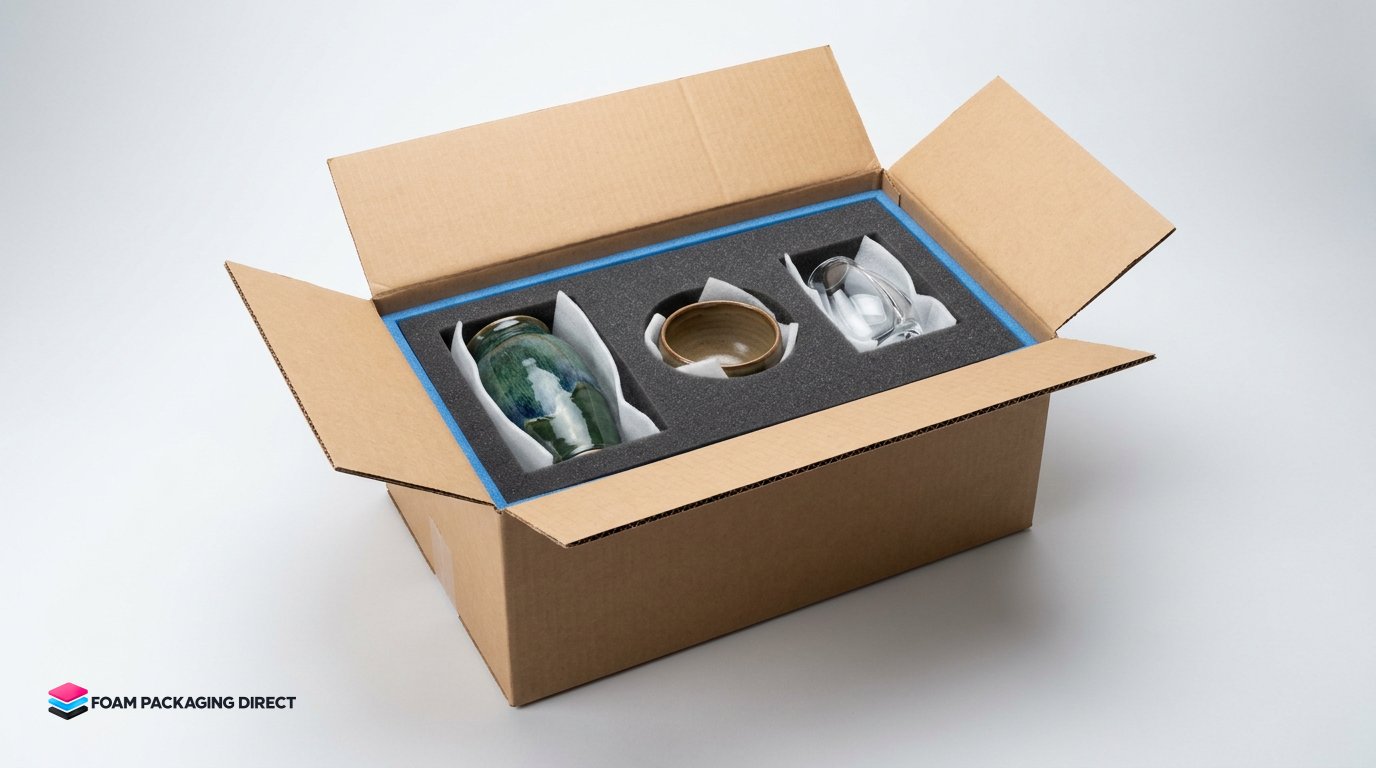
Contoured foam should support each ceramic or glass piece, while individual wrapping and separation prevent pieces from touching in transit. Ceramic and glass art transit packaging with contoured foam combines a fitted cradle with cushioning sheets or pads to limit movement and protect vulnerable edges. For higher-risk shipments, place a cushioned inner carton inside a second outer box.
It’s easy to focus on cushioning alone, but the way pieces are separated and held in place matters just as much. This guide shows how to pair contoured inserts with individual wrapping, structured separators, and shock-absorbing sheets. You’ll also see how to adapt the packing approach for single pieces, grouped items, and shipments that need extra protection, so you can make practical choices based on the artwork, its surfaces, and the journey ahead.
Key Takeaways
- Measure each piece’s shape and vulnerable areas so a custom insert can support it without creating pressure points.
- Plan separate spaces for multiple ceramics, accounting for how their shapes and surfaces affect packing and removal.
- Use cushioning sheets strategically to help distribute impact around delicate edges and corners.
- Match the insert and protective components to the artwork, box dimensions, and shipping conditions before requesting a quote.
Individual wrapping and separation for fragile products
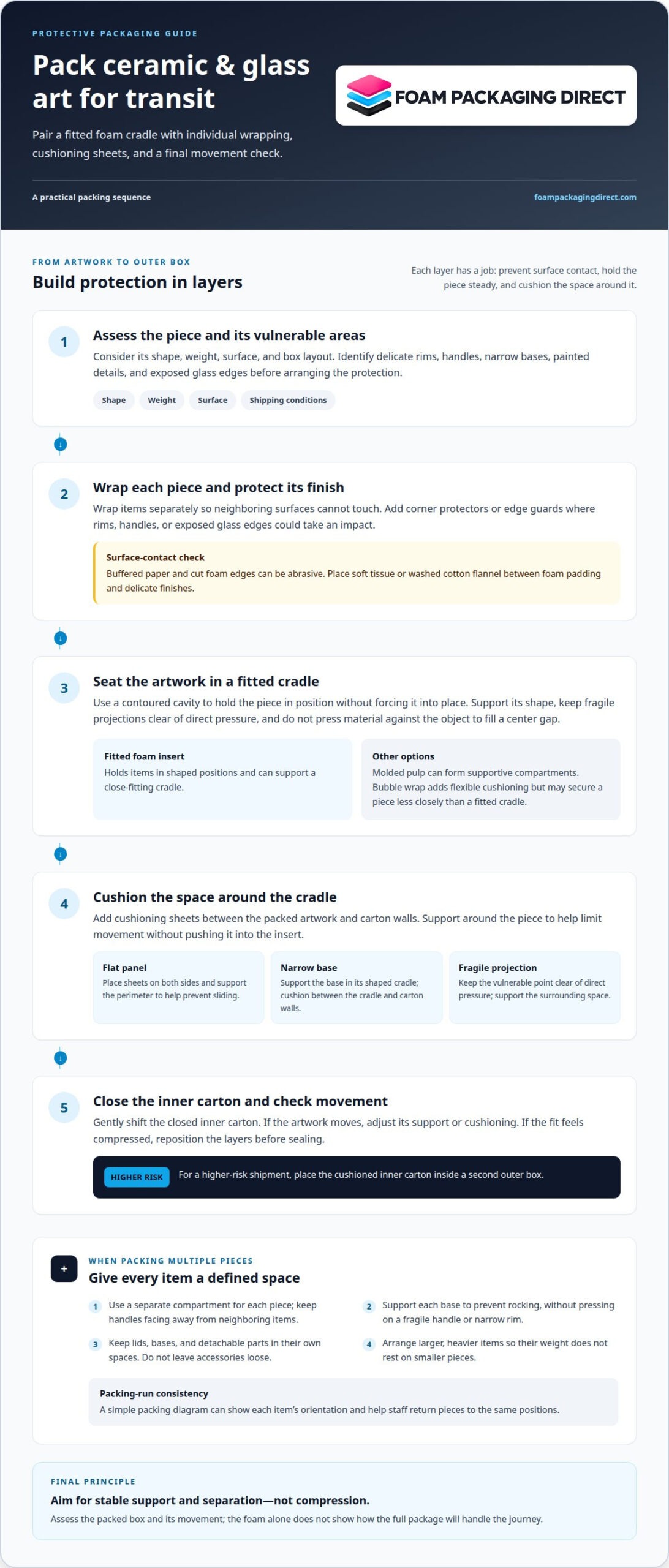
Wrap each ceramic or glass piece separately before packing it in a shared carton. This barrier helps prevent neighboring surfaces from touching in transit. A glazed vase and a glass ornament, for example, need separate wraps and dedicated spaces. Add corner protectors or edge guards where rims, handles, or exposed glass edges could take an impact.
Situation: Two ceramic bowls share a carton, and their rims could knock together. Action: Wrap each bowl separately and place it in its own compartment. Result: The bowls remain apart instead of rubbing or striking each other as the carton moves. Structured dividers can separate the spaces, while a snug inner carton and fitted cushioning help limit shifting.
Choose a barrier with the surface in mind. Buffered paper can be slightly abrasive, so don’t place it directly against a delicate finish. Polyethylene foam can also have abrasive cut edges. If using foam padding, isolate the artwork with soft tissue or washed cotton flannel. Don’t fill a center gap by pressing material against the object.
Foam inserts hold items in shaped positions, while molded pulp can create supportive compartments. Bubble wrap adds flexible cushioning, but may not secure a piece as closely as a fitted cradle. Choose based on the artwork’s shape, weight, surface, and box layout.
ISTA testing may help evaluate a fully packed shipment against handling stresses. There is no universal test requirement for every artwork shipment; the appropriate approach depends on the distribution route and package design. Assess the packed box, not the foam alone.
For a delicate glass sculpture, wrap the surface, place it in a contoured cavity, and separate it from other pieces. Fill remaining gaps without pressing on the sculpture. Check that the inner carton limits movement, then consider a second outer box for a higher-risk shipment.
Keeping multiple ceramic pieces separated
A shared carton needs a defined place for every ceramic piece. Otherwise, movement can bring handles, rims, or glazed surfaces into contact. Give each item its own compartment, sized to hold its shape without forcing it into position. A divided tray or contoured cavity can keep pieces organized and make packing repeatable across a shipment.
Situation: A set of ceramic cups has projecting handles and rounded bodies. Action: Place each cup in a separate cavity, with handles facing away from neighboring pieces. Use dividers between cavities and support each base to prevent rocking. Result: The layout keeps handles apart and limits contact between cups.
For mixed shapes, group pieces by size and form before arranging the carton. Position larger, heavier items so their weight doesn’t rest on smaller pieces. Keep lids, bases, and detachable parts in their own spaces. A saucer, for example, can sit beside its matching cup, but shouldn’t be loose beneath it. This makes the set easier to pack and helps prevent pressure from transferring between pieces.
A snug inner carton should limit movement, while dividers or fitted inserts fill out the layout. Gently move the closed inner carton to check each cavity. If an item shifts, adjust its support or reduce the excess space. Don’t use a divider that presses against a fragile handle or narrow rim. The goal is stable support and separation, not compression.
Situation: Several cartons of ceramic pieces are prepared for pallet shipment. Action: Stack cartons symmetrically without overhang, placing heavier cartons beneath lighter ones. Secure the load with stretch wrap and suitable edge protection. Result: Stable stacking helps limit carton movement, while edge protectors help keep straps from pressing directly into boxes.
Before sealing, confirm that every piece has an assigned space and no loose accessory can move into another compartment. A simple packing diagram can show each item’s orientation and help staff return pieces to the same positions during packing runs.
Shock-absorbing sheets and cushioning
A cushioning sheet between the packed artwork and carton wall adds a protective layer across broad surfaces. For a flat ceramic panel, place sheets on both sides and support its perimeter to prevent sliding. This spreads contact over a wider area rather than concentrating pressure on an exposed corner.
Situation: A glass sculpture has a narrow base inside a larger box. Action: Support the base in its shaped cradle, then add cushioning layers between the cradle and carton walls. Result: The layers help absorb movement around the support without pressing against delicate projections.
Ceramic and glass art transit packaging with contoured foam pairs a fitted cradle with cushioning sheets. The cradle holds the artwork in place; sheets help fill the space around it. For example, a broad pad beneath a ceramic platter can separate its base from the carton, while side pads reduce direct contact with the walls.
Check surface contact before closing the package. Polyethylene foam is stable, but its cut edges can be abrasive. If polyurethane or polyethylene foam pads the artwork, place soft tissue or washed cotton flannel between the foam and the finish. This barrier is important around painted details, glossy glaze, and delicate glass surfaces.
For a piece with a fragile projection, identify the vulnerable point before arranging the cushioning. Keep it clear of direct pressure, and place supporting layers around the surrounding space. Each layer should complement the fitted insert, not push the object into its cavity.
Close the inner carton and gently shift it to assess movement. If the artwork shifts, adjust the support or cushioning. If the fit feels compressed, reposition the layers before sealing. This final check helps confirm the item is supported without excess pressure.
Measuring Ceramic or Glass Art for Custom Foam Inserts
Measure the artwork in its shipping-ready condition, including removable components that need separate spaces. Record its overall length, width, and height, then note projections such as handles, stems, feet, and uneven rims. For a glass sculpture, measure its widest points and narrow sections. Designing ceramic and glass art transit packaging with contoured foam starts with a clear understanding of the object’s shape and the areas that need support or clearance.
- Record the outer dimensions. Measure the longest, widest, and tallest points. Label each measurement’s orientation, such as front-to-back or base-to-rim.
- Map the shape. Sketch top and side views. Mark a vase’s neck, shoulder, base, and handle, or a glass figure’s thin extensions.
- Identify contact zones. Mark sturdy areas that can carry support and delicate areas needing clearance. Note the position of painted details or exposed edges.
- Include the package layout. Record the box’s interior dimensions and the intended positions of dividers or accessories. A lid packed beside a vessel needs separate space.
A single outline may not capture an irregular artwork. A hand-built ceramic form, for example, may have an uneven base and asymmetrical sides. Record measurements across its widest points and provide photos from different angles. A labeled drawing can clarify which face should sit upward and how the piece fits its container.
Consider loading and removal, too. A narrow cavity may hold a sculpture securely but make removal awkward or put pressure on projections. Mark suitable lift points and show where fingers need access. For nested pieces, measure each item separately and document the intended arrangement.
Include the artwork’s weight, quantity, existing box dimensions, and surface concerns with your measurements. These details help align the insert layout with the product and shipping conditions. Request a quote for a custom foam insert and include available drawings or photos.
Foam Packaging Direct: Custom Foam Inserts
Foam Packaging Direct turns artwork measurements into packaging layouts designed to support each piece in transit. Custom foam inserts hold individual ceramic or glass forms, while foam end caps and foam sheets and pads add protection at vulnerable edges or along carton walls. Foam rolls and wrap provide a separate cushioning layer when the surface needs isolation.
For multiple pieces, tote and tray inserts organize items in separate positions. The right arrangement depends on the artwork’s shape, weight, surface sensitivity, and shipping conditions. When requesting a quote, provide the product dimensions, weight, quantity, shipping ZIP code, existing box dimensions, and any drawings or photos.
Contact Foam Packaging Direct to discuss a packaging layout for your ceramic or glass artwork.
Plan the next shipment with confidence
A packaging design should suit the artwork and your team’s packing process. As product lines or routines change, review whether the insert layout still fits the pieces being shipped. Consistent placement makes packing easier to repeat and helps staff notice a missing item or protective component.
For ceramic and glass art transit packaging with contoured foam, prepare a quote request around the artwork’s needs. Include product dimensions, weight, quantity, shipping ZIP code, and any available drawings or photos. Add existing box dimensions or special protection requirements if they affect the design.
Contact Foam Packaging Direct to request a quote and start planning packaging around your next shipment. A clear description of the application gives the conversation a useful starting point, so you can move forward with a solution suited to your products and packing process.
Frequently Asked Questions
What types of contoured foam are used to package ceramic and glass art for transit?
Common choices include Polyethylene (PE) Foam, Cross-linked Polyethylene (XLPE) Foam, Polyurethane (PU) Foam, Expanded Polystyrene (EPS) Foam, and Expanded Polypropylene (EPP) Foam. PE suits heavier or sharp-edged items; XLPE supports clean, premium finishes; and PU can suit delicate, lightweight pieces. EPS provides rigid protection, while EPP is used for returnable packaging. Consider surface sensitivity, product weight, and reuse needs when selecting a material.
What foam density and thickness protect fragile art from shock and vibration?
No single foam density or thickness suits every ceramic or glass piece. Selection depends on the item’s weight, fragility, shape, surface sensitivity, box size, and shipping conditions. A heavy sculpture and a thin glass ornament need different support. Foam thickness should cushion vulnerable areas without letting the item move freely or forcing it into its cavity. Evaluate the packed design as a whole.
How is contoured foam fabricated for ceramic and glass art packaging?
Design starts with product dimensions, drawings or photos, and the intended box or container. The layout sets pocket shapes and depths to match the item, then precision cutting, routing, die-cutting, laminating, or bonding forms the components. For example, a routed pocket can support a vessel’s base while leaving a fragile handle clear. A prototype is made for approval before full production.
How should ceramic and glass art be packed in contoured foam for parcel or freight shipping?
Plan packaging around how each shipment will be handled, not just the artwork’s shape. For parcel shipments, note whether each carton holds one piece or a matched set, and keep packing instructions consistent. For freight, state whether cartons travel as a consolidated load or separate units. This context helps define practical preparation and handling for the shipment.
Which U.S. companies make custom foam transit packaging for ceramic and glass art?
Foam Packaging Direct makes custom foam inserts for commercial shipments, with pocket shapes and depths tailored to product and container dimensions. Material options include PE, XLPE, PU, EPS, EPP, anti-static, and conductive foam. A prototype is prepared for approval before production, and designs are kept on file for consistent reorders. When requesting a quote, share dimensions, weight, carton size, quantity, and available photos or drawings.