

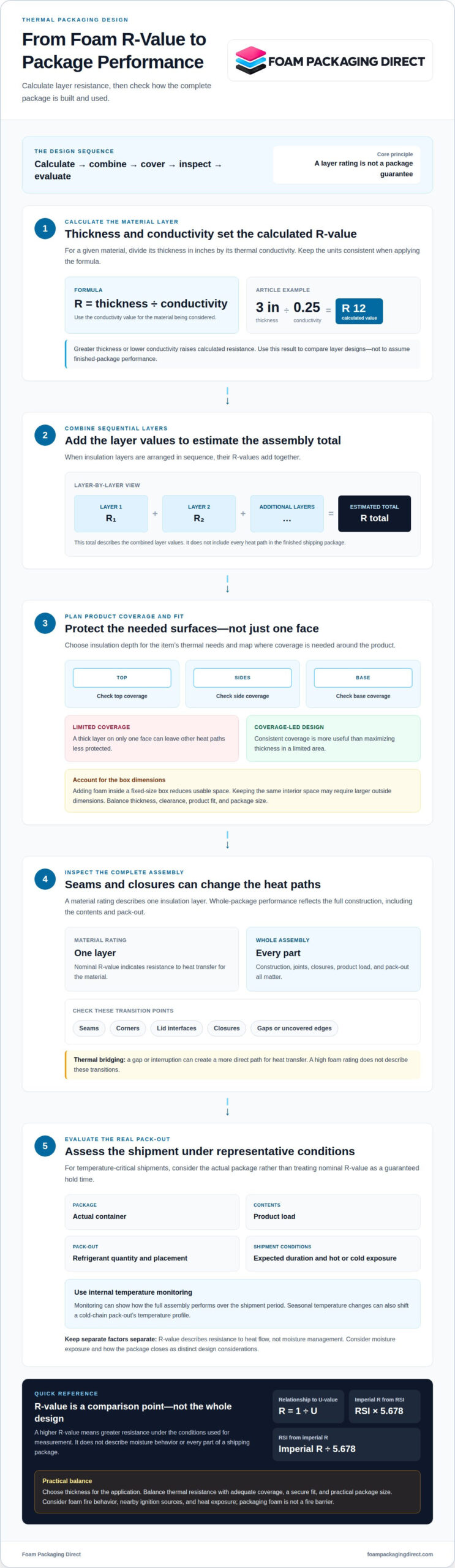
The highest R-value is not automatically the best choice for a shipping package. Packaging foam thermal insulation R value calculations begin with each layer’s resistance to heat flow: divide its thickness by its thermal conductivity. For layers arranged in sequence, add their R-values to estimate the assembly’s total. That figure alone does not show how a finished package will perform.
A higher rating can matter when temperature protection is important, but seams, corners, closures, and packing methods also affect heat transfer. The useful goal is to meet the thermal needs without adding unnecessary bulk or material.
This article explains what R-value measures, how to combine values across layers, and why a material rating may differ from whole-package performance. It also covers practical factors to consider when planning foam thickness and evaluating a temperature-sensitive shipment.
Key Takeaways
- Use insulation thickness and thermal conductivity to understand how a material’s resistance to heat flow is calculated.
- Choose a practical insulation level for the shipment rather than assuming the highest rating is always the best fit.
- Account for seams, corners, closures, and pack-out details when considering how the complete package will perform.
- See how layer values combine, and when custom foam components can help fit insulation to a product and its shipping needs.
Should You Choose the Highest R-Value Available?
Not automatically. The right thickness balances resistance to heat flow with package fit and product coverage. For safety, consider the foam’s fire behavior, nearby ignition sources, and heat exposure. Do not treat packaging foam as a fire barrier.
Calculating Resistance from Foam Thickness
For a given material, divide its thickness in inches by its thermal conductivity to calculate R-value. A three-inch layer with a conductivity of 0.25 calculates to an R-value of 12. This shows how material and thickness work together: lower conductivity or greater thickness raises calculated resistance. Use the result to compare layer designs, not to assume the finished package will perform identically.
Product Thickness and Coverage
Product-specific thickness is the insulation depth selected for an item’s thermal needs; coverage describes how much of the product or package the layer protects. Map the product’s surfaces and identify where insulation is needed, including the top, base, and sides. A thick layer on just one face leaves other heat paths less protected. Consistent coverage is more useful than maximizing thickness in a limited area.
Package dimensions set a practical limit. Adding foam inside a fixed-size box reduces the usable space for the product and other packing materials. Keeping the same interior space instead increases the package’s outside dimensions. For example, adding a layer around a product may require a larger box to maintain clearance and fit. Account for both dimensions before choosing a thickness.
Choose thickness for the application, not the largest available R-value. A higher calculated value may require more room and material, while heat exposure and coverage needs determine what is useful. Compare the calculation with the package construction and product dimensions. An efficient design balances thermal resistance with a secure fit, adequate coverage, and practical package size.
Comparing nominal R-value with whole-assembly performance
A material rating describes one insulation layer, while a shipping package includes joints, closures, and its contents. Packaging foam and building insulation can both be compared by R-value, but a building product’s rating alone cannot predict a shipping package’s thermal performance.
Material Ratings and Package Performance
Nominal R-value measures a material’s resistance to heat transfer; whole-assembly performance reflects every part of the finished package. Seams, corners, lid interfaces, and closures, for example, create heat paths that a foam sample’s rating does not capture. Two packages with insulation of similar nominal value can perform differently if their construction or pack-outs differ. Compare the full assembly, not just the foam layer.
Moisture and Temperature Effects
R-value describes resistance to heat flow, not moisture management. Moisture exposure and thermal performance are separate design considerations, so account for the shipment’s conditions and how the package closes. Temperature matters too: seasonal changes can shift a cold-chain pack-out’s temperature profile. A rating alone does not show how a specific package responds to these conditions.
Thermal bridging occurs when a gap or interruption creates a more direct path for heat transfer. In a shipping assembly, an uneven lid interface or uncovered corner can affect heat loss even when the surrounding foam has a high rating. Review these transitions along with the insulation material, especially where panels meet or the product sits close to an edge.
For temperature-critical shipments, assess the complete pack-out under representative conditions. Consider the actual container, product load, refrigerant quantity and placement, expected duration, and hot or cold exposure. Internal temperature monitoring can show how the assembly performs over the shipment period. This is more informative than treating a nominal value as a guaranteed hold time.
When package construction must account for insulation and product protection together, foam and box packaging can bring those elements into one assembly.
R-value as a measure of thermal resistance
R-value measures how strongly an insulation material resists heat flow. It is the reciprocal of U-value, which measures heat transmission: R = 1 ÷ U. In U.S. customary units, R-value is expressed in ft²·°F·hr/BTU; metric RSI uses m²·K/W. A higher R-value means greater resistance under the conditions used for measurement, but does not describe moisture behavior or every part of a shipping package.
To convert between systems, multiply RSI by 5.678 for imperial R-value. Divide an imperial R-value by 5.678 to get RSI. Keep the units consistent when applying the formula; mixing metric thickness with imperial conductivity produces an invalid result. Temperature is another factor: thermal resistance values depend on test conditions, so compare figures measured on a consistent basis.
ASTM C518 measures heat flow through an insulation sample under steady-state conditions. ISO 8302 and ISO 6946 address measuring or calculating thermal resistance for building components. These named methods clarify what a reported value represents; they don’t establish the performance of a complete shipping assembly. For packaging, use the material figure as a comparison point and consider seams, closures, and coverage separately.
Long-term thermal resistance, or LTTR, addresses aging for insulation board. Its stated method represents a 15-year time-weighted average and estimates resistance at an effective age of 5 years. ASTM C1289 specifies LTTR values for polyiso at a mean temperature of 75°F, with values at 40°F and 110°F available on request. These figures show why test temperature and aging method matter when comparing ratings. Moisture exposure is a separate application factor; R-value alone doesn’t describe how an assembly handles it. For a packaging design, distinguish a tested material value from the thermal resistance required across the shipment’s actual conditions.
Adding R-values across multiple insulation layers
For layers arranged in sequence, add their individual R-values to estimate the assembly’s nominal thermal resistance. Use packaging foam thermal insulation R value calculations to compare layered constructions when the values share compatible units and measurement conditions. The total represents the resistance the layers contribute together, not how the complete package performs under every shipping condition.
Consider a stated insulation example: a one-inch rigid foam board layer has an R-value of 5, and a half-inch drywall layer has an R-value of 0.45. Together, those layers contribute R-5.45 before other components are counted. A separate multi-layer wall example calculates a total R-value of 16.44, showing how additional components change the assembly total.
For a package design, map the planned layers around the product and note where each sits. A continuous inner layer combined with an outer layer can add resistance across covered surfaces. Gaps at joints, corners, or closures create different heat-transfer paths. The arithmetic describes layers in sequence; it does not account for every interruption in the package.
Conductivity also matters when choosing materials. At the same thickness, materials with lower thermal conductivity have higher R-values. Increasing a material’s thickness raises its calculated resistance, but each added layer changes interior clearance or exterior dimensions. Compare the layer total with available space and product fit.
Use the shipment environment to determine what the assembly needs to address. Expected duration, seasonal climate, delays, and temperature exposure affect cold-chain conditions. A higher total alone does not establish hold time; the intended pack-out and refrigerant arrangement matter too.
Planning a layered package around product dimensions and shipping conditions? Request a quote for foam packaging, and include your existing box dimensions and protection requirements.
Foam Packaging Direct
Foam Packaging Direct helps businesses turn insulation requirements into practical packaging designs for their products and shipping conditions. When R-value calculations point to layered protection, custom foam inserts, foam sheets and pads, or foam and box packaging can be designed to fit insulation around the product and limit movement in transit.
Share the product’s dimensions and weight, order quantity, shipping ZIP code, and any available drawings or photos when requesting a quote. Include existing box dimensions and specific temperature or protection requirements, so the proposed packaging can account for both fit and application.
Put Your Insulation Plan Into Practice
The packaging foam thermal insulation R-value calculations you have completed can guide the next design decision, but the package must also fit the product and shipping process. Bring together the product’s dimensions, weight, surface sensitivity, shipping conditions, and order quantity. These details help shape a foam layout that supports protection while accounting for fit and packing needs.
Foam Packaging Direct can translate those requirements into practical packaging, including custom foam inserts, foam end caps, and foam sheets and pads. Share existing box dimensions, drawings, or photos, along with any special protection requirements, when requesting a quote. This context helps assess the packaging application.
Ready to discuss a packaging design for your shipment? Request a quote from Foam Packaging Direct with your product details and shipping ZIP code. A clear starting point can make the next packaging decision easier.
Frequently Asked Questions
What Does R-Value Mean?
R-value describes an insulation material’s resistance to heat flow. A higher value means greater resistance under the conditions used to measure it, but it does not specify a shipment’s hold time. Use the rating to compare material options, then consider package fit, closures, product load, and shipping exposure. These details help distinguish a material rating from the needs of a finished shipping package.
Do insulation R-values add together?
Yes. You can add R-values for layers arranged in sequence to estimate their combined nominal resistance. Keep the units and measurement basis consistent. For example, if a package uses two different foam layers, add their individual ratings only when both values describe comparable conditions. The sum helps compare the planned layers, but does not account for uncovered areas, seams, or the complete pack-out.
How Is Insulation Quantity Calculated?
Estimate insulation quantity from the package surfaces requiring coverage and the dimensions of each foam piece. A simple layout separates the base, sides, and top, then accounts for the coverage each piece provides. For a custom insert, product shape and container dimensions also affect the layout. Allow for overlapping joints or gaps, since they change how much material is needed.
What Is R-Value & Why Does It Matter?
R-value measures resistance to heat transfer and helps compare insulation materials in a packaging design. It gives buyers and engineers a shared reference for assessing layer options. For a temperature-sensitive product, consider it alongside shipment duration, expected climate, and package construction. R-value alone does not indicate whether a product will arrive at a specific temperature or remain cold for a set time.
How do you calculate R-value from packaging foam thickness and thermal conductivity?
Divide foam thickness in inches by thermal conductivity expressed on a compatible basis to calculate R-value. A thicker layer of the same foam increases calculated resistance, while a material with lower conductivity provides more resistance at equal thickness. Check that the conductivity units match the formula. This calculation describes the material layer, not the full package or its hold time.
What are the R-values per inch of EPS packaging foam?
EPS ratings depend on the product type and measurement conditions. ASTM C578 lists a minimum R-value of R-3.6 per inch at 75°F for Type I EPS insulation board. Treat this as a reference for that specific board classification, not as a universal rating for every EPS packaging shape or assembly. Thickness, coverage, joints, and package design also affect the finished system’s thermal behavior.