
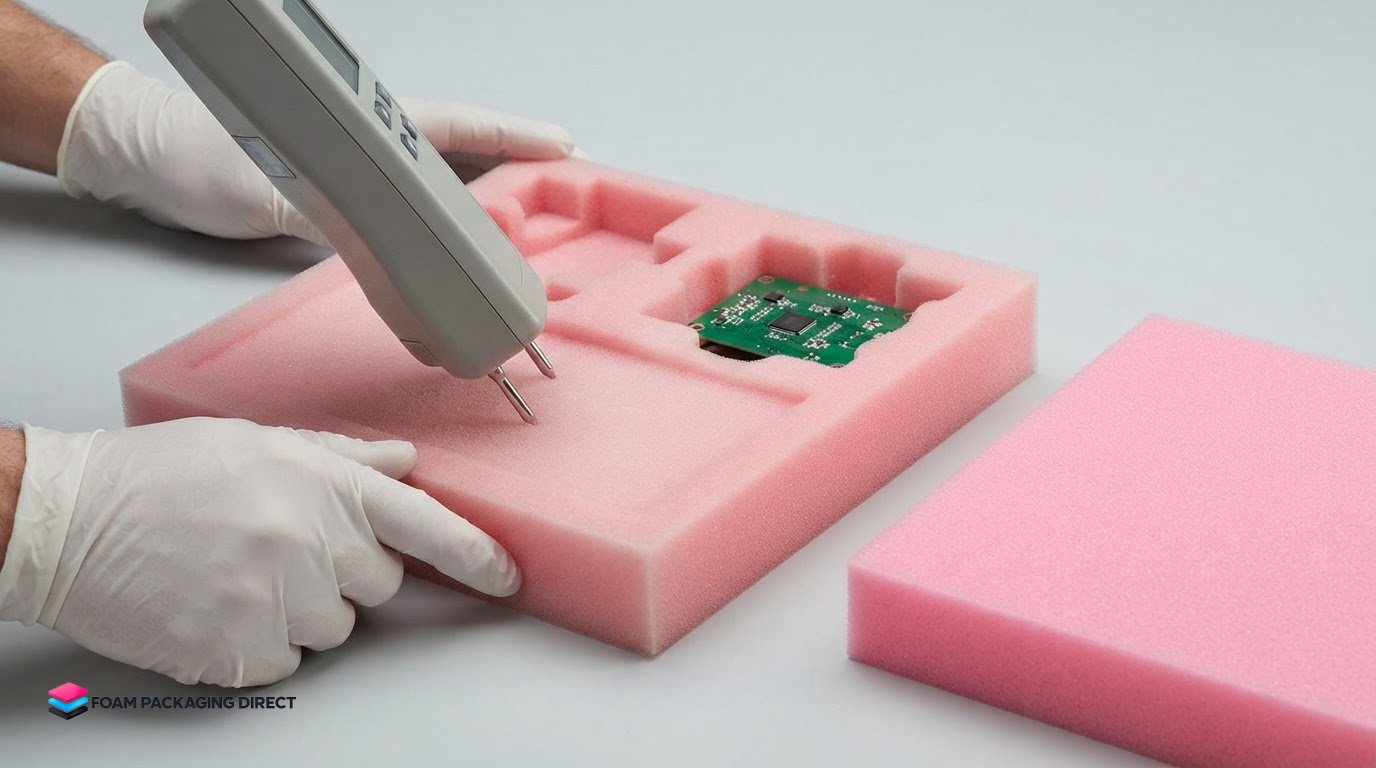
Pink ESD foam can still look usable after its antistatic performance has changed. There is no established expiration guideline for static dissipative pink foam shelf life and amine blooming, although some industry experts consider one year a point to start testing. Humidity, storage conditions, and handling can affect performance without an obvious change in appearance.
It’s reasonable to expect packaging that has protected components before to keep doing so. But pink foam’s antistatic additives can migrate to the surface, a process called amine blooming. Appearance alone can’t confirm that the foam still meets your program’s needs.
This article explains how blooming and environmental exposure can affect pink foam, why there is no fixed shelf-life date, and when testing or a different ESD material may be appropriate. It also explains how to consider pink foam alongside the other packaging controls your compliance program requires.
Key Takeaways
- Learn why pink foam’s color and condition aren’t enough to judge whether it still suits your ESD packaging needs.
- See how storage and handling conditions can affect antistatic performance, and which factors matter when evaluating older material.
- Understand what packaging standards address and why they don’t set a universal shelf-life date for pink foam.
- Explore when alternative ESD materials or custom foam formats may better fit your product and packaging requirements.
Is Pink Foam Helping or Hurting Your ESD Compliance Program?
Pink foam can support an ESD program only while its antistatic performance suits the application. Amine blooming and aging can affect performance without an obvious visual warning.
Factors Affecting Foam Shelf Life
Pink foam shelf life depends on additive migration, storage conditions, handling, and the electrical needs of the packaged product. Antistatic additives are introduced during foam manufacturing, and mobile surfactants can migrate toward the surface. The foam may retain its pink color even when its static properties no longer suit the application. Assess function, not color alone.
Environmental Effects on Foam Aging
Environmental aging refers to changes caused by humidity, surrounding conditions, and repeated handling over time. These factors can affect how quickly surfactant molecules become saturated and lose their antistatic effect. Foam stored in a humid area may behave differently from foam stored elsewhere. Frequent handling also exposes foam to changing conditions and contact, which can affect performance.
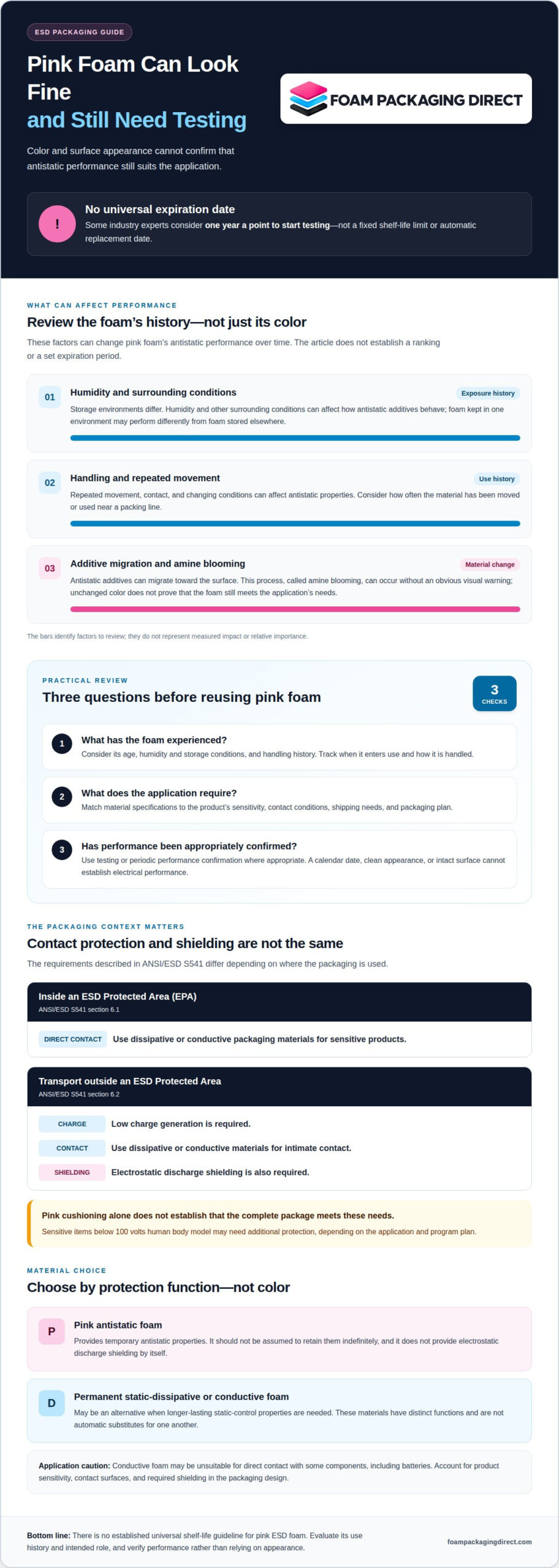
Compliance depends on where packaging is used and what it touches. ANSI/ESD S541 section 6.1 calls for dissipative or conductive packaging materials for direct contact with sensitive products inside an ESD Protected Area. For transport outside an EPA, section 6.2 requires low charge generation, dissipative or conductive materials for intimate contact, and electrostatic discharge shielding. Pink cushioning alone doesn’t establish that the complete package meets these needs.
Use this distinction when utilizing foam for a shipment. A component contacting pink foam inside an EPA needs suitable contact protection. An item transported outside an EPA also needs shielding. Sensitive items below 100 volts human body model may need additional protection, depending on the application and program plan. A visible bubble or intact surface can’t demonstrate electrical performance.
Humidity and environmental effects on antistatic properties
Humidity can affect how long pink foam’s antistatic treatment remains useful. Antistatic additives are introduced during foam manufacturing. Mobile surfactants, often based on fatty acids and amides or amines, can migrate toward the surface. Environmental conditions and handling can affect the foam’s antistatic performance over time. Humidity, surrounding conditions, and handling influence this process. For electronics packaging, storage exposure is part of the material’s history and can affect performance.
Amine blooming describes the migration of amine-based additives toward the foam surface. It is one way an antistatic treatment can change over time. Don’t treat color or surface appearance as a reliable performance indicator: pink foam may lose ESD protective properties without an obvious visual change. A clean-looking piece may no longer have the static properties needed for its application. Likewise, a visible change alone doesn’t establish the foam’s electrical performance.
Consider the foam’s full use history, not just how long it has been in a box. A roll stored in one environment may experience different humidity and handling from foam kept near a packing line. Repeated movement, contact, and exposure can affect its antistatic properties. Periodically confirming packaging-material performance can help identify changes that appearance can’t reveal. The material’s required function and the packaging plan determine what performance matters.
Pink anti-static foam provides temporary antistatic properties, so don’t assume it will retain them indefinitely. For electronics, match the material specifications to the product’s sensitivity, contact conditions, and shipping needs. Anti-static cushioning and conductive materials serve different roles, so they aren’t automatic substitutes. Permanent static-dissipative or conductive foams may be alternatives when pink foam’s temporary properties don’t suit the application. Choose material for the protection required, not by pink color alone.
Pink ESD foam shelf life
There is no established guideline for how long pink ESD foam’s antistatic properties last. Some industry experts consider one year a point to start testing, not a universal expiration date. Actual performance depends on humidity, environment, and handling. Foam stored carefully may age differently from material repeatedly moved or exposed during production. A calendar date alone can’t show whether packaging still suits sensitive components.
Use pink foam as a short-term solution, especially when a package protects components during storage or shipment. Track when the foam enters use and how it is handled. This history helps identify material that has been in service longer or experienced changing conditions. Remember, a pink surface can look unchanged even after its ESD protective properties have declined.
A practical review of static-dissipative pink foam shelf life and amine blooming should consider the foam’s role in the complete packaging system. Pink cushioning may help limit charge generation around a product, but it does not provide electrostatic discharge shielding by itself. A sensitive device shipped outside an ESD Protected Area may need shielding in addition to suitable contact material. Friction, contact, and separation during packing can also affect charge generation.
Permanent static-dissipative or conductive foam may be an alternative when longer-lasting static-control properties are needed. These materials serve distinct functions, so selection depends on the product and protection plan. Conductive foam may be unsuitable for direct contact with some components, including batteries. The packaging design must account for product sensitivity, contact surfaces, and required shielding.
A practical decision considers age, exposure history, and intended application. The manufacturing date alone does not establish present performance, and appearance can’t replace an appropriate evaluation. If pink foam remains in use, include its age and storage conditions in the packaging review. For sensitive electronics, the key question is whether the foam still meets its assigned role, not simply whether it remains intact.
What standards or manufacturer guidance specify shelf life for anti-static packaging foam?
ANSI/ESD S541 addresses packaging requirements, but it does not establish a universal shelf-life date for pink anti-static foam. Sections 6.1 and 6.2 distinguish packaging used inside and outside an ESD Protected Area. Section 6.1 addresses direct contact with sensitive products inside an EPA. Section 6.2 addresses transport outside an EPA, including low charge generation, suitable contact materials, and electrostatic discharge shielding. These provisions describe packaging performance, not a foam expiration calendar.
ANSI/ESD S20.20 also appears in the context of packaging for sensitive items inside an ESD Protected Area. The cited S541 sections help distinguish what the package must do in each location. Neither section supplies a set age at which pink foam automatically fails. That distinction matters for inventory decisions: a roll’s age alone cannot determine whether its properties remain suitable. Packaging plans need to account for the assigned function and verify material performance.
ESD TR53-01-06 covers compliance verification of ESD protective equipment and materials. It is relevant to evaluating packaging performance, rather than assigning a shelf-life period. Periodic confirmation is recommended because packaging materials vary widely. Users should develop a verification plan suited to their materials and uses. For example, the plan can identify which packaging material is in scope, its intended contact or shielding role, and when performance is reevaluated.
There is no established guideline for how long pink anti-static foam takes to lose its antistatic properties. Some industry experts consider one year a point to start testing. Treat this as a prompt to test, not a universal expiration rule. A practical review records foam age, humidity exposure, handling, and application, then compares findings with program requirements. If a material no longer supports its assigned role, consider another packaging material, such as permanent static-dissipative or conductive foam.
Foam Packaging Direct: Anti-Static Foam
Foam Packaging Direct can help match anti-static foam packaging to your product and shipping needs. Consider custom packaging when pink foam’s age or changing performance raises questions, or when designing packaging for sensitive components. The right format depends on product weight, fragility, dimensions, surface sensitivity, and shipping conditions.
Custom foam inserts, foam end caps, and foam sheets and pads can cushion products and reduce movement inside a package. Anti-static foam provides cushioning with antistatic properties; conductive foam is a different material and isn’t interchangeable. Neither type alone establishes compliance for a complete package. The packaging design must suit the product’s ESD protection requirements.
To discuss a suitable option, contact Foam Packaging Direct with your product dimensions, weight, quantity, shipping ZIP code, and any available drawings or photos. Include existing box dimensions and special protection requirements, if applicable.
Choose the Next Packaging Step
Use your ESD program’s requirements to guide the next packaging decision. If the storage history or intended role of existing foam is uncertain, consider the component’s sensitivity, contact surfaces, and shipping conditions. Reviewing static-dissipative pink foam shelf life alongside amine blooming can help clarify whether the current material still fits the job or a different design is more appropriate.
Foam Packaging Direct offers custom foam inserts, foam end caps, and foam sheets and pads for protective packaging applications. Share your product dimensions, weight, quantity, shipping ZIP code, and any available drawings or photos when requesting a quote. Include existing box dimensions and special protection requirements if they apply. Contact Foam Packaging Direct to discuss packaging options for your application and take a practical next step.
Frequently Asked Questions
What material is static-dissipative pink foam packaging made from?
Pink static-dissipative foam packaging can be made from polyethylene (PE) foam or polyurethane (PU) foam. Each uses antistatic treatment, while the foam base affects cushioning and fit. For example, an insert holding electronic components should suit their weight, shape, and contact requirements. Pink color alone doesn’t identify the foam base or establish that the complete package provides the protection an application requires.
What is the typical shelf life of pink anti-static foam?
There is no established universal shelf-life period for pink anti-static foam. Some industry experts consider one year the point to start testing, rather than a fixed expiration date. Track when foam enters inventory and its intended use so older material can be considered during packaging reviews. Its suitability depends on storage conditions, handling, and the application’s electrical requirements.
How should pink static-dissipative foam be stored to maximize shelf life?
Limit humidity exposure and unnecessary handling, since both can affect the foam’s antistatic performance. Keep storage conditions consistent and record when material enters inventory, where it is stored, and when operators begin using it. This history can help distinguish older stock from recently received material during an ESD packaging review. Don’t use color or an intact surface as proof that the foam remains suitable.
Does pink anti-static foam lose its static-dissipative properties over time?
Yes, pink anti-static foam can lose antistatic properties over time. This matters when packaging is expected to control charge around sensitive electronics. For example, foam used repeatedly in a packing operation may have a different exposure and handling history from unused stock. Evaluate whether it still suits its assigned role rather than assuming material from the same batch performs identically.
What is amine blooming in polyethylene foam?
Amine blooming in polyethylene foam is the migration of amine-based additives toward the foam’s surface. It describes a change in where additives are located, not a shelf-life date. In packaging applications, the key question is whether the material still performs its intended function. A surface change may prompt closer evaluation, but appearance alone doesn’t establish the foam’s electrical properties.
Can amine blooming occur in pink static-dissipative foam, and what causes it?
Yes, amine blooming can occur in pink static-dissipative foam when mobile antistatic additives migrate toward the surface. Humidity, surrounding conditions, and handling can affect how quickly additives become saturated and lose their antistatic effect. Foam may show no obvious visual change as performance declines. Consider its exposure and use history alongside its packaging role, especially for sensitive electronic components.