
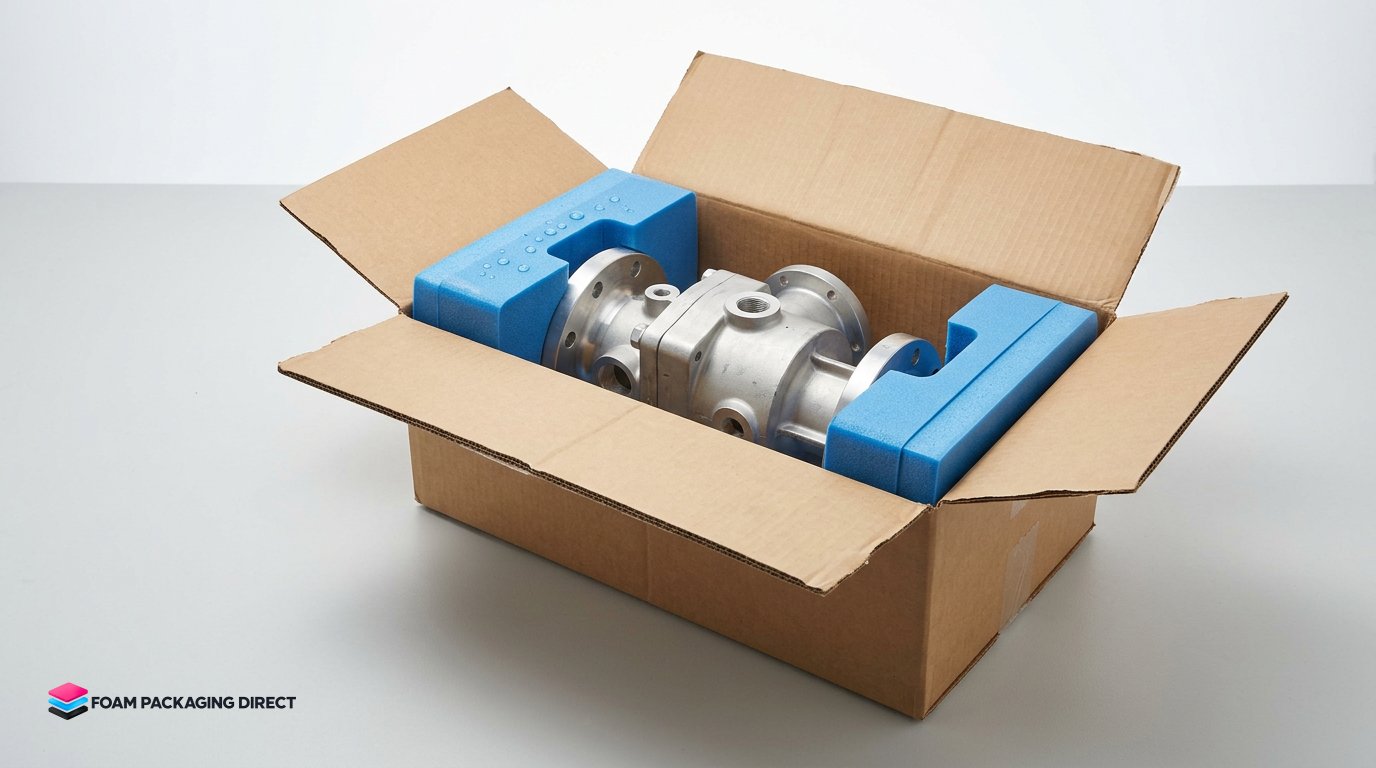
Closed-cell foam resists water, but its structure does not make every package waterproof. Its separate cells limit water absorption and slow moisture-vapor movement through the material. Understanding closed cell foam water absorption and moisture barrier properties helps you assess what foam can protect against and where packaging design still matters.
It is reasonable to expect moisture-resistant foam to help keep a product dry, but resistance is not the same as a complete seal. Edges, closures, and exposure conditions all affect how well a package protects its contents. This article explains how closed-cell structure affects water and vapor, compares it with open-cell foam and other packaging materials, and outlines what to consider when selecting foam for products exposed to damp shipping or storage conditions.
Key Takeaways
- Distinguish water resistance from a fully sealed package, and account for seams, openings, and exposure conditions.
- Use vapor-permeance ratings and material thickness to understand how much moisture vapor a foam can limit.
- Compare closed-cell and open-cell structures against the product’s moisture exposure and protection needs.
- Choose packaging foam based on product weight, fragility, surface sensitivity, and shipping conditions, not moisture resistance alone.
Closed-cell foam water resistance
Closed-cell foam resists water because its compact structure limits pathways into the material. In shipping and storage, that resistance can help protect products in damp conditions, but it does not make every package watertight.
Waterproof, Water-Resistant, and Watertight Terms
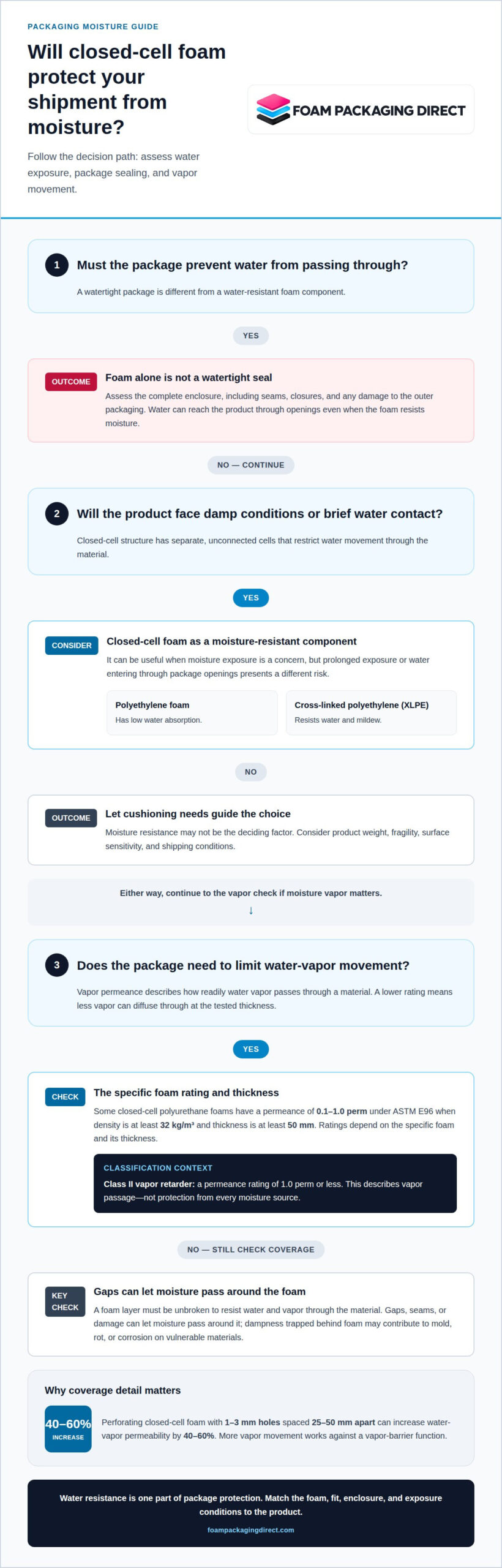
Waterproof means a material resists water penetration under relevant conditions. Water-resistant means it limits penetration, while watertight describes a seal that prevents water from passing through. These terms are not interchangeable. For example, a polyethylene foam component may resist moisture while a gap between it and the box still lets water reach the product. Understanding the difference helps set realistic packaging expectations instead of treating foam as a complete barrier on its own.
Closed-Cell Structure and Water Resistance
Closed-cell foam contains separate, unconnected cells that restrict water movement through the material. Unlike open-cell foam, it does not have the same connected pathways for water to travel through. This makes closed-cell materials useful when moisture exposure is a concern, such as in protective packaging for equipment shipped through damp environments. The structure can also limit air movement, but a suitable design is still needed to protect package edges and openings.
Water resistance and water absorption are related but describe different properties: resistance limits water entry, while absorption describes how much water the foam takes up. Polyethylene foam has low water absorption, and cross-linked polyethylene (XLPE) foam resists water and mildew. These properties can help preserve protective performance after brief contact with water, but prolonged exposure or water entering through package openings presents a different risk.
Closed-cell spray foam is used as insulation, where limiting moisture movement can help retain thermal performance after brief water contact. Packaging has different demands: foam must fit the product and box, support the product, and reduce movement. XLPE can be suitable when water and mildew resistance matter, while the required protection depends on the product’s surfaces and shipping conditions.
Foam alone cannot make a package watertight if water can enter through seams, closures, or damaged outer packaging. For example, a moisture-resistant foam insert can cushion a component inside a closed box, but it does not replace a sealed package. Assess the foam’s water resistance alongside the enclosure and exposure conditions to avoid overestimating what the material can protect against.
Closed-cell foam vapor permeance and vapor-retarder classifications
Closed-cell foam slows water-vapor movement because its structure limits pathways through the material. Moisture can still get behind the foam through gaps or a damaged enclosure. Trapped dampness may contribute to mold, rot, or corrosion on vulnerable materials.
Moisture Vapor Permeability
Moisture vapor permeability describes how readily water vapor passes through a material. A lower vapor-permeance rating means less vapor can diffuse through the foam at the tested thickness. For example, some closed-cell polyurethane foams have permeance of 0.1-1.0 perm under ASTM E96 when density is at least 32 kg/m³ and thickness is at least 50 mm. The rating depends on the specific foam and its thickness.
Some spray-applied polyurethane products with permeance below 1 perm qualify as vapor retarders. Closed-cell spray foam is often described as Class II, but that description doesn’t establish the rating of every product. Temperature differences can drive vapor toward cooler surfaces, so the material’s permeance matters when limiting moisture movement through an assembly.
Water and Vapor Barriers
A water barrier limits liquid water, while a vapor barrier limits water vapor moving through a material. Closed-cell foam can resist both, but the layer must be unbroken: gaps, seams, or damage can let moisture pass around it. In packaging, this means a foam component may resist vapor without making the complete package sealed.
Can perforation change performance? Yes. Perforating closed-cell foam with 1-3 mm holes spaced 25-50 mm apart can increase water-vapor permeability by 40-60%. That may allow more vapor movement, which works against a vapor-barrier function. The change illustrates why a durable cell structure and intact coverage are relevant to the intended moisture protection.
A Class II vapor-retarder classification uses a permeance rating of 1.0 perm or less. It describes vapor passage, not protection from every moisture source. In a shipment, for example, moisture may enter at a box closure even when an interior foam part has low permeance. Consider the foam, enclosure, exposure, and required protection together.
Comparison with XPS, polyiso, EPS, and open-cell foam
XPS, polyiso, and EPS are distinct insulation materials, so their names alone do not determine moisture performance. Compare the specific product, intended thickness, and exposure conditions rather than assuming all closed-cell materials are interchangeable. For commercial packaging, choose foam that cushions the item and suits its shipping environment. Thermal insulation comparisons do not automatically predict how foam will protect a product in a box.
Cell structure explains the difference between open-cell and closed-cell foams. Open-cell foam is more porous, allowing air and moisture to pass through more readily. Closed-cell foam has separate cells and is less likely to absorb water. It is therefore a stronger candidate when moisture resistance matters, while open-cell foam’s airflow can suit applications where permeability is useful.
Density also distinguishes the two: closed-cell foam typically exceeds 1.75 pounds per cubic foot, compared with around 0.5 pounds per cubic foot for open-cell foam. Closed-cell foam is about four times denser. Density alone doesn’t establish package performance, but it’s one factor alongside product weight, fragility, and the required cushioning. A dense material may suit a different protective design than a softer, more porous foam.
Open-cell spray foam can absorb significant amounts of water, making it less suitable for damp conditions than closed-cell foam. At a typical thickness of 5 inches, open-cell spray polyurethane foam has a vapor permeance of 5 to 10 perms, depending on the product. That allows more vapor movement than a low-permeance closed-cell option. In an exterior insulation assembly, outward drying may be useful; for a moisture-sensitive shipment, limiting water entry may matter more.
For packaging, choose material based on the job. Consider whether the product needs impact cushioning, moisture resistance, thermal insulation, or a combination. Polyethylene and cross-linked polyethylene are closed-cell packaging options; open-cell foam offers a different balance of airflow and cushioning. Thickness and fit also affect how well foam supports the product and limits movement in transit.
Closed-cell foam water absorption
Water-absorption test results describe a material under specific conditions, not every shipping situation. Understanding closed cell foam water absorption and moisture barrier properties helps distinguish measured uptake from moisture that reaches a product through package openings.
Water Absorption Test Measurements
ASTM D2842 measures water absorbed by foam under defined test conditions, with results expressed by volume for the cited measurements. High-performance closed-cell spray foams typically absorb less than 1% by volume in the cited test, while other high-quality closed-cell foams absorb less than 3% by volume after 24-hour immersion. These are separate reported results, not a specification for every foam grade.
A test result is useful when its material and conditions match the application. It does not provide a weight-based figure unless reported that way. When comparing data for procurement, keep the foam type and measurement basis together rather than treating volume and weight percentages as interchangeable.
Performance After Prolonged Water Exposure
Prolonged water exposure raises a different question from a brief absorption test: how the material behaves over the actual duration and conditions of contact. A test result alone cannot describe every shipping environment, including repeated wetting or water held against a packed item.
For a shipment, assess the complete protective arrangement, including the outer package and the foam’s position. Measured water uptake helps inform material selection, while the exposure route and duration help define the application’s needs.
Factors Affecting Water Absorption
Foam type, thickness, density, cell consistency, and fit all matter when evaluating water uptake. Test data applies to the sample and method tested; thickness or density alone doesn’t establish an absorption percentage. Neoprene closed-cell foam used in composite applications has more than 95% closed-cell content, helping prevent water ingress.
Accurate sizing and placement matter because water can travel around a foam component rather than through it. Consider exposed edges, cutouts, and the space between the foam and the product. Together with the material’s measured results, these details help determine whether the closed cell foam water absorption and moisture barrier properties suit the shipping conditions.
Foam Packaging Direct
Foam Packaging Direct helps businesses select protective foam packaging for products that need cushioning and controlled movement during shipping. When moisture exposure is a concern, foam selection should also account for product weight, fragility, dimensions, surface sensitivity, and package design.
Custom foam inserts and tote or tray inserts hold components in defined positions. Foam sheets and pads provide separation or cushioning, while rolls and wrap can protect surfaces and help group items. The right format depends on how the product is packed and the protection it needs.
To request a quote, send your product dimensions, weight, order quantity, shipping ZIP code, and any available drawings or photos. Include existing box dimensions and special protection requirements if they apply. Contact Foam Packaging Direct to discuss a packaging fit for your application.
Plan Packaging Around Your Product
Use the closed cell foam water absorption and moisture barrier properties discussed here as one factor when defining packaging requirements. Consider how the product will be handled, what needs cushioning, and which surfaces need support. Clear priorities make it easier to design packaging around the item’s actual shipping demands.
Once those requirements are defined, the next step is to turn them into a practical packaging design. Request a quote to get started.
Frequently Asked Questions
Chapter 1: What is the principle behind closed cell foam?
Closed-cell foam cushions by using enclosed pockets that deform under pressure and help distribute contact across the product. In a shipping insert, pocket shape and support points matter as much as the foam itself. A cavity cut too loosely can allow movement, while a well-fitted cavity can hold the item in position. The design should match the product’s shape and fragile areas.
How much water does closed-cell foam absorb by volume or weight?
There’s no single absorption amount that applies to every closed-cell foam. The result depends on the specific grade and how the test reports uptake. When reviewing a specification, keep the foam’s exact material designation with the measurement basis, such as volume or weight. That makes comparisons more meaningful and helps avoid applying one product’s result to a different foam.
Does closed-cell foam act as a vapor barrier or only an air barrier?
Some closed-cell foam products can limit water-vapor movement as well as airflow, but these describe different forms of movement. For packaged goods, a vapor-related rating alone does not show how contents respond to temperature changes inside the package. Consider the product’s sensitivity, the shipping environment, and the complete enclosure when deciding what moisture control the package needs.
How do closed-cell foam moisture properties compare with open-cell foam and rigid foam boards?
The best comparison depends on the packaging task, not just the material category. Rigid foam boards, flexible foam, and open-cell foam differ in form and in how they can be shaped around an item. An irregular component, for example, may need shaped support at specific contact points. Consider the product’s dimensions, weight, surface sensitivity, and packing method alongside its moisture-protection needs.