
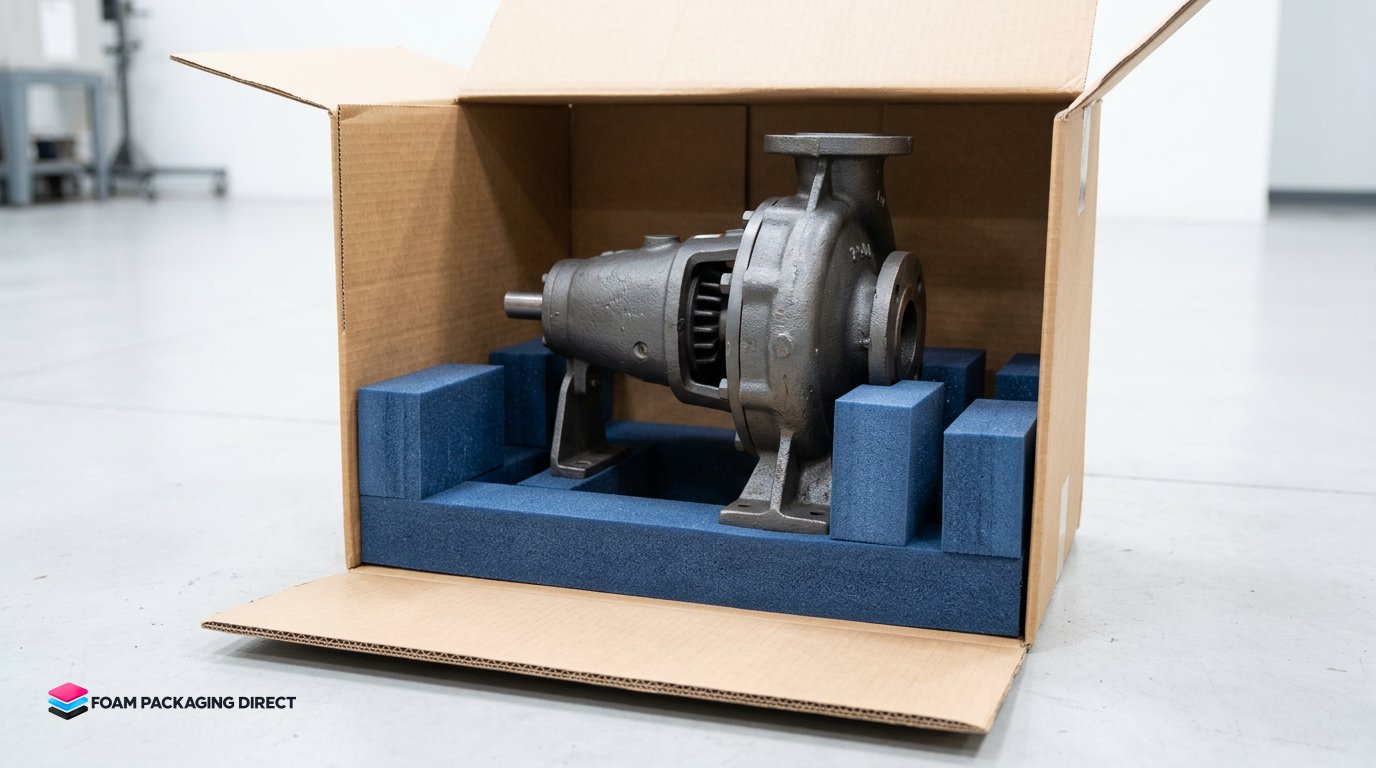
A heavier item needs more than a thick foam block. For extruded polyethylene foam planks for heavy blocking, the listed density for laminated polyethylene planks is 2.3 lb/ft³, but density alone doesn’t determine whether the foam will support and cushion a specific product. The fit also depends on the item’s weight, shape, contact points, and shipping conditions.
It’s reasonable to look at color and thickness first when you need a practical blocking material that’s easy to work with. But those visible details don’t answer every important question about cushioning, flammability, or toxicity.
This guide explains how density relates to blocking and shock absorption, what color can and can’t tell you, and why flammability and toxicity should be considered separately from cushioning performance. You’ll also learn how product weight, surface sensitivity, and packing method can help you narrow down a suitable material and configuration.
Key Takeaways
- Use density as one factor in selecting blocking; product weight, contact points, and shipping conditions also shape the right fit.
- Color alone doesn’t tell you whether foam is suitable for an application’s flammability or toxicity requirements.
- According to the United States Environmental Protection Agency, recycled polyethylene foam withstood repeated shock impacts with as little as 12 percent decay in cushioning properties.
- Compare polyethylene, expanded polyethylene, polyurethane, and wood by the protection and practical handling your packaging needs.
Flammability and toxicity
Flammability and toxicity are separate from cushioning performance. A polyethylene plank’s density, color, and thickness don’t establish either property. For example, color alone doesn’t show that a blue plank and a white plank have different fire behavior.
Start by defining the package’s actual safety concern. Does the product need a documented flammability characteristic, or is the question about possible exposure during ordinary packing and handling? These questions require different product information. The material’s LDPE composition identifies its base polymer, but that name alone answers neither question. Don’t treat color, density, or the word “polyethylene” as a substitute for material-specific safety information.
- For fire-related screening: Identify the exact foam construction and request applicable flammability information for that material.
- For toxicity questions: Ask about the specific composition and intended handling conditions, rather than inferring safety from appearance.
- For packaging design: Keep the foam away from heat sources unless the application’s material information supports the planned conditions.
Temperature capability is not the same as flammability performance. The manufacturer states that this polyethylene foam can reach temperatures up to 200 degrees Fahrenheit. That figure doesn’t establish ignition behavior, smoke characteristics, or suitability for a particular fire-related requirement. Similarly, limiting direct sunlight exposure to no more than 3 hours per day is a sunlight recommendation, not a toxicity statement.
Use a simple sequence: identify the foam construction, define the exposure concern, then review material-specific information for that concern. If the package also needs anti-static cushioning, treat that as a separate selection requirement. Anti-static properties don’t establish flammability or toxicity. Keeping these checks separate helps prevent a cushioning choice from being mistaken for a safety determination.
Foam sheets for packaging heavier items
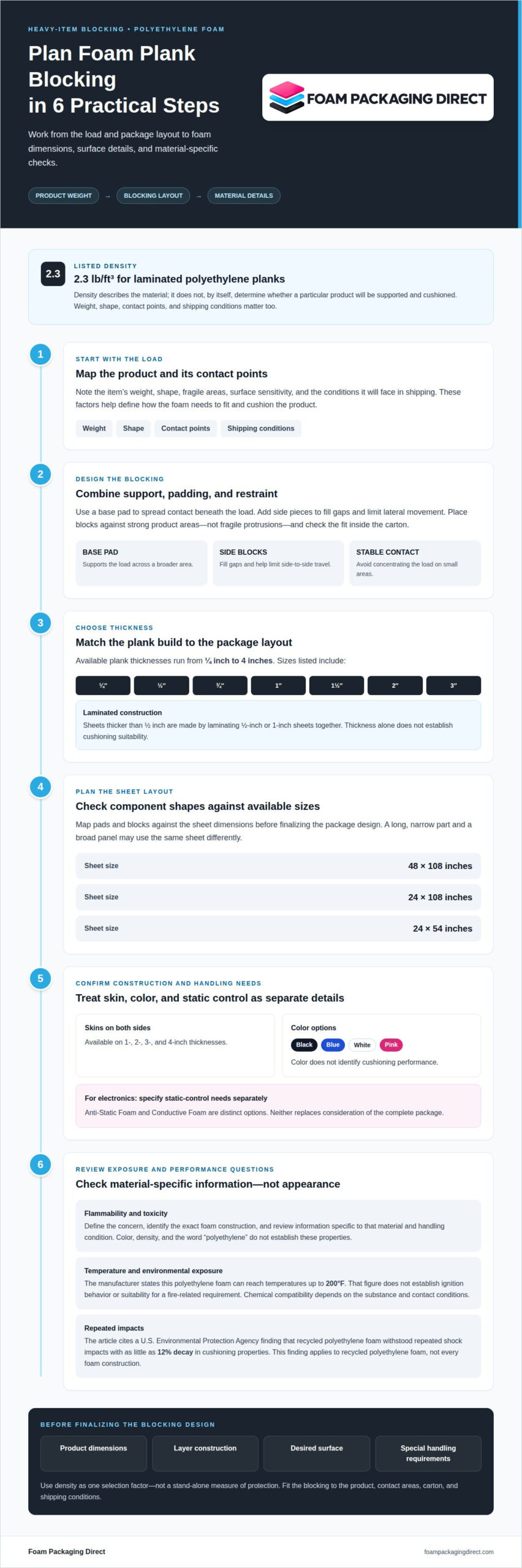
Laminated polyethylene planks have a listed density of 2.3 pounds per cubic foot. That measurement describes the material, but it doesn’t determine the best sheet format for every product. Start with the package layout: note which faces need coverage, how much room the foam can occupy, and whether the design calls for flat pads or fitted pieces. These details help align the foam format with the packaging design.
Plank thicknesses range from 1/4 inch to 4 inches, including 1/2, 3/4, 1, 1-1/2, 2, and 3 inches. Sheets thicker than 1/2 inch are made by laminating 1/2-inch or 1-inch sheets together. This gives packaging designers thickness options assembled from laminated layers. For example, a design needing a thicker side panel can use a laminated section rather than relying on one thin sheet.
Available sheet sizes are 48 by 108 inches, 24 by 108 inches, and 24 by 54 inches. These formats affect how a layout can be nested and how much trimming a design may require. Map the package components against the sheet dimensions before finalizing the layout. A long, narrow part and a broad panel may use the same sheet differently, even when their foam thickness matches.
Surface details also vary across the available material. Only 1-inch, 2-inch, 3-inch, and 4-inch thicknesses have skins on both sides. Color options include black, blue, white, and pink, but color doesn’t identify the foam’s cushioning performance. Choose based on the construction and package design, not appearance alone.
For electronics, consider the cushioning layout separately from static-control needs. Anti-Static Foam and Conductive Foam are distinct options, and neither replaces consideration of the complete package. Before finalizing a blocking design, document the dimensions, layer construction, desired surface, and any special handling requirements.
Packaging, padding, and shock absorption
A protective package needs to cushion impacts and keep a heavy product positioned during handling. Effective blocking combines contact area, padding, and restraint.
Packaging and Padding Uses
Polyethylene foam cushions a product inside its outer package and can also form blocks that limit movement. For a heavy assembly, a base pad spreads contact beneath the load, while side pieces fill gaps and limit lateral travel. Position blocks against strong product areas, not fragile protrusions. Match pad dimensions and block placement to the item’s weight, shape, and box interior. This layout helps prevent direct carton contact and supports consistent packing.
Shock Absorption
Temperature, moisture, chemicals, and repeated impacts affect polyethylene foam in different ways. The manufacturer states that this foam does not absorb water and does not mold, rot, or mildew. It can reach temperatures up to 200 degrees Fahrenheit. Chemical exposure depends on the substance and contact conditions, so material compatibility matters for the actual shipping environment.
Repeated impacts also matter. According to the United States Environmental Protection Agency, recycled polyethylene foam withstood repeated shock impacts with as little as 12 percent decay in cushioning properties. That finding concerns recycled polyethylene foam, not every foam construction. For a package exposed to recurring handling, consider impact frequency alongside product fragility and cushioning placement.
Load Support and Securing
To limit shifting, support the load across broad, stable contact areas rather than isolated points. Place blocks beneath structural areas, then add side restraint to control movement inside the box. A concentrated load on a small foam area can compress it more than a broad base would. Check the fit between product, blocks, and carton so the load has little room to slide during transit.
For example, a machine with a broad base and projecting feet needs support beneath its stable frame, not just under the feet. Keep blocks snug without pressing on delicate surfaces. The base should carry the weight, while side blocks restrict movement.
How do polyethylene foam planks compare with expanded polyethylene foam, polyurethane foam, and wood blocking?
Choose blocking by matching the material to the load and protection needs. Polyethylene, expanded polyethylene, polyurethane, and wood behave differently under contact and movement.
Polyethylene planks: The laminated polyethylene planks discussed here have a listed density of 2.3 pounds per cubic foot. They provide firm padding and can be arranged as base or side blocks. Their usefulness depends on product geometry, load distribution, and the package’s required cushioning. For a heavy assembly, plan broad support and separate restraint rather than relying on density alone.
Expanded polyethylene: Expanded polyethylene, often called EPE, is polyethylene expanded into a cellular form. Don’t assume it performs exactly like a laminated plank. Compare the specific product’s cushioning behavior, shape, and fit with the item. A molded EPE piece, for example, may follow a product contour, while a plank can provide a straightforward blocking face.
Polyurethane: Polyurethane foam is a distinct material, not another name for polyethylene. It may suit packaging that needs a different cushioning feel or closer conformity around a product. Consider surface sensitivity and compression needs. A delicate finished surface may need a softer contact layer, while a heavy part may need firmer support beneath its structural areas.
Wood blocking: Wood provides rigid restraint and can hold a load in position, but it doesn’t cushion impact like foam padding. Direct wood contact may require an added protective layer for finished or sensitive surfaces. In a mixed design, wood can restrain a heavy item while foam separates it from contact points.
Compare the options by asking what must carry weight, absorb shock, protect the surface, and prevent movement. If the package needs both cushioning and restraint, include the product dimensions, weight, and box layout when requesting a foam packaging quote.
Foam Packaging Direct: Polyethylene Foam
Foam Packaging Direct helps businesses create practical foam protection for heavier products. Choose Custom Foam Inserts when a part needs shaped support, or Foam Sheets & Pads for broad cushioning and blocking. Foam Rolls and Foam Wrap can add a protective layer around surfaces before an item is secured inside its package.
The right format depends on product weight, dimensions, surface sensitivity, and shipping conditions. Existing box dimensions and the locations that need support help shape the packaging layout. Drawings or photos can clarify contact points and areas that should remain clear.
To request a quote, send the product dimensions and weight, order quantity, shipping ZIP code, and any available drawings or photos. Include existing box dimensions and special protection requirements if they apply. Contact Foam Packaging Direct to discuss polyethylene foam packaging for your application.
Plan the Next Packaging Step
The best blocking layout starts with the product’s handling needs, not a foam choice made in isolation. Before specifying extruded polyethylene foam planks for heavy blocking, consider where the item bears weight, which surfaces need protection, and how the package should limit movement.
Foam Packaging Direct offers Custom Foam Inserts, Foam End Caps, and Foam Sheets & Pads to support different packaging layouts. A drawing or photo can help show contact points, clearances, and areas that need extra protection. Include your product dimensions, weight, order quantity, shipping ZIP code, and existing box dimensions when available.
Use those details to describe the packing challenge clearly and move toward a suitable configuration. Contact Foam Packaging Direct to request a quote and share your product information. A clear starting point makes it easier to discuss the protection your shipment needs.
Frequently Asked Questions
What is extruded polyethylene foam plank and what applications is it designed for?
Polyethylene foam plank is cushioning stock shaped into blocks, pads, or other protective components. For heavy machinery or industrial parts, extruded polyethylene foam planks for heavy blocking can support products, fill space, and limit movement during shipping or storage. A part may use foam beneath its base and along its sides. The layout depends on the item’s geometry, contact points, and protection needs.
What density and compression strength are available in polyethylene foam planks for heavy blocking?
The laminated polyethylene plank has a listed density of 2.3 pounds per cubic foot. Density identifies mass per volume, but it isn’t a compression-strength rating and doesn’t specify how much load a block will support. When selecting extruded polyethylene foam planks for heavy blocking, consider how the product’s weight meets the foam, whether contact is broad or concentrated, and how the packaging restrains movement during transit.
Can polyethylene foam planks be cut, laminated, or fabricated for custom blocking?
Yes. Custom foam components can be precision-cut, routed, die-cut, laminated, and bonded to suit a product and container. For example, a design can pair a base pad with shaped side blocks or include a cutout that holds a part in position. Custom products are made to the required dimensions and shapes, with a prototype or sample approved before production begins.
What safety and fire-rating requirements apply to polyethylene foam used for blocking or packaging?
Requirements depend on the application and any fire-rating specification attached to the shipment or facility. Polyethylene foam’s material name, color, or density alone doesn’t establish a fire rating or toxicity profile. Identify the required rating or documentation and intended use, then compare the foam information with that requirement. A foam component by itself doesn’t establish compliance for the complete package.