
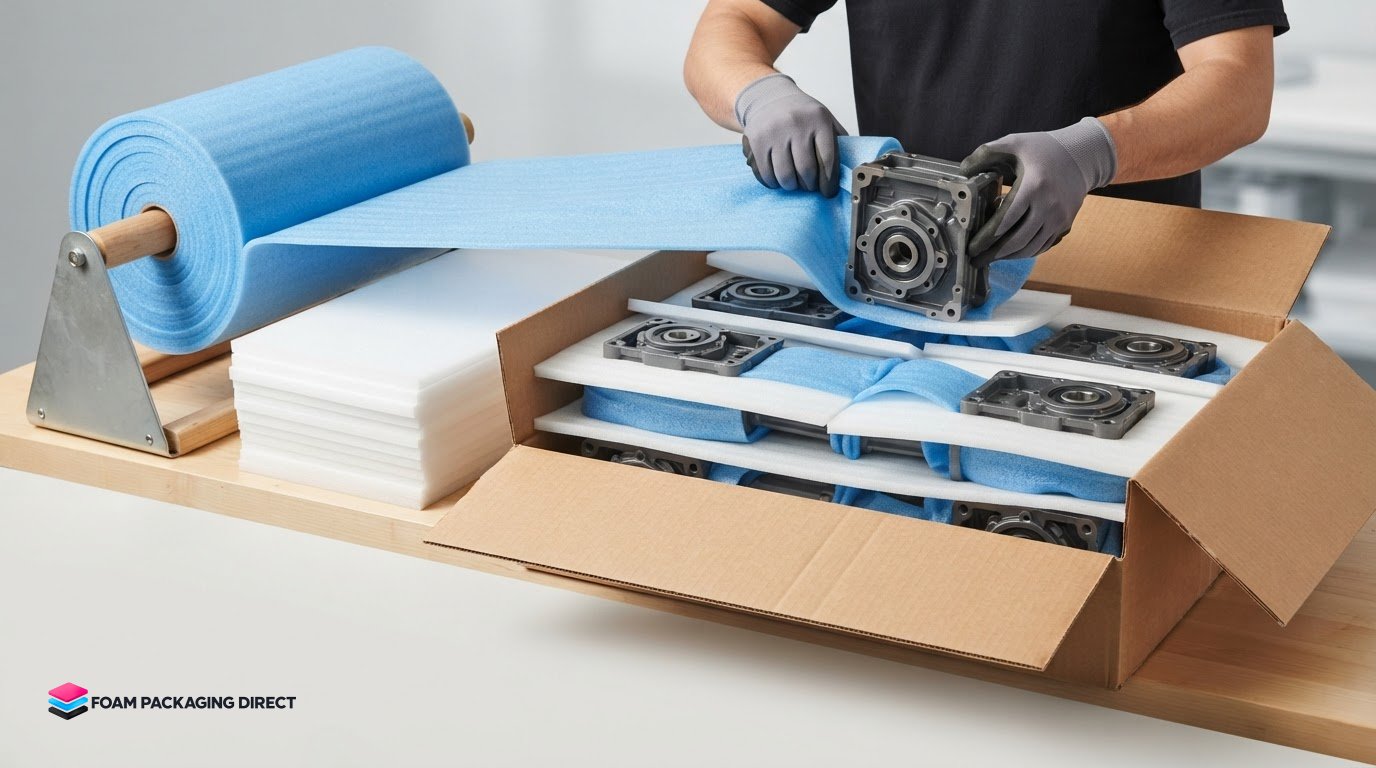
Bulk foam packaging can protect fragile or heavy products in formats suited to the task, from flexible sheets and rolls to shaped inserts that hold items in place. Choose based on the product’s weight, fragility, dimensions, surface sensitivity, and shipping conditions. Sheets and rolls can work well on manufacturing lines where cushioning needs to be cut, layered, or wrapped around different items.
A format that suits one product or packing process may not suit another. This guide explains how foam sheets and rolls support packaging lines, when shaped protection may be a better fit, and how foam materials differ. It also covers the product and order details that help define the right packaging.
Key Takeaways
- Match cushioning to the product’s weight, fragility, dimensions, surface sensitivity, and shipping conditions to help limit movement and impact.
- Choose foam protection based on the risk: a soft separation layer can protect surfaces, while a fitted insert can hold an item more securely.
- Use sheets and rolls when flexible coverage or adaptable cushioning suits the packing process, and consider how material choice affects the application.
- Compare foam types and formats against your product and order needs to narrow down practical options for a manufacturing line.
Additional cushioning for fragile or heavy items
Foam cushioning can absorb handling impact, separate delicate surfaces, and limit movement inside a suitably sized carton. Select it according to the product’s weight, dimensions, fragility, surface sensitivity, and shipping conditions.
Choosing Foam for Fragile Shipments
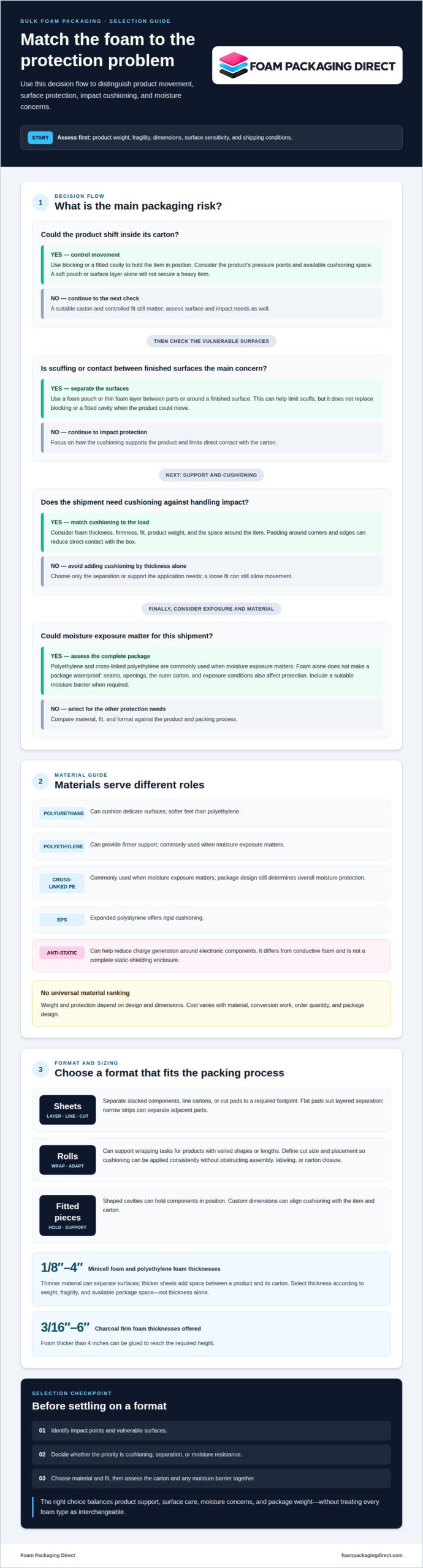
Start with the item’s vulnerable surfaces and likely movement points. A glass component may need a shaped cavity to keep its edges from contacting the carton. A finished metal panel may need a soft layer to help prevent scuffs. Consider the item’s position, pressure points, and available cushioning space, then choose a firmness that supports the load without allowing the product to shift.
Heavy products need cushioning that supports their weight while allowing room for impact absorption. Foam thicker than 4 inches can be glued to reach the required height. Foam pouches add a soft separation layer for small parts or finished surfaces, but they don’t replace a suitable carton or cushioning that controls movement.
For U.S. shipments, determine applicable requirements based on the product, destination, and packaging use. Food-contact applications, for example, may involve different material considerations than industrial parts.
Bulk Sizes, Shapes, and Custom Options
Bulk foam packaging can include sheets, blocks, pads, pouches, and cut-to-shape pieces. Charcoal firm foam is offered in thicknesses from 3/16 inch to 6 inches. Select a format that fits the product and packing process: flat pads suit layered separation, while shaped cavities hold components in position. Custom dimensions can align cushioning with the item and carton.
Businesses can buy commercial foam packaging from U.S. packaging suppliers that provide bulk formats or custom-cut pieces. Compare the required shape, material, dimensions, and order quantity for the application.
Recycling depends on the foam material and local collection options. Identify the material and check whether the local recycling program accepts it, since acceptance varies by location and foam type.
Foam can become waste when packaging is discarded rather than reused or recycled. Harvard Health Publishing notes that some chemicals in plastics may be harmful to long-term health, so material selection and responsible disposal are practical considerations.
Impact protection and water resistance
Impact protection depends on how cushioning supports the product and limits movement inside its carton. Padding around a machined component’s corners and edges, for example, can reduce direct contact with the box. Foam thickness, firmness, fit, and the space around the product all influence how the package responds to handling.
Surface protection serves a different purpose. A foam pouch or thin layer separates finished surfaces, such as painted panels or polished parts, to help limit scuffing in transit. It cannot hold a heavy item in place by itself. If the product could shift inside the carton, pair surface separation with blocking or a fitted cavity.
Moisture resistance depends on the foam’s structure and the complete package. Polyethylene and cross-linked polyethylene are commonly used when moisture exposure matters, but foam alone does not make a package waterproof. Seams, openings, the outer carton, and exposure conditions affect whether moisture can reach the product. Include a suitable moisture barrier when the shipment requires one.
How do materials compare for protection, weight, and cost? Polyurethane can cushion delicate surfaces, polyethylene can provide firmer support, and expanded polystyrene offers rigid cushioning. Weight and protection depend on the design and dimensions. Cost varies with material, conversion work, order quantity, and package design, so there is no reliable universal ranking.
For electronic components, anti-static foam can help reduce charge generation. It differs from conductive foam and is not a complete static-shielding enclosure. Match the foam to the component’s handling needs, then design the carton to control movement and exposure.
A practical selection sequence is straightforward:
- Identify the product’s impact points and vulnerable surfaces.
- Decide whether the main need is cushioning, separation, or moisture resistance.
- Choose foam material and fit, then consider the carton and any moisture barrier together.
The goal is to balance cushioning, surface care, moisture concerns, and package weight without treating every foam type as interchangeable.
The waterjet machine cuts foam in two dimensions, straight through the material (2D). Foam pouches are not rigid inserts or outer shipping containers; use a suitable carton and enough blocking or cushioning to control movement and impact. Package-level protection remains important.
Foam sheets and rolls for packaging
Foam sheets and rolls suit manufacturing lines that need flexible cushioning across products or packing steps. Sheets can separate stacked components, line cartons, or be cut into pads for a required footprint. Rolls can support wrapping tasks, letting packers apply cushioning to products of varied shapes. For example, a line shipping finished housings might place flat foam between units and wrap exposed surfaces.
Minicell foam and polyethylene foam are available in thicknesses from 1/8 inch to 4 inches. Thinner material can provide surface separation, while thicker sheets add space between a product and its carton. The right thickness depends on product weight, fragility, and how much room the package allows. Avoid choosing by thickness alone: a loose fit may let a component move during transit.
For repeatable packing, define the cut size and placement before selecting sheets or rolls. A pad sized to the carton base covers a consistent area; narrow strips can separate adjacent parts, while a roll can suit items that vary in length. These formats work best when operators can apply them consistently without obstructing assembly, labeling, or carton closure.
Material choice matters as well. Polyethylene foam provides a different feel and level of support from softer polyurethane, so the two are not interchangeable. Pink anti-static foam can reduce charge generation, but it is not a static-shielding enclosure. For electronic components with ESD concerns, consider the product, cushioning, and enclosure together.
When comparing formats for a manufacturing line, consider these practical factors:
- Coverage: Sheets suit flat layers; rolls suit wrapping and variable lengths.
- Handling: Set a repeatable cut size and packing position for each product.
- Protection: Match thickness and material to the item, carton space, and shipping conditions.
Sheets and rolls offer adaptable cushioning, but consistent results depend on a clearly defined application. A sample packing sequence can show whether a pad, wrap layer, or combination fits the line’s actual workflow.
What types of foam packaging are available in bulk?
Bulk foam packaging ranges from flat stock to shaped protection. Sheets and pads separate layers, rolls wrap products, and planks provide thicker blocks for cutting or positioning. Inserts and end caps fit around specific products, while tote and tray inserts organize components during handling. For repeated packing of similar products, a consistent shape can make placement more predictable.
Material choice affects how each format protects. Polyethylene and cross-linked polyethylene provide firmer support than softer polyurethane, while expanded polystyrene and expanded polypropylene offer different cushioning options. These materials are not interchangeable. Consider product weight, fragility, dimensions, finish, shipping conditions, and order quantity when selecting a format and material.
Available dimensions vary by product and format. Charcoal firm foam is listed in thicknesses from 3/16 inch to 6 inches. Minicell and polyethylene foam are listed from 1/8 inch to 4 inches. These ranges show how thickness can be matched to available carton space and the cushioning task. Thickness alone doesn’t determine suitability; fit and firmness also matter.
Bulk listings can also use repeatable, smaller pieces. Examples include adhesive-backed Minicell pieces measuring 3 inches by 3 inches by 3/4 inch, with listed quantities of 480, 2,400, or 4,800 pieces. That format may suit applications needing consistent pads at contact points. These are market examples, not a guarantee that every size or quantity fits every project.
For electronic parts, anti-static foam can help reduce charge generation. Conductive foam is a separate option for applications requiring conductive material. Neither type alone makes a package compliant with an ESD standard. The packaging design must suit the component and its handling requirements.
- Choose a format: match sheets, rolls, inserts, end caps, or trays to the packing task.
- Set the specifications: define dimensions, thickness, material, and order quantity.
- Review the fit: consider the product, carton, and packing process together.
Foam Packaging Direct
Foam Packaging Direct helps businesses develop practical packaging for manufacturing lines, from custom foam inserts and end caps to sheets, pads, rolls, and wrap. When product dimensions, handling needs, or packing steps call for a closer fit, custom options can be designed around the application. The right format depends on the product, shipping conditions, order quantity, and how operators pack each item.
For repeated shipments, share the product details and existing carton dimensions so the packaging can be matched to the application. Drawings or photos can help show vulnerable areas, contact points, and special protection requirements. Designs are kept on file to support a consistent fit on future orders, and Foam Packaging Direct supplies businesses nationwide.
To request a quote, provide your product dimensions, weight, order quantity, shipping ZIP code, and any available drawings or photos. Include existing box dimensions and special protection requirements if relevant.
Plan the next packaging run
Use your next packaging review to connect product protection with how your line packs and ships. A useful specification starts with the item’s dimensions, weight, and vulnerable surfaces, then accounts for carton size, packing steps, and order quantity. These details turn a general need for bulk foam packaging into a clear design direction.
Foam Packaging Direct offers Custom Foam Inserts, Foam End Caps, and Foam Sheets & Pads for different cushioning needs. To request a quote, share your product dimensions, weight, quantity, shipping ZIP code, and available drawings or photos. Include existing box dimensions and any special protection requirements. Contact Foam Packaging Direct to discuss the right packaging approach for your next run.
Frequently Asked Questions
What are common bulk foam packaging uses and applications?
Common applications include protecting industrial parts in transit, organizing components in trays, and separating products during storage. An aerospace assembly, for example, can sit in a fitted insert, while a medical device kit can use shaped compartments to keep accessories arranged. Foam packaging also suits electronics and automotive components that need cushioning inside a shipping carton. The right format depends on the item and packing workflow.
Is foam packaging recyclable, and where can it be recycled in the United States?
Recycling depends on the foam material and local collection options. Identify the material and check whether your local recycling program accepts it, since acceptance varies by location and foam type.