
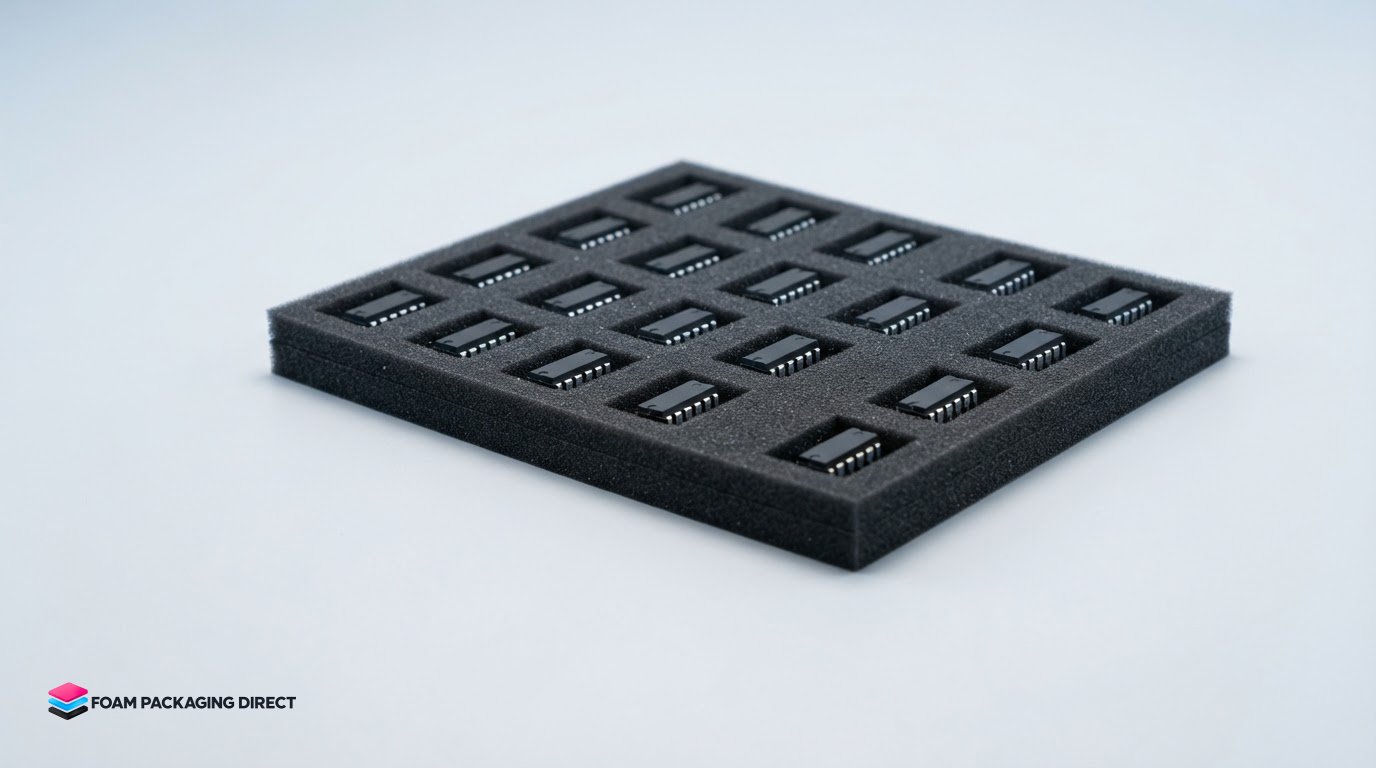
The softest foam isn’t automatically the safest choice for electronics. Microcellular foam packaging for microelectronics must match a component’s cushioning needs and sensitivity to electrostatic discharge (ESD). Anti-static, static-dissipative, and conductive foams have different properties, so the material label alone doesn’t tell the whole story.
Cushioning is only part of the decision. Packaging also needs to limit movement, support the product’s weight, and provide the appropriate level of electrostatic protection. Anti-static foam helps dissipate static charges; conductive foam is used for highly sensitive components that need greater protection.
This guide compares foam options and explains how polyethylene, cross-linked polyethylene, and polyurethane can suit different electronics. It also covers the factors to weigh, including product fragility, surface sensitivity, shipping conditions, and whether components need individual compartments, so you can narrow down a practical packaging choice.
Key Takeaways
- Match foam firmness and support to the component’s weight, fragility, and surface sensitivity to help limit movement without excess compression.
- Compare polyethylene, cross-linked polyethylene, and polyurethane by the protection your shipping and storage conditions call for.
- Consider moisture exposure, temperature changes, and stacking pressure when choosing packaging for electronics.
- Use a custom-fit insert or other suitable foam format to organize components and support a more consistent packing process.
Is Packaging Foam Safe for Electronics?
Foam can protect electronics when its static properties, fit, and support suit the product. A circuit board, sensor module, and heavy control unit each need different packaging.
Foam Selection by Static Sensitivity and Weight
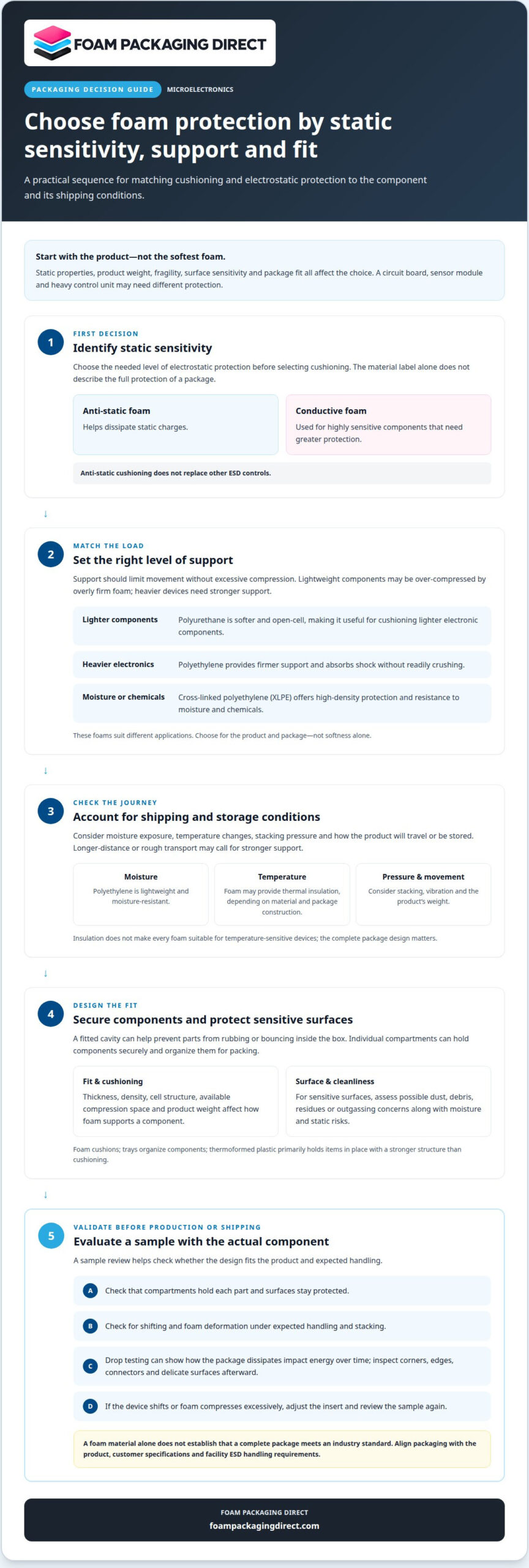
Start with static sensitivity, then match foam support to product weight. Anti-static foam helps dissipate static charges; conductive foam serves highly sensitive components. A lightweight circuit board may need softer support, while a heavy control unit needs firmer cushioning to limit movement. U.S. suppliers include custom foam converters and protective-packaging manufacturers that make packaging to fit specific electronics.
| Foam option | Static consideration | Weight and fit consideration |
|---|---|---|
| Anti-static | Helps dissipate static charges | Choose support for the component’s weight |
| Conductive | For highly sensitive components | Design compartments to hold parts securely |
| Polyethylene | Pair with suitable ESD protection | Firm support for heavier electronics |
Choose foam based on static sensitivity first, then weight, fragility, and fit.
Contamination, Outgassing, Moisture, and Static Risks
Unsuitable foam can shed dust or debris into internal parts, expose electronics to moisture, or build static charge. Material compatibility also matters for surfaces sensitive to contamination, where residues or outgassing may be a concern. Specify surface sensitivity and storage conditions, then assess the foam and package together. Anti-static cushioning addresses static charge, but it doesn’t replace other ESD controls.
Applicable U.S. Standards and Regulations
Requirements depend on the product, customer specifications, and the facility’s ESD handling program. A foam material alone does not establish that a complete package meets an industry standard. Align packaging for electronics with the applicable product and handling requirements, including the needed level of ESD protection. Custom foam suppliers can produce options to match those requirements.
Before production or shipping, evaluate a sample package with the actual component. Check that compartments hold each part, surfaces stay protected, and foam doesn’t deform under expected handling and stacking. Share drawings, material preferences, design requirements, and production quantity early to plan the process from prototype review to production.
Foam cushioning and impact-energy absorption
Foam cushioning helps slow electronics during impacts by spreading deceleration over time. Material, thickness, fit, and product weight all affect how a package responds.
Shock and Vibration Cushioning
During a drop or vibration event, cushioning compresses to absorb and distribute impact energy. This can reduce abrupt movement, while a fitted cavity helps prevent components from rubbing or bouncing inside the box. For example, a compact circuit board needs stable support at its edges, while a bulky power supply needs cushioning suited to its greater weight.
Polyurethane foam is softer and open-cell, making it useful for cushioning lighter electronic components. Polyethylene foam provides firmer support for heavier devices and absorbs shock without readily crushing. These materials suit different applications, so match the foam to the product rather than choosing by softness alone. Longer-distance or rough transport may call for stronger support.
Cushioning, Density, Thickness, and Cell Size
There is no single cushioning, density, thickness, or cell-size specification for every microelectronic product. These choices depend on component weight, fragility, package space, shipping conditions, and how the foam contacts the device. Thicker foam can extend deceleration, but it must fit the package design and available compression space.
Density affects how foam supports a load. Lightweight components can be over-compressed by overly firm material, while heavier parts need stronger support. Cell structure also influences how foam compresses and recovers. Choose dimensions based on the actual product and box, not a generic specification.
For a practical assessment, place the component in a sample package and evaluate fit, movement, and foam deformation. Drop testing can show how the package dissipates impact energy over time. Check corners, edges, connectors, and delicate surfaces after testing. A thin display, for instance, may need a soft contact layer with firm support beneath it. Review the sample before production or shipping, then adjust the insert if the device shifts or the foam compresses excessively.
Moisture resistance and thermal insulation
For microelectronics, packaging must account for moisture exposure and temperature changes during storage and transit. Microcellular foam, conventional foam, trays, and thermoformed plastic differ in fit and support: foam cushions, trays organize components, and thermoformed plastic primarily holds items in place with a stronger structure than cushioning.
Moisture and temperature considerations
Polyethylene foam is lightweight and moisture-resistant, which can suit electronics moving through warehouses or changing transit conditions. Cross-linked polyethylene (XLPE) offers high-density protection and resistance to moisture and chemicals. These properties can help limit exposure, but the complete package design still matters. Consider where the product will be stored, how it will travel, and whether moisture or temperature shifts affect its surfaces or operation.
Foam can also provide thermal insulation, depending on the material and package construction. That doesn’t make every foam suitable for temperature-sensitive devices. A sensor module stored for an extended period, for example, may have different protection needs from a component shipped directly between controlled facilities. Choose the material and package geometry based on the product’s conditions, not the material name alone.
Foam, trays, and thermoformed plastic
Foam offers cushioning and can be cut to fit a product’s outline. A tray or thermoformed plastic package can keep several components organized and prevent them from striking one another. Thermoformed plastic relies on its shape and geometry for structural support rather than providing as much cushioning as foam. A combined package can pair a formed holder with foam cushioning when both organization and impact protection matter.
To compare options, map each component’s dimensions and contact points, then consider stacking and transit conditions. For example, a fitted foam cavity can separate delicate connectors, while a formed tray can organize several lightweight parts. The right choice depends on the required resistance to moisture, temperature variation, and impact. Review the complete package design to ensure each component stays positioned and protected throughout storage and shipping.
Anti-static, static-dissipative, and conductive foam
For microelectronics, foam selection should account for static sensitivity during handling, storage, and transit. Anti-static, static-dissipative, and conductive describe different electrostatic properties, so the right choice depends on the component and its packaging requirements.
Foam materials for electronic-component packaging include polyethylene (PE), cross-linked polyethylene (XLPE), polyurethane (PU), expanded polystyrene (EPS), and expanded polypropylene (EPP). Static-sensitive applications can use anti-static or conductive options. Foam provides cushioning, while its electrostatic properties address a separate protection need.
How the three options differ
Anti-static foam helps dissipate static charges that could otherwise build during handling. Static-dissipative foam controls the movement of charge through the material. Conductive foam provides a conductive path and is used for highly sensitive components that need a higher level of electrostatic protection. These options aren’t interchangeable, and foam alone doesn’t make a complete package compliant with an industry standard.
For example, a semiconductor or circuit board with high static sensitivity may call for conductive foam. A component with lower static sensitivity may use anti-static cushioning, depending on its handling requirements. Static-dissipative material offers another option when controlled charge movement is needed. The product’s sensitivity, contact points, storage conditions, and transit path guide the decision.
Match foam to the handling process
Start by identifying which surfaces contact the foam and how staff handle the component. Then consider whether it sits in an individual cavity, travels between work areas, or remains packed during storage. Temperature, product weight, and required cushioning also affect material choices. A package may need both suitable foam support and ESD controls beyond the cushioning material.
Choose the electrostatic property for the component’s sensitivity, then select the foam structure and fit for its physical protection. For a packaging quote, provide the product dimensions, weight, quantity, shipping ZIP code, and any drawings or photos. Include special ESD handling requirements so the package design can address them.
Foam Packaging Direct
Foam Packaging Direct serves businesses throughout the United States, with manufacturing capabilities across the country. Turn to the team when electronics need packaging designed around their dimensions, weight, handling, and protection requirements. Regional production may help manage freight and turnaround needs.
Custom Foam Inserts can hold components in position, while Foam End Caps and Foam Sheets & Pads provide other packaging formats. The right design depends on product details, order quantity, shipping conditions, existing box dimensions, and any special ESD requirements.
Request a quote with your product dimensions and weight, quantity, shipping ZIP code, and available drawings or photos. Include existing box dimensions and special protection requirements to give the packaging design a practical starting point.
Turn the packaging choice into a workable design
The next step is to translate your electronics’ handling needs into a package design that fits your workflow. A well-planned specification clarifies how each component is positioned, protected, and packed, with static-control requirements considered alongside cushioning needs.
Foam Packaging Direct offers Custom Foam Inserts, Foam End Caps, and Foam Sheets & Pads for different protection and separation needs. Share your drawings or photos, product dimensions and weight, order quantity, shipping ZIP code, and any existing box dimensions or special ESD requirements. These details help shape a quote around your application.
Whether you’re refining an established pack or developing microcellular foam packaging for microelectronics, a clear set of product and shipping details gives the design process a practical starting point. Request a quote from Foam Packaging Direct and take the next step toward packaging built around your components.
Frequently Asked Questions
What Happens If You Use the Wrong Packaging Material for Electronics?
The wrong material can expose electronics to static discharge, unwanted moisture, debris, or damaging contact. For example, a loose component may shift until a connector strikes the carton, while a sensitive board can be affected by static during unpacking. Surface contamination can also interfere with close-fitting parts. Match packaging to the component’s sensitivity, surfaces, and handling path, not just the outer box size.
What is microcellular foam packaging for microelectronics?
Microcellular foam packaging for microelectronics uses foam with a fine cellular structure to cushion and position small electronic components. The package can use shaped cavities or layers to separate parts and reduce movement. Its design still needs to suit the device’s weight, fragility, and static sensitivity. A material’s cellular structure alone doesn’t establish that it provides the required ESD protection.
What are the ESD protection and surface resistivity requirements for microelectronics packaging foam?
ESD requirements and surface resistivity targets depend on the component and its handling program; there isn’t one universal target for every package. Use the value and test method required by the product or facility specification. Anti-Static Foam and Conductive Foam aren’t interchangeable, and color or material name alone doesn’t demonstrate performance. Include the required electrostatic property in the packaging specification.
How should microcellular foam packaging be designed, fabricated, and tested for sensitive components?
Start with component dimensions, weight, contact points, and the box or container. Design cavities to keep parts positioned without placing pressure on delicate features, then fabricate the sample using the specified material and cut depth. Review fit and movement in the actual container, and evaluate the package under expected handling conditions. For each new design, Foam Packaging Direct provides a prototype for approval before production; designs are kept on file for consistent reorders. Request a quote with your product dimensions, weight, quantity, shipping ZIP code, and available drawings or photos.