
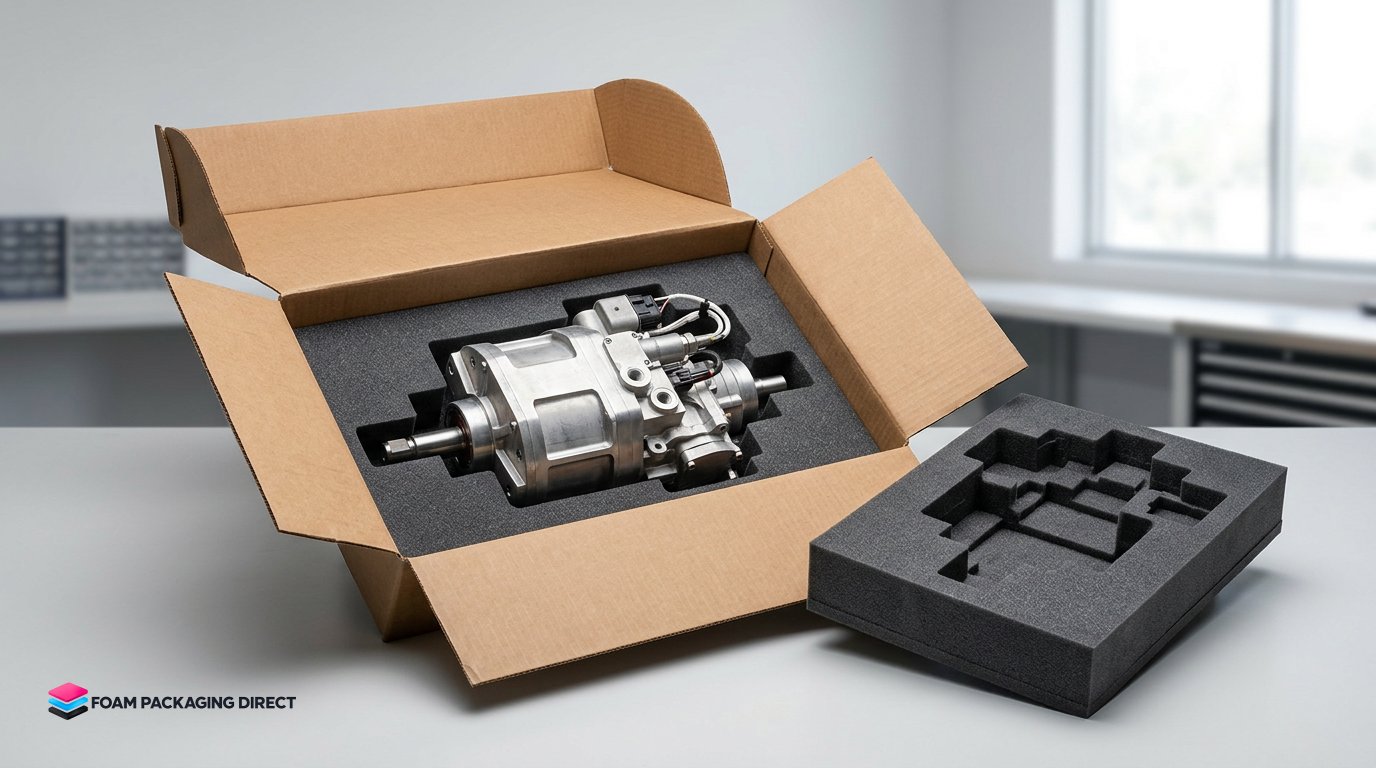
MIL-PRF-26514 is a performance specification for rigid and flexible polyurethane foam used in product packing materials. Understanding military-spec foam packaging and MIL-PRF-26514 compliance starts with the foam type, class, and grade, then connects those choices to the cushioning design. A foam designation alone doesn’t establish that an entire package meets every program requirement.
It’s easy to focus on the specification number and overlook the engineering decisions around it. Foam must suit the item and its shipping conditions, while the cushioning design manages shock and limits movement. G-limit requirements describe the acceleration a protected item can experience during handling or transport.
This article explains what MIL-PRF-26514 covers, how its classifications distinguish foam materials, and how G-limits relate to cushioning performance. It also clarifies where military packaging specifications fit into defense, aerospace, and government programs, so you can better understand the requirements behind a foam callout and the design choices that follow.
Key Takeaways
- Read the type, class, and grade together to understand the foam’s intended properties and application.
- Use cushioning design and G-limit requirements to match the protection system to the item and shipping conditions.
- Distinguish foam material specifications from package-level requirements, which may include additional engineering and inspection criteria.
- Custom foam inserts can help position equipment and reduce movement; product dimensions, weight, and shipping conditions guide the design.
Applications in defense, aerospace, and government programs
MIL-PRF-26514 foam cushions equipment during handling, shipping, and storage. In defense and aerospace programs, packaging requirements connect the material to the item’s protection needs.
Defense and Aerospace Uses
Military packaging may use foam to cushion equipment or block and brace it inside a package. Programs referencing MIL-STD-2073 may specify MIL-PRF-26514 foam through their cushioning design requirements. That distinction matters: the foam designation describes material requirements, while the design addresses how the package protects its contents.
Closed-cell plank foam appears under a separate specification, MIL STD CID A-A-59136. Its classes distinguish polyethylene plank, polypropylene plank, general-purpose plank, and special-purpose materials such as skived sheets or shapes. A program’s callout therefore matters; a similar-looking foam from another specification isn’t automatically an equivalent substitute.
Noncompliance can result from using the wrong specification, class, or material, or from a cushioning design that fails to meet program requirements. Missing or mismatched inspection records can also make it difficult to demonstrate that the delivered material conforms.
Checking Supplier Compliance
Buyers can verify compliance by comparing the purchase requirement with material identification and inspection documentation. Check that the documents name MIL-PRF-26514 and match the specified type, class, and grade. Then compare reported results with the requirements cited in the contract or packaging specification. This review helps identify mismatches before a shipment enters a government program.
Look for evidence of First Article Inspection, followed by Conformance Inspections for ongoing shipments. These stages address initial evaluation and continued shipment conformity. Keep records linked to the material and shipment they cover; a general product description is not proof of conformity for every delivery.
For electronics, Type III identifies anti-static polyurethane foam under MIL-PRF-26514. Anti-static cushioning is one packaging consideration, not proof that the complete package provides every form of ESD protection. Match the foam documentation to the program’s stated requirements, then review the full packaging design separately. In a broader military packaging requirement, that means keeping the material specification, cushioning design, and shipment records aligned.
Foam cushioning design and G-limit requirements
A cushioning design connects an item’s fragility and shipping conditions to foam performance. Its G-limit describes the acceleration level the protected item can experience during a shock event.
Start with the item’s mass, dimensions, and vulnerable areas. Then consider how it will be handled, shipped, and stored. These details affect how cushioning supports the item and manages impact. A design must account for the foam’s response under load, not just its material name. MIL-HDBK-304 is a package cushioning design reference for MIL-PRF-26514 foam.
Cushioning evaluation can consider how foam responds to stress during impact. These curves relate cushioning stress to the acceleration experienced by a protected item. The designer uses that relationship to assess whether the selected foam and package arrangement suit the application. A G-limit is therefore part of a system design, not a stand-alone foam property.
Compression creep also matters in long-term support. Compression creep can be a consideration when selecting foam for sustained support. Creep describes gradual deformation while foam remains under load. The package design should account for the supported item and the duration and conditions of storage, as well as shipping shocks.
Documentation should connect the required specification and material designation with relevant test and inspection records. Traceability links those records to the material or shipment they cover, in line with the program’s contract and packaging requirements.
A sensitive instrument and a robust equipment housing, for example, may need different cushioning layouts even if both use foam covered by the same specification. Contact areas, support points, and available package space all affect cushioning performance. Anti-static foam addresses static-related needs, but the cushioning design must still protect against shock. Aligning the item requirements, G-limit criteria, foam response, and package arrangement gives engineers a clearer basis for evaluating the design.
Military foam packaging specifications
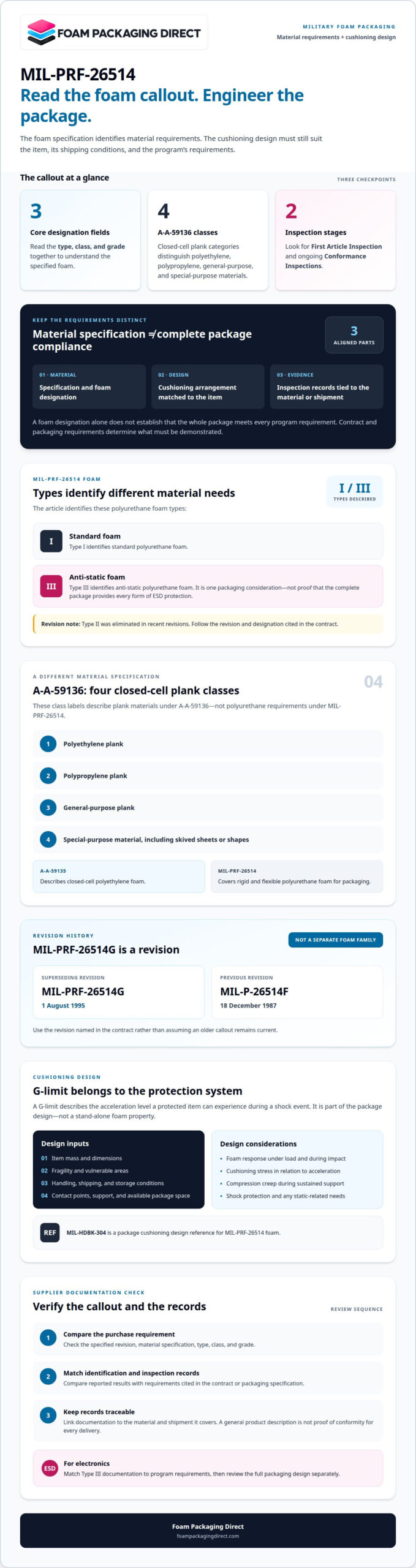
MIL-PRF-26514 sets performance requirements for rigid and flexible polyurethane foam used in packaging. Its revision, type, class, and grade define the material callout. For military-spec foam packaging under MIL-PRF-26514, read these identifiers together to understand the requirement.
Specification Differences and Revisions
MIL-PRF-26514G is a revision, not a separate foam family. Dated 1 August 1995, it supersedes MIL-P-26514F, dated 18 December 1987. Type II was eliminated in recent revisions. Buyers should follow the revision and designation cited in the contract rather than assume an older callout remains current.
Other specifications address different materials. A-A-59135 describes closed-cell polyethylene foam, while MIL STD CID A-A-59136 covers closed-cell foam plank materials. Under A-A-59136, Class 1 is polyethylene plank, Class 2 polypropylene plank, Class 3 general-purpose plank, and Class 4 special-purpose material, including skived sheets or shapes. These are not interchangeable with polyurethane requirements.
Compliant Foam Materials and Grades
MIL-PRF-26514 covers polyurethane foam. Type I identifies standard foam, and Type III identifies anti-static foam. Class 1 is rigid, non-resilient foam; Class 2 is flexible and returns to shape after pressure is released. A grade alone does not define the entire material callout.
For Type I, Class 2 flexible foam, Grade A density is 1.2-1.5 lb/ft³; Grade B is 1.6-1.9 lb/ft³. Grade C is 2.5-3.0 lb/ft³, and Grade D is 3.0-4.0 lb/ft³. Type I grades use blue, green, and charcoal colors. Type III anti-static grades A, B, and C are yellow, red, and brown. Color can help identify a grade, but it doesn’t replace the full specification.
Qualification and Certification
Qualification demonstrates that material meets applicable performance and engineering requirements; a label alone isn’t proof. The process includes First Article Inspection, followed by Conformance Inspections to verify ongoing shipments. Inspection evidence should correspond to the specified material and program documents.
Compare the cited revision, type, class, and grade with the inspection and test records. Then verify that those records address the governing contract requirements. Material qualification and package-level evaluation are distinct: meeting the foam specification does not establish that the complete package meets every design requirement.
What are the current MIL-PRF-26514 revisions and applicable amendments?
MIL-PRF-26514G is the revision identified for this specification. Dated 1 August 1995, it supersedes MIL-P-26514F, dated 18 December 1987. The “G” identifies the revision, while “MIL-PRF-26514” names the specification. That distinction helps procurement teams interpret callouts and compare them with contract documents.
For a purchase, use the revision and any amendments explicitly cited in the governing contract or packaging requirement. A material description alone may not capture every applicable requirement. Compare the purchase documents’ callout with the revision, type, class, and grade in the material records. If a contract carries an older designation, preserve that exact requirement during review rather than silently substituting a newer label.
Type II was eliminated in recent revisions, which can matter when older drawings or inventories use legacy terminology. A Type II reference should prompt a review of the controlling procurement documents and their intended material designation. Don’t infer a replacement type from the old label alone; the document governing the order determines the requirement.
Other military foam specifications address different materials. A-A-59135 covers closed-cell polyethylene foam, while MIL STD CID A-A-59136 addresses closed-cell foam plank. Those designations don’t become MIL-PRF-26514 revisions simply because they apply to military packaging. Match the material specification to the stated requirement before assessing grade or performance.
Review the documents in sequence: identify the cited specification, note its revision and any contract-invoked amendments, then compare the material callout with the supporting records. Keep order documents, drawings, and inspection records aligned so the requirement remains traceable through procurement and receipt. For electronic protection, identify anti-static material separately. That property does not replace the governing revision or establish complete package compliance.
Foam Packaging Direct: Custom Foam Inserts
Foam Packaging Direct makes custom foam inserts to organize equipment and limit movement inside a package. Designs are kept on file to support consistent reorders. For MIL-PRF-26514 applications, insert dimensions and layout should follow the program’s requirements; fabrication alone doesn’t establish complete package compliance.
Foam end caps, sheets, and pads offer other ways to cushion or support products. Choose a format based on product dimensions, weight, fragility, surface sensitivity, shipping conditions, and quantity.
Request a quote with the product dimensions and weight, quantity, shipping ZIP code, existing box dimensions, and any drawings or photos. Include special protection requirements or the applicable packaging callout. Contact Foam Packaging Direct to discuss your packaging needs.
Turn the Packaging Requirement Into a Clear Next Step
Translate the applicable packaging callout into a design brief your team can use. Include the product’s dimensions and weight, quantity, existing box dimensions, and special protection requirements. Drawings or photos can also show component placement and sensitive surfaces.
For military-spec foam packaging, MIL-PRF-26514 compliance depends on more than choosing a foam insert. Keep the material requirement and package design aligned with the program’s documentation. Foam Packaging Direct offers custom foam inserts, foam end caps, and foam sheets and pads to help protect and organize products in transit.
Share your project details to start a quote request. Contact Foam Packaging Direct with your shipping ZIP code and available drawings or photos. A clear brief is a practical first step toward packaging that fits your product and requirements.
Frequently Asked Questions
What is MIL-PRF-26514 foam?
It’s polyurethane foam identified for packaging applications by a military performance specification. In practice, a purchasing callout needs more than the specification number to identify the requested material. Compare the complete designation on the purchase order with the drawing and material records. This helps prevent a quotation or delivery from matching the general specification while missing the project’s specific foam requirement.
What Does MIL-PRF-26514 Actually Govern?
The specification governs foam material performance expectations, not every detail of an assembled shipping package. For example, a purchase requirement may name the foam while a separate drawing defines the insert shape and component locations. Treat these documents as related but distinct: the foam designation identifies material expectations, while the package documents describe how the foam is incorporated for the specific item.
What does MIL-PRF-26514 stand for?
MIL-PRF denotes a military performance specification, and 26514 is the identifier assigned to this specification. The letters distinguish this kind of document from other military specification designations. In procurement records, preserve the prefix and number as written, since changing or shortening the identifier can make it harder to match a material requirement with its supporting documentation.
What is the difference between Class 1 and Class 2 under MIL-PRF-26514?
The practical distinction is how the foam behaves under pressure: Class 1 is rigid, while Class 2 is flexible. For a package designer, that difference affects how the material supports or conforms around a product. Consider the part’s shape and contact points when reviewing a proposed insert, then check that the material callout and design documents refer to the intended class.
Where is MIL-PRF-26514 used beyond the military?
A nonmilitary buyer can use MIL-PRF-26514 when a contract or internal purchasing requirement calls for that material specification. For instance, a commercial aerospace supplier may receive a customer drawing that includes the designation. In that case, the drawing and purchasing documents define its relevance to the order; the specification should not be assumed to apply to unrelated commercial shipments.
What does MIL-PRF-26514 cover for military foam packaging?
For a military packaging purchase, it provides a way to identify and specify polyurethane foam material. The purchasing team can use the callout to compare offered material with the order, while the package drawing and contract provide project-specific context. Keep the material description consistent across those records so receiving and quality teams can trace what was ordered to what arrived.