
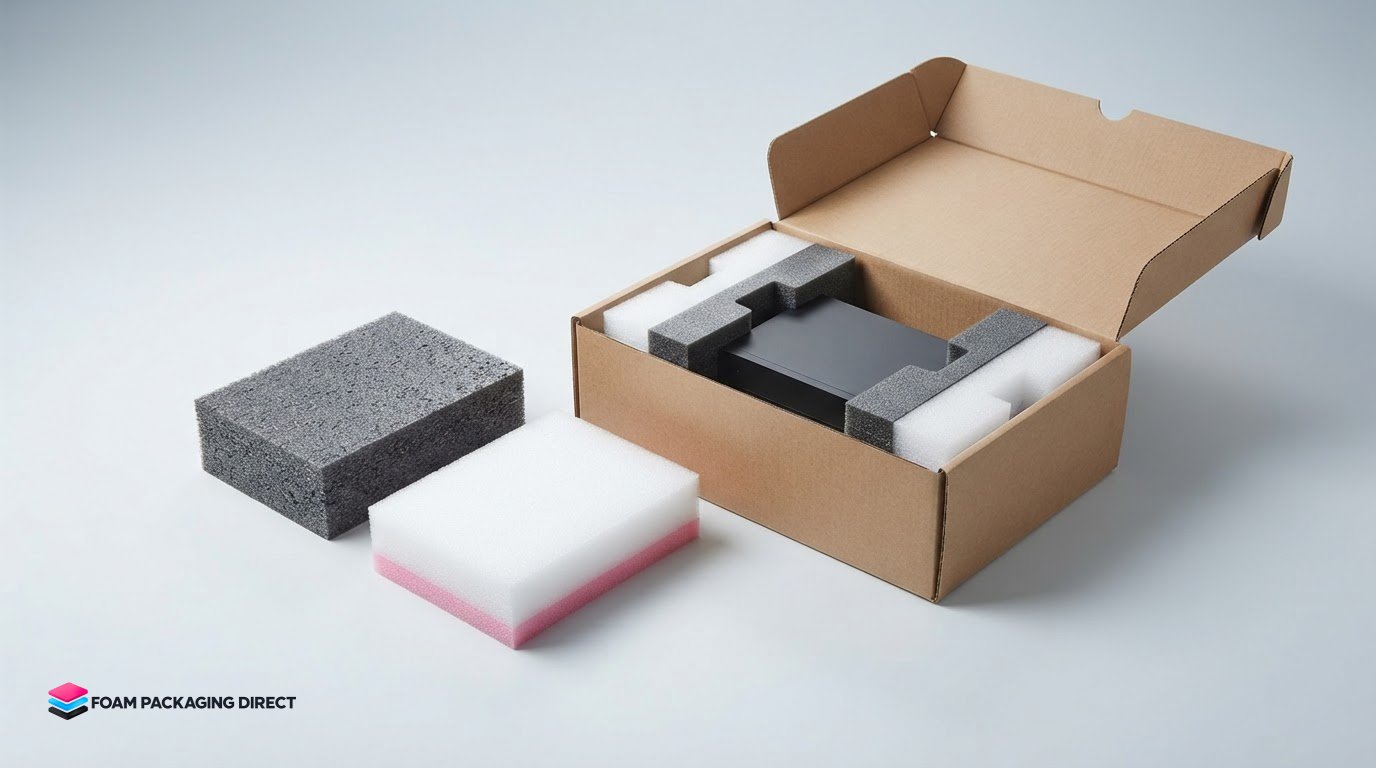
Stratocell and generic polyethylene foam belong to the same material family, but they are not automatic substitutes. The right choice in the stratocell foam vs generic polyethylene foam comparison depends on the cushioning, fit, and performance the package requires. Cross-linked polyethylene has different material characteristics, and brand names do not establish that products are interchangeable.
A direct swap may seem straightforward: foam descriptions can sound similar, and the goal is to protect a product under its shipping conditions. But electronics vary in weight, fragility, dimensions, and surface sensitivity, so the right material and package design depend on the specific application.
This article compares Stratocell with standard and cross-linked polyethylene foam, explains considerations for shipping electronics, and shows why a trade name alone is not enough to choose a replacement. Foam structure and package design both affect the decision.
Key Takeaways
- Stratocell’s lightweight cushioning may suit electronics shipments, but package design still needs to control movement and protect sensitive surfaces.
- Compare foam by product weight, fragility, and shipping conditions rather than assuming trade names are interchangeable.
- Cross-linked polyethylene offers fine-cell consistency and impact resistance that can matter for demanding shipping applications.
- Match the foam format to the job: inserts and end caps position products, while sheets, pads, and wrap provide different kinds of coverage.
Is Stratocell suitable for shipping electronics?
Stratocell can cushion shipped electronics because it is lightweight and provides consistent protection. Whether it suits a particular device depends on the device’s weight, shape, surface sensitivity, and the cushioning space available inside the package.
Cushioning and Shock Absorption
Stratocell compresses under impact to help absorb shock before it reaches a device or component. Its lightweight construction can protect electronics without adding much package weight, which may matter when shipping several parts. For example, a fitted insert can hold a control unit away from the box walls and limit movement during transit. The package still needs to suit the item’s shape and handling conditions.
Repeated-Impact Performance
Stratocell can be reused multiple times without degradation in its protective qualities. This repeated-impact characteristic may suit equipment that passes through several handling stages or travels in reusable packaging. For industrial equipment with removable electronic components, separate foam cavities can keep each piece in place. Reuse does not compensate for a poor fit: loose components can still shift and strike one another inside the box.
Thickness and Load Effects
Foam thickness and product load work together. A heavier item places greater demands on the cushioning, while the available foam depth affects how it responds to impact. A thin layer beneath a heavy instrument may compress differently from a thicker insert surrounding a lightweight sensor. Match the foam to the item’s weight and contact points, and account for the clearance between the product and the box.
For electronics, cushioning is only one part of protection. Stratocell can help limit impact and movement, but the package also needs to support and separate components. Anti-static cushioning addresses static-related concerns; it is distinct from static-dissipative or conductive packaging and does not, by itself, establish complete ESD protection. Consider these requirements alongside the product’s weight and shipping conditions.
Are Ethafoam, Stratocell and Jiffy foam interchangeable?
No single foam is best for packaging, shipping, construction, and every protective application. Match the material to the product’s weight, fragility, shipping conditions, and required properties. A trade name alone does not establish that another foam is an equivalent replacement.
Foam Selection Factors
Foam selection means matching density and cushioning properties to the item and its route. This matters because a fragile component and a heavy industrial part place different demands on packaging.
Consider the product’s weight, shape, surface sensitivity, and exposure to handling or environmental conditions. A lightweight electronic component may need close-fitting support, while a heavier part may need foam designed for greater load. Shipping distance and handling conditions also affect how the package must control movement. Compare these requirements before choosing sheets or a fabricated insert.
Interchangeability and Product Choice
Two foams are interchangeable only when both perform suitably in the same package, not simply because their names sound similar. Checking fit and protection helps prevent a replacement from changing how the package performs.
Ethafoam and Stratocell are proprietary forms of polyethylene foam, while Jiffy is another product name. Select by performance requirements rather than name alone. Stratocell grades illustrate why: Stratocell E has a density of 24 kg/m³, Stratocell S has a density of 30 kg/m³, and Stratocell AS is a pink anti-static grade with a density of 30 kg/m³. Stratocell 65 has a density of 65 kg/m³. These differences affect the material choice; they don’t make every grade interchangeable.
Packaging and Protective Applications
Application-based selection matches foam properties to the job, helping packaging support the product without assuming one material fits every use.
For shipping, assess the product’s weight, fragility, and the conditions packages face in transit. For construction or another protective use, define the material’s job first, then compare relevant properties. Stratocell and Ethafoam are available in black, white, and a pink anti-static option. Anti-static cushioning addresses static concerns, but it is not the same as static-dissipative or conductive protection. Cross-linked polyethylene is a distinct material category, so compare actual performance needs rather than relying on the word “polyethylene.”
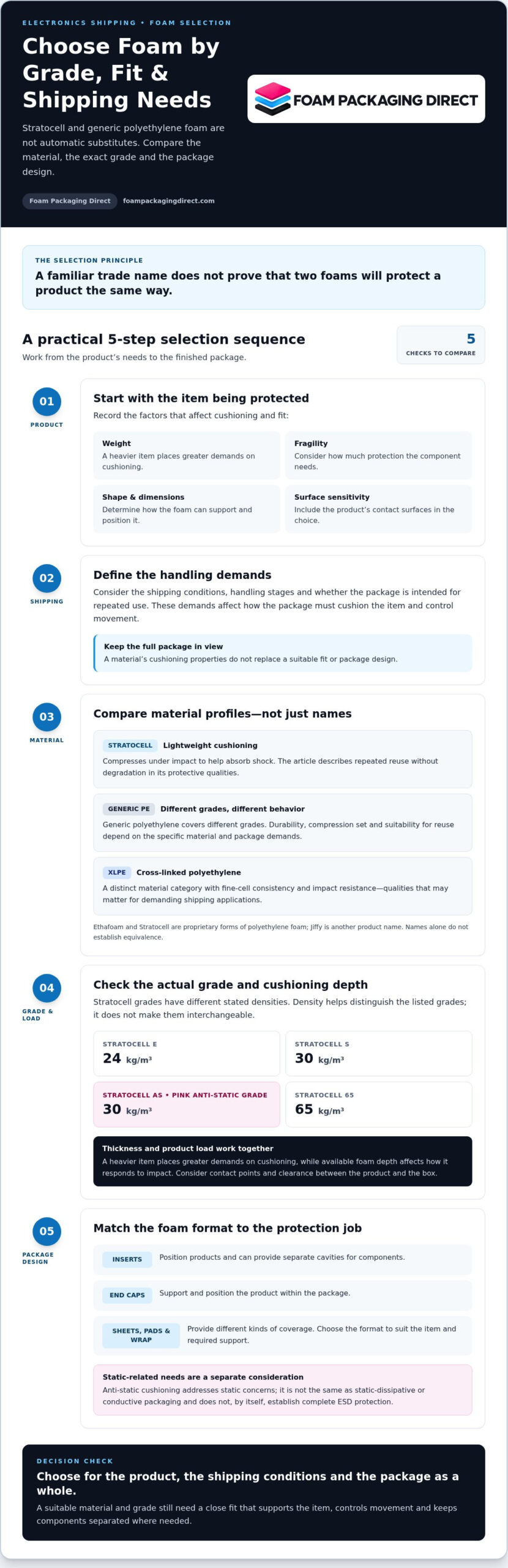
XLPE impact resistance and fine-cell consistency
Cross-linked polyethylene (XLPE) has fine-cell consistency and superior impact resistance, while Stratocell can be reused multiple times without degradation in its protective qualities. Generic polyethylene foam covers different grades, so durability, compression set, and suitability for reuse depend on the specific material and package demands.
Fine-cell consistency means the foam’s internal cells have a more uniform structure. In protective packaging, this can support predictable cushioning around electronics or industrial components. XLPE’s impact resistance makes it worth considering when shipments face repeated handling or heavier contact loads. It does not mean every XLPE grade suits every product: item weight, shape, and required support still matter.
Compression set describes how much foam remains compressed after a load is removed. It matters in reusable packaging because a permanently compressed area may no longer fit the product as intended. Compare the actual foam grades against the package’s expected load and use pattern. The broad label “polyethylene” alone does not show how a particular foam responds to repeated compression.
Stratocell and XLPE have different material profiles. Stratocell’s stated reuse characteristic may suit returnable packaging, while XLPE’s impact resistance and fine-cell consistency may suit applications that need those properties. For example, a reusable industrial equipment case may need shaped cavities that continue to hold components securely after repeated trips. Fit and cushioning design remain essential to the decision.
Evaluate the whole application: the product’s mass, contact points, shipping conditions, and whether the packaging returns for reuse. Repeated impacts can affect the foam and product differently, so assess how the insert supports each component. Choose a grade and package design for those demands rather than assuming standard polyethylene, Stratocell, and XLPE have identical durability or compression behavior.
Stratocell versus standard and cross-linked polyethylene foam
A useful way to assess stratocell foam vs generic polyethylene foam is to compare their structures and packaging roles. Stratocell is described as flexible, non-cross-linked, open-cell polyethylene foam. Generic polyethylene foam is generally described as closed-cell, while cross-linked polyethylene (XLPE) has a fine-cell structure. These differences help explain why the shared PE name does not make the materials equivalent.
Stratocell can use up to 35% less raw material than standard or cross-linked polyethylene foam while achieving similar protective cushioning performance. That comparison can inform material-use decisions, but it doesn’t establish a universal replacement. Product weight, required support, and package layout still matter. A foam choice that works for a light product may not suit a heavier item or different box configuration.
For a lightweight, sensitive product, a shaped insert can position each item and separate it from other contents. Stratocell may suit applications that call for flexible cushioning. XLPE may be considered where its impact resistance and fine-cell consistency match the package’s demands. For example, an automotive component with exposed edges may need support positioned around those contact points.
Generic polyethylene foam describes a broad material category, not one fixed performance profile. Grades and constructions can differ, so compare the specific material with the package’s requirements. The format matters too: a sheet, plank, or shaped insert supports a product differently. A flat pad beneath an item does not position it like a fitted cavity.
Choose among Stratocell, standard PE, and XLPE by matching material structure and package design to the product’s cushioning and impact-protection needs. Consider where the foam contacts the item and how the package restrains movement. This application-based comparison is more useful than relying on a material label alone, particularly for protective foam packaging used with electronics or automotive parts.
Foam Packaging Direct: Custom Foam Inserts
Foam Packaging Direct makes custom foam inserts to help position electronics and organize components. A shaped insert can provide support or separation that a standard sheet or wrap cannot. Foam end caps can protect product edges, while foam sheets, pads, and rolls suit other cushioning and surface-separation needs.
For a quote, provide the product dimensions, weight, order quantity, shipping ZIP code, and any available drawings or photos. Include existing box dimensions and special protection requirements so the packaging can be considered as a complete fit.
Request a quote from Foam Packaging Direct to discuss the right foam format for your shipment.
Turn your foam choice into a package design
Use the Stratocell foam vs generic polyethylene foam comparison as a starting point, then define what the package must do for your product. Map its contact points, required support, and packing process before selecting a material. These details give the packaging design a practical basis and help identify potential gaps.
Foam Packaging Direct offers custom foam inserts, foam end caps, and foam sheets and pads for different packaging needs. An insert can organize a product and its components, while end caps or pads can add targeted support within the existing package. Share your product dimensions and weight, order quantity, shipping ZIP code, available drawings or photos, and existing box dimensions to help shape a quote request.
Request a quote from Foam Packaging Direct and take the next step toward packaging designed around your shipment. A clear set of product details makes it easier to begin.
Frequently Asked Questions
What is Stratocell?
Stratocell is used as cushioning in packaging for electrical appliances, industrial equipment, automotive parts, and household equipment. A shaped piece can support a product inside its package, while separate cavities can organize multiple components. Its role is to help protect items during handling and shipment. For electronics with static-sensitive components, select static-control packaging separately according to the product’s requirements.
Trade name or material description?
“Stratocell” functions as a product identifier in purchasing documents, while “polyethylene foam” identifies a material family. For a repeat order or substitute review, record the grade, dimensions, color, and any static-control requirement alongside the product name. Those details give packaging and purchasing teams a clearer basis for comparison than a trade name alone, particularly when a package includes several foam components.
Why are there so many names for polyethylene foam?
Polyethylene foam names can refer to different things, including the polymer family, processing method, grade, or commercial product line. A packaging drawing might use a general PE description, while purchasing documents identify a named grade. Consistent terminology across drawings, purchase orders, and production records helps teams work from the same material description throughout a packaging program.
What is Stratocell foam and how is it made?
Stratocell starts as low-density polyethylene formed into cellular foam. For packaging production, the material can be converted into components through precision cutting, routing, laminating, or bonding. For example, a layered piece can be shaped into a cavity, while a cut profile can provide end support. The finished geometry is based on the product and container dimensions.
What are the density, thickness, and load-bearing options for Stratocell versus generic PE foam?
Density, thickness, and load capacity are related, but describe different aspects of a foam design. A useful drawing identifies the product outline, cavity depth, support locations, and clearance inside the carton. These details show where the foam surrounds or supports the item. An irregular part may need different pocket depths at each end, so specify the finished geometry as well as the material grade.
What are the moisture, chemical, and temperature resistance differences?
Moisture behavior depends partly on cell structure: closed-cell polyethylene foam generally absorbs less water than open-cell polyurethane foam. Consider chemical and temperature exposure separately, since a broad material label does not describe every grade’s response. For packaging stored near cleaning agents or exposed to changing temperatures, identify the specific material grade and the substances and conditions it will encounter.