
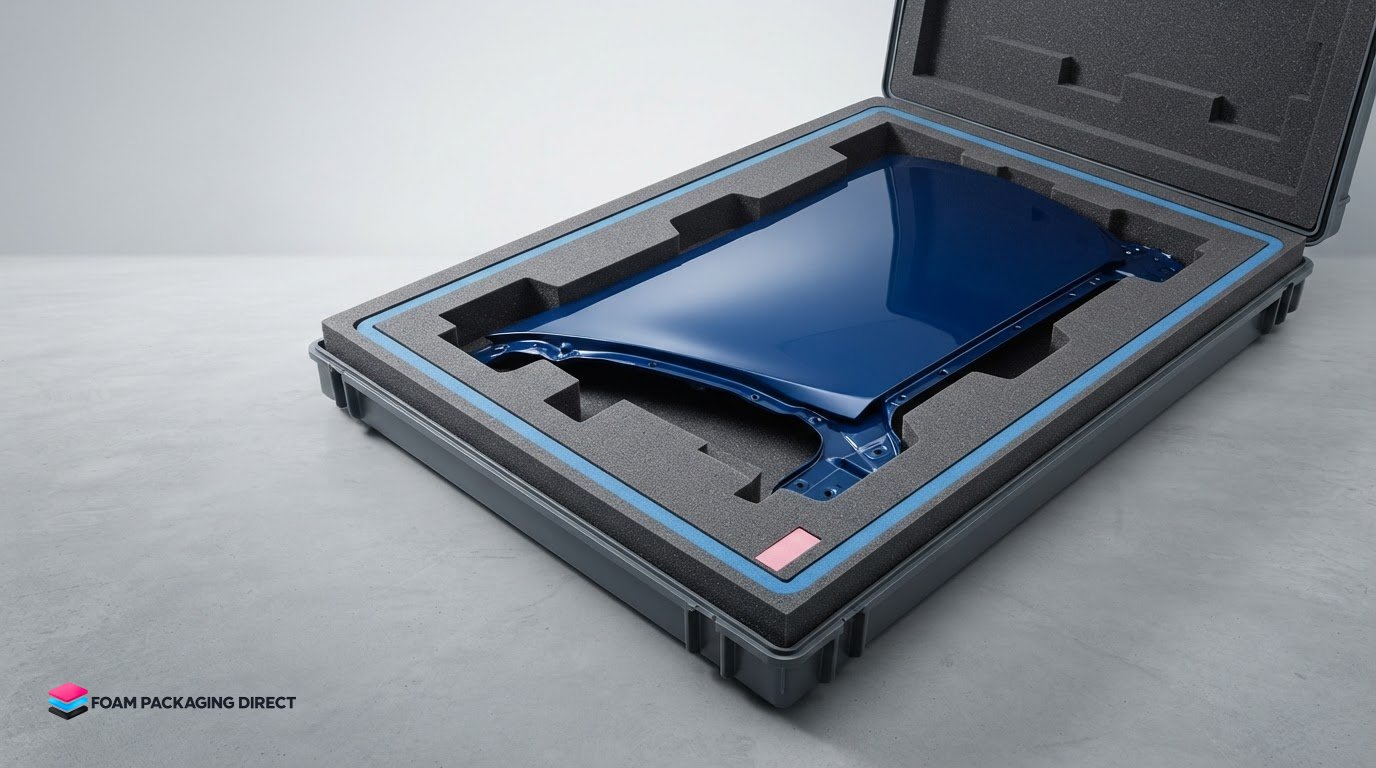
A cushioning layer of cross-linked polyethylene foam can help protect Class A surfaces from scuffs during handling and shipping. For cross-linked polyethylene Class A surface protection, the foam must fit the product: it should cushion the item without creating unnecessary contact or movement. The right design depends on the product and its packaging requirements.
It’s reasonable to want protective packaging that helps prevent marks on a finished surface. But protection also depends on how the product sits in its package and whether it can move in transit. Material alone cannot make up for a poor fit.
This article explains why XLPE is used for surface-sensitive products, what its closed-cell structure means in practice, and how it compares with other foam options. It also covers the product and shipping details that help shape a suitable protective design, so you can make your next packaging decision with less guesswork.
Key Takeaways
- Choose a smooth, nonabrasive foam contact surface to help reduce scuffing on Class A finishes.
- Consider how XLPE’s closed-cell structure affects cushioning, resilience, and suitability for your packaging conditions.
- Match foam type and design to the product’s weight, fragility, surface sensitivity, and shipping environment.
- Custom foam inserts can help hold products in place and provide targeted protection inside a box.
Class A surface protection
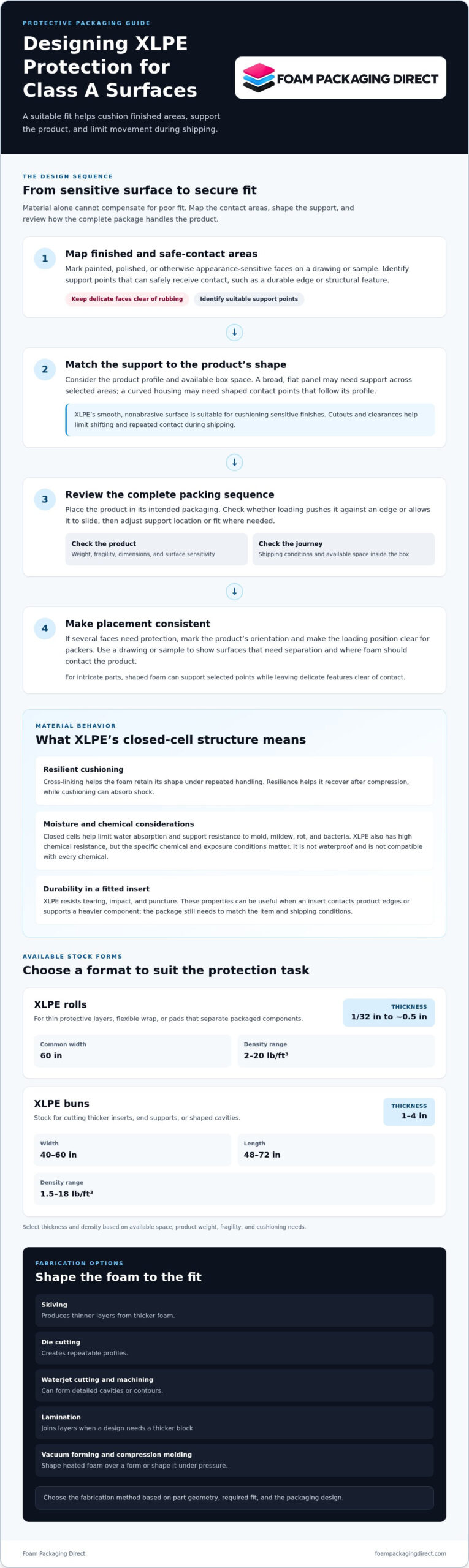
When using cross-linked polyethylene foam for Class A surface protection, start by mapping the product’s finished areas. Mark painted, polished, or otherwise appearance-sensitive faces on a drawing or sample. Then identify where the item can safely receive support, such as at a durable edge or structural feature. This distinguishes suitable support points from areas where rubbing could leave visible marks.
Next, consider the product’s shape and how it sits inside its package. A broad, flat panel may need support across selected areas, while a curved housing may need shaped contact points that follow its profile. XLPE’s smooth, nonabrasive surface makes it suitable for cushioning sensitive finishes. The insert’s cutouts and clearances also matter: they help limit shifting that could cause repeated contact during shipping.
Review the complete packing sequence, not just the foam material. Place the product in its intended packaging and note whether loading pushes it against an edge or allows it to slide. For example, a finished panel that moves inside a box may rub against its support during handling. Adjusting the support location or fit can reduce movement. Consider the product’s weight, fragility, dimensions, and shipping conditions when making design decisions.
Surface protection also depends on consistent packing. If a product has several finished faces, mark its orientation and make the loading position clear for packers. Use a sample or drawing to show which surfaces need separation and where the foam should make contact. This can help prevent incorrect placement across repeat shipments. For intricate parts, shaped foam can support selected points while leaving delicate features clear of contact.
Closed-cell cross-linked polyethylene foam structure
Cross-linked polyethylene foam starts with polymer chains bonded through heat and a chemical reaction. That cross-linking creates a connected structure that helps the foam retain its shape under repeated handling. Its cells are closed rather than open and interconnected. In practical terms, the cell walls form small pockets throughout the material, shaping how it responds to compression and moisture. This structure makes XLPE a durable option when packaging needs thicker, resilient cushioning.
Closed cells help limit water absorption and support resistance to mold, mildew, rot, and bacteria. The structure also contributes to high chemical resistance, but the specific chemical and exposure conditions matter. These properties can be useful for products moving through humid storage or occasional moisture exposure. They do not make the foam waterproof or establish compatibility with every chemical. Choose materials based on the actual environment and contact conditions.
For shipping, resilience helps foam recover after compression, while cushioning can absorb shock. XLPE also resists tearing, impact, and puncture, useful properties for an insert that contacts product edges or supports a heavier component. For example, a shaped cavity can hold an instrument housing while foam walls help reduce movement inside the box. The package still needs to suit the item’s weight, shape, and shipping conditions.
Evaluate the foam based on the job it must do. First, identify the contact points and available space around the product. Then consider whether the foam needs to cushion repeated handling, withstand moisture exposure, or maintain a close fit. Finally, match the material and thickness to the product’s weight and fragility. XLPE is not interchangeable with every polyethylene foam: its cross-linked structure gives it distinct resilience and durability. These properties can support protective packaging, but the product and transit requirements determine whether they suit the application.
Cross-linked polyethylene foam is a durable closed-cell foam used in applications requiring thicker, more resilient foam pieces. This makes the intended form and degree of resilience central considerations when assessing its use. The choice should reflect the demands of the application, with the material selected where its thicker, more resilient construction matches the need.
Uses of cross-linked polyethylene foam
Cross-linked polyethylene foam can be made into packaging components, protective case padding, and industrial parts. For shipping, sheets and rolls can separate finished surfaces, while shaped inserts hold products in place. The right format depends on the product’s dimensions, weight, fragility, and available box space. Density matters too, because it affects how the foam responds to pressure and supports the item.
XLPE rolls are made in thicknesses from 1/32 inch to approximately 0.5 inch, with a common width of 60 inches. Roll densities range from 2 to 20 pounds per cubic foot. These formats suit applications requiring thin protective layers or flexible wrap. For example, a roll can be cut into pads that separate packaged components. Select thickness and density based on the space available and the product’s cushioning needs.
For thicker components, XLPE buns can be 1 to 4 inches thick, 40 to 60 inches wide, and 48 to 72 inches long. Bun densities range from 1.5 to 18 pounds per cubic foot. These dimensions provide stock for cutting thicker inserts, end supports, or shaped cavities. A packaging designer can match the bun size to the part layout, then plan cuts that use the material efficiently.
Fabrication methods shape XLPE for different protective tasks. Skiving produces thinner layers from thicker foam, while die cutting creates repeatable profiles. Waterjet cutting and machining can form detailed cavities or contours. Lamination joins layers when a design needs a thicker block. Vacuum forming shapes heated foam over a form, while compression molding shapes it under pressure. Choose a method based on the part geometry, required fit, and packaging design.
- Use rolls or sheets for separating layers and wrapping products.
- Use buns as stock for thicker, shaped protective components.
- Match density and fabrication method to the part’s weight and geometry.
Water and chemical resistance
Assess the actual exposure before choosing foam for a packaged product. A component might encounter process fluid during production, cleaning residue before packing, or moisture during storage. These situations involve different contact conditions. Record the substance, where it touches the foam, and whether contact is occasional or repeated.
Chemical resistance does not mean universal compatibility. Oils, cleaners, and other fluids vary in composition, so the specific chemical matters. A useful specification names the substance and describes how it contacts the packaging. For example, a part carrying light surface residue presents a different condition from a component stored against a fluid-soaked pad.
Consider the product as well as the foam. A metal housing, painted panel, and optical surface may each respond differently to residue transferred from packaging. Note any sensitive finish, coating, or material that touches the foam. If several components share a package, identify each contact point so the design can keep incompatible surfaces separated.
Exposure details can be organized into a short checklist:
- Name the liquid or chemical and describe its source.
- Mark the foam contact area and the product surface nearby.
- Describe whether contact is direct, incidental, or repeated.
- Note when exposure occurs, such as before packing or during storage.
Use these details to assess the packaging application rather than relying on a broad label such as “chemical-resistant.” If the substance or exposure changes, review the material choice and package layout. For instance, a change from a dry component to one carrying cleaning residue can alter which surfaces touch the foam. Clear exposure notes make material selection more specific and help align the packaging with actual handling conditions.
Cross-linked polyethylene foam’s closed-cell structure provides resilience to mildew, mold, rot, and bacteria, along with high chemical resistance and low water absorption. Cross-linking involves heating polymers and using a chemical reaction to bond polymer chains together. The foam offers shock absorption and resistance to tearing, impact, and puncture. It can be skived, die cut, waterjet cut, machined, laminated, vacuum formed, and compression molded. These characteristics describe material properties, but do not establish compatibility with every substance or product surface. Assess them against actual exposure and contact conditions.
Foam Packaging Direct: Custom Foam Inserts
Foam Packaging Direct makes custom foam inserts to hold products in position and help protect sensitive finishes during shipping. Share the item’s shape, contact surfaces, and existing box dimensions to guide the design. Foam end caps can cushion product ends, while foam sheets and pads can separate surfaces or components.
For Class A finishes, explain which areas must avoid rubbing and where the package can support the product. Drawings or photos can help show these details. Include the product’s weight, quantity, shipping ZIP code, and any special protection requirements when requesting a quote.
Contact Foam Packaging Direct to request a quote for packaging suited to your product and shipping needs.
Make the Next Packout More Consistent
Cross-linked polyethylene Class A surface protection works best as part of a repeatable packaging plan. Treat the insert as one part of the packout, alongside product orientation and handling steps.
When products or packaging change, revisit the layout before the next production run. Even a small change in shape, finish, or packing sequence can affect how the item sits in its protective support.
Keep the packaging approach aligned with the product and the people packing it. This gives every shipment a clearer, more consistent starting point.
Frequently Asked Questions
What is Class A surface protection for cross-linked polyethylene (PEX)?
Class A surface protection uses cushioning to help prevent scuffs on a product’s visible, finished surfaces during handling and shipping. In packaging, cross-linked polyethylene is usually abbreviated as XLPE; PEX commonly refers to cross-linked polyethylene pipe, a different product form. For XLPE foam protection, the design should limit movement and avoid unwanted rubbing against sensitive areas, such as a polished panel or painted housing.