
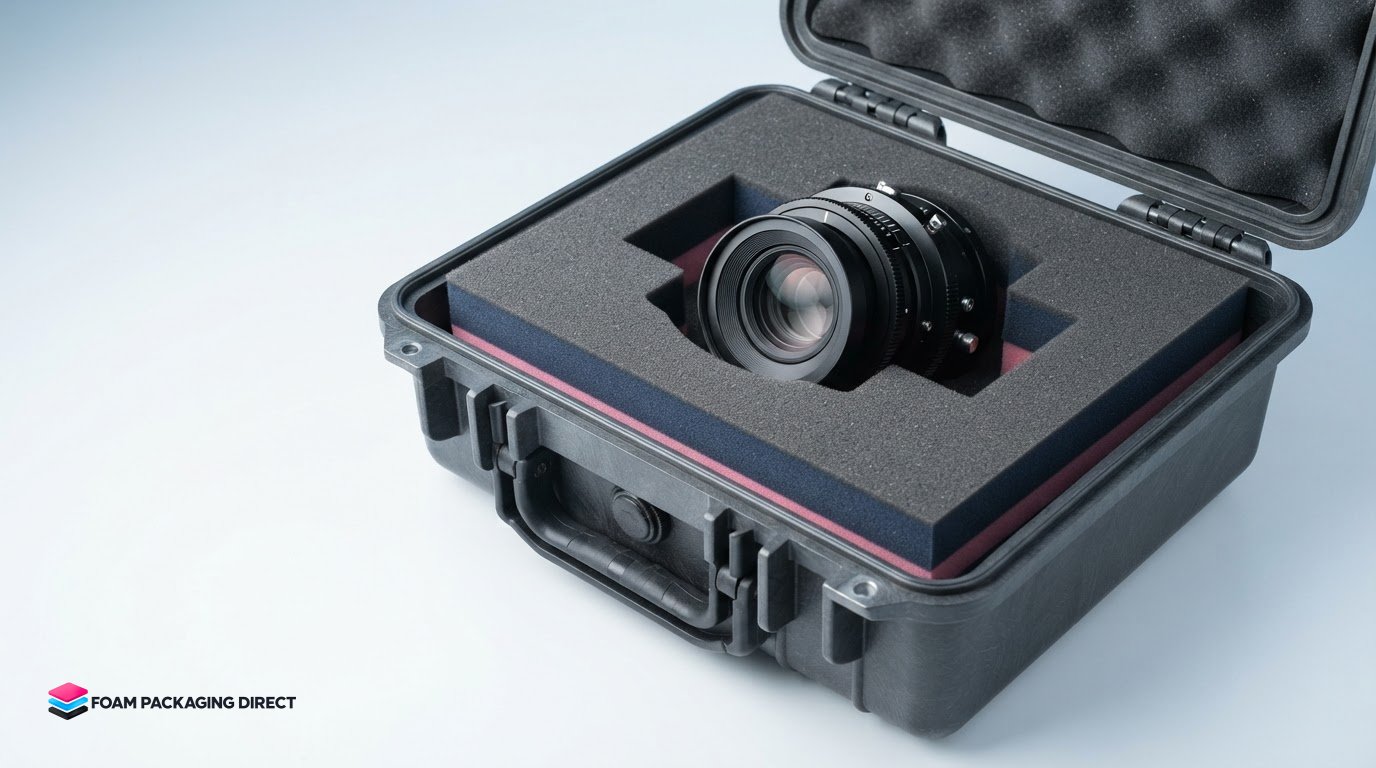
Closed-cell foam isn’t automatically non-outgassing. Choosing non-outgassing packaging foam for optical components means considering material test data as well as cell structure. The foam must protect delicate surfaces without introducing unwanted contamination risk.
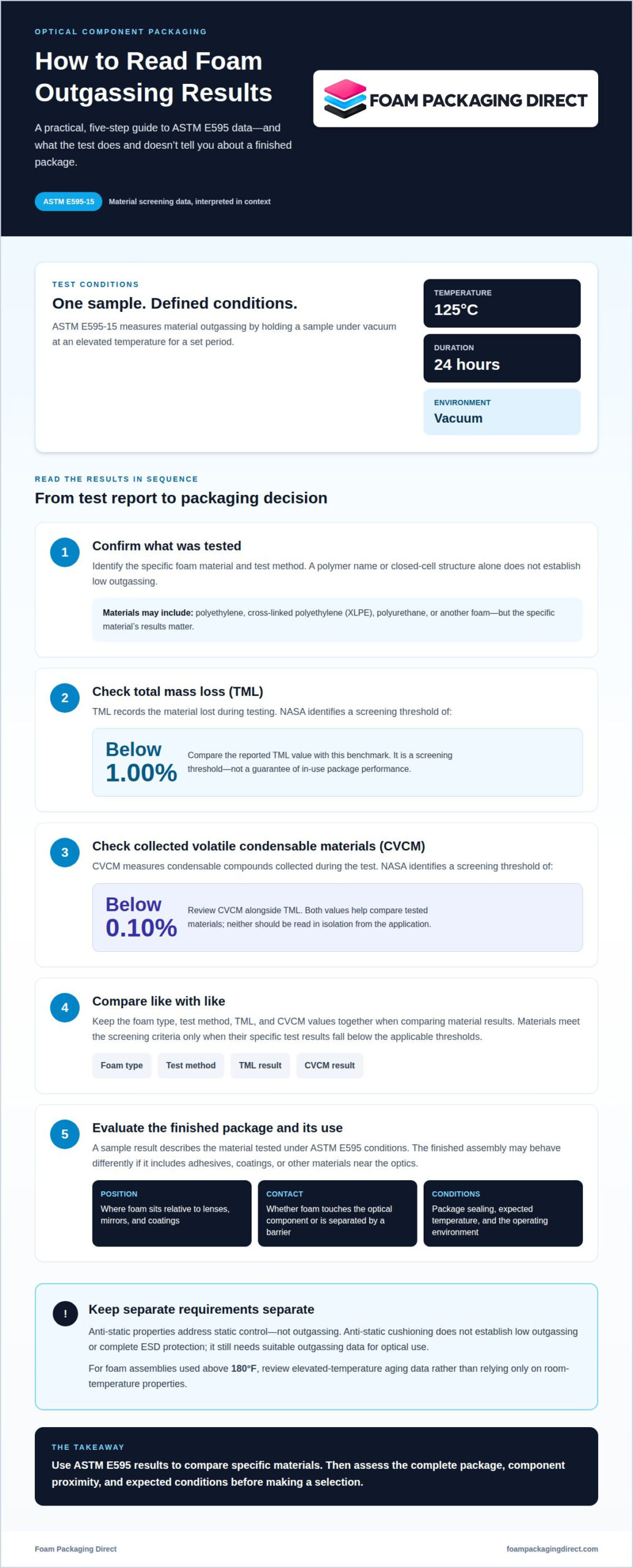
That distinction matters when packaging needs to control movement, limit particulate exposure, or form a seal around an optical assembly. ASTM International’s ASTM E595-15 test holds a material sample at 125°C under vacuum for 24 hours. NASA identifies a total mass loss (TML) screening threshold below 1.00%; the collected volatile condensable materials (CVCM) threshold is below 0.10%. These results help compare materials, but they don’t replace evaluating the finished package and its operating conditions.
This guide explains what foam outgassing means, how to read ASTM E595 results, and why cleanroom handling and closed-cell materials matter. You’ll also see how polyethylene, XLPE, and other foam options can fit packaging or sealing needs, and which product and shipping details shape a practical choice.
Key Takeaways
- Compare foam materials by their outgassing behavior, not cell structure alone.
- Use ASTM E595 results as one part of material selection, alongside the conditions the package will face.
- Consider particulate control and handling needs when packaging optics for cleanroom environments.
- Match closed-cell foam and package design to the component’s weight, fragility, surface sensitivity, and sealing needs.
Outgassing from open-cell polyurethane foam
Open-cell polyurethane can release volatile compounds from its formulation or processing residues. In a sealed optics package, those emissions may reach nearby lenses, mirrors, and coatings.
Open-Cell Polyurethane Emissions
Outgassing is the release of volatile substances from a material into the surrounding air or vacuum. Open-cell polyurethane has connected pores that allow air and vapor to move through the foam. The type and amount of released compounds depend on the formulation and manufacturing process. Foam placed close to a lens, for example, may expose its surface more directly than foam separated by a barrier.
Effects on Optical Coatings and Components
Outgassing can affect optics when vapor settles on a cooler surface and leaves a thin residue. Deposits on coated lenses or mirrors may reduce light transmission or change reflection. Residue can also affect sensitive components if it collects on functional surfaces or interferes with inspection. The impact depends on the emitted compounds, package conditions, and distance from the foam to the optical surface.
Polyurethane and polyethylene are not interchangeable. Polyurethane is available in open-cell cushioning forms, while packaging polyethylene foam is commonly closed-cell. Closed cells limit movement through the foam structure, but cell type alone doesn’t establish low outgassing. The specific material and its intended use matter, so assess a polyethylene insert for the optical assembly and packaging environment.
Temperature also affects material evaluation. For foam assemblies used above 180°F, review elevated-temperature aging data rather than relying only on room-temperature properties. Heat can change how materials behave and what they release. A foam that performs suitably during ordinary warehouse handling may not be appropriate near a heated optical assembly or in a demanding storage environment.
For a practical comparison, note each foam’s position relative to the lenses, mirrors, and coatings. Consider whether the package is sealed, the expected temperature exposure, and whether the foam contacts an optical surface. These details help clarify cushioning needs and contamination concerns before you select a material.
ASTM E595 outgassing measurement
ASTM E595 provides a controlled way to compare material outgassing under defined conditions. According to ASTM International, ASTM E595-15 testing holds a material sample at 125°C under vacuum for 24 hours to measure outgassing. The test records total mass loss (TML) and collected volatile condensable materials (CVCM), which indicate material lost and condensable compounds collected during testing.
NASA identifies a standard screening threshold for TML below 1.00%. The CVCM screening threshold is below 0.10%. These figures help assess a tested material’s outgassing results. They are screening benchmarks, not proof that every package made from the same foam will behave identically in service.
Which foam materials meet NASA low-outgassing requirements? Polyethylene, cross-linked polyethylene (XLPE), polyurethane, and other foam materials meet the screening criteria only when test results for the specific material fall below the applicable TML and CVCM thresholds. A polymer name or closed-cell structure alone doesn’t establish compliance.
Read test data against the actual packaging application. A sample result describes the material tested under the ASTM E595 conditions; the finished assembly may include adhesives, coatings, or other components that also affect outgassing. For example, a foam insert tested by itself does not represent an assembled package if a separate bonding material sits beside the optics.
Compare like with like: record the foam type, test method, TML, and CVCM values together. Then consider the foam’s position, whether it contacts the component, and how the package will be used. Anti-static properties address static control, not outgassing, so anti-static foam still needs appropriate outgassing data for optical use.
Cleanroom compatibility and particulate control
Cleanroom packaging must limit both surface contamination and loose particles. Standard open-cell foams can trap and release particulates during handling, potentially contaminating sterile fields or interfering with sensitive medical optics. Controlling static charge does not automatically control particles or outgassing.
Are antistatic or conductive foams suitable for low-outgassing optical packaging? They may be suitable when their outgassing data and particle behavior fit the application. Antistatic cushioning helps limit static charge, while conductive foam serves a different electrical-control purpose. Neither property alone establishes low outgassing or complete ESD protection.
Assess these requirements separately during material selection. A protected optical assembly, for example, may need cushioning that limits movement, while its handling process also requires particulate control. Review the foam’s test information alongside how it will be cut, handled, and positioned near the optics. Inspect cut edges and cavities because those areas are directly exposed during packing.
How should low-outgassing foam be cleaned, conditioned, and stored before use? Follow the material-specific cleaning method and cleanroom work instructions, then let the foam reach the packaging environment before assembly. Keep it sealed in clean packaging until use, and handle it in the designated clean area with the required protective equipment.
For example, don’t open a wrapped insert at a general packing bench and carry it uncovered into an optics cleanroom. Keep the packaging closed during transfer, open it at the approved station, and avoid unnecessary handling. If the process uses a cleaning agent or wipe, choose one approved for that foam and application.
Document the material identity, handling steps, and storage conditions for each packaging lot. This record helps link a foam insert to its cleaning and assembly process if a component later shows residue or particle contamination. Review the full path, from incoming storage to final closure, rather than treating foam selection as the only cleanroom control.
Closed-cell foam materials for packaging and sealing
Low-outgassing options for optics can include polyethylene (PE) and cross-linked polyethylene (XLPE), provided material test data supports the intended use. Closed-cell construction can help limit liquid uptake and maintain a consistent cushioning shape, but doesn’t establish low emissions on its own. Choosing non-outgassing packaging foam for optical components means considering the tested material and package conditions.
PE has a listed temperature range of -40°F to 194°F, one factor in material selection. XLPE is cross-linked polyethylene, with a different structure from standard PE. For both, compare data for the specific material and consider expected temperature exposure, component contact, and storage conditions. A polymer name alone can’t show how a particular foam will perform near optics.
Closed-cell foam can support a component in a shaped cavity or serve as a compressible interface. A fitted insert, for example, can stabilize a lens barrel while keeping the coated face clear. A perimeter gasket can close a gap around an assembly. Shape, thickness, and compression affect fit and contact, so account for them in the design.
Packaging and sealing solve related but distinct problems. A shipping insert limits product movement and cushions it during handling. A seal requires continuous contact along its intended surface. For a lens housing, map the contact area to ensure the foam supports the housing without reaching sensitive optical surfaces.
Combine material evidence with package geometry. Compare test data for the chosen foam with the component’s weight, fragility, dimensions, and surface sensitivity. Then review the finished design for gaps, pressure points, and unwanted contact. Closed-cell PE or XLPE may suit the application when the evidence and design meet those requirements.
Foam Packaging Direct: Custom Foam Inserts
Foam Packaging Direct makes custom foam inserts to hold optical components in place during shipping and handling. Inserts can be shaped around a lens housing or instrument body, with clearance to help avoid contact with sensitive surfaces.
For optics packaging, provide your preferred foam material and any applicable outgassing or cleanroom requirements. The design also depends on component dimensions, weight, fragility, surface sensitivity, shipping conditions, and order quantity. Foam sheets and pads suit simpler layouts, while custom inserts can organize multiple components within a box.
To request a quote, share your product dimensions, weight, quantity, shipping ZIP code, and any drawings or photos. Include existing box dimensions and special protection requirements if available. Contact Foam Packaging Direct to discuss your packaging needs.
Plan the Next Packaging Decision
Turn the material criteria into a package design suited to how your optical components are handled, stored, and shipped. A clear drawing showing the part, its contact-sensitive surfaces, and the intended box layout gives the design process a practical starting point.
Foam Packaging Direct offers custom foam inserts, foam end caps, and foam sheets and pads for different protective packaging needs. The right format depends on the component’s shape, support points, and available packaging space. For non-outgassing packaging foam for optical components, include applicable material test data or cleanroom handling requirements with the project details.
To request a quote, share dimensions, product weight, order quantity, shipping ZIP code, and any available drawings or photos. Include existing box dimensions and special protection needs where relevant. Contact Foam Packaging Direct to request a quote and take the next step toward a packaging design suited to your optics.
Frequently Asked Questions
What are the ASTM E595 outgassing limits for optical packaging materials?
The screening thresholds are below 1.00% for total mass loss (TML) and below 0.10% for collected volatile condensable materials (CVCM). NASA identifies the TML threshold; the CVCM threshold is also used in screening. Compare both values for the specific material being considered. A result for one foam formulation doesn’t establish the performance of another formulation or a complete package.
How do polyethylene, polyurethane, and melamine foam compare for optical packaging?
Polyethylene foam is a closed-cell option, while polyurethane packaging foam can have an open-cell structure. Melamine foam is another material category, so evaluate its own test data rather than assuming it behaves like either polyethylene or polyurethane. For an optical insert, compare documented outgassing results, component support, contact points, and surface sensitivity. Material names alone don’t establish suitability.
What tests verify foam outgassing and particulate shedding?
ASTM E595 evaluates outgassing, while particulate shedding needs a separate assessment focused on particles released during handling or use. Treat these as distinct questions: low emissions don’t establish low particle release. For a useful evaluation, use samples matching the selected foam and surface treatment, then consider cutting, packaging, and handling conditions that resemble the intended process.
What cleanroom grades and handling requirements apply to optical-component packaging foam?
Foam does not have a cleanroom grade solely because it is used to package optics. Match the material and handling procedures to the facility’s contamination controls and the component’s sensitivity. For example, an insert opened in a controlled packing area may need different handling from one transferred between work areas. Protect the material during storage and follow the site’s established cleaning and entry procedures.
Where can I buy low-outgassing packaging foam for optics in the United States?
Foam Packaging Direct supplies custom foam packaging to businesses nationwide. Material options include polyethylene, XLPE, and polyurethane, and custom inserts can be shaped around product dimensions and container layouts. When requesting a quote, share applicable material requirements and test information, product weight, quantity, box dimensions, shipping ZIP code, and any available drawings or photos.