
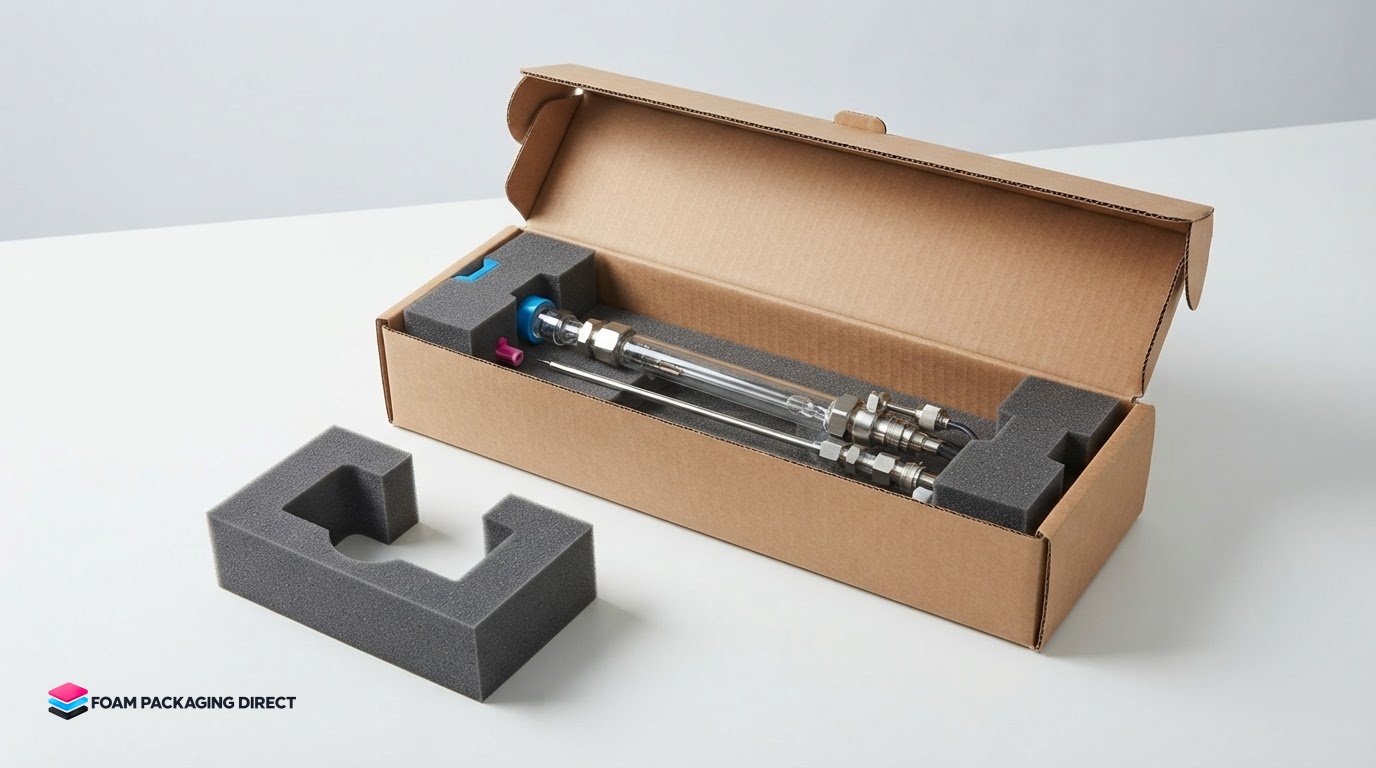
Custom foam end caps protect a product’s ends and help limit movement inside its box. Foam packaging for fragile products works best when the caps are shaped to the item’s dimensions and chosen for its weight, fragility, and shipping conditions. A well-fitted design supports the product without assuming every foam material works the same way.
Protecting delicate surfaces does not have to make packing complicated. The key is choosing a design and material that suit the product, the box, and how the package will be handled.
This guide explains how custom end caps contribute to protection, which details matter when choosing foam, and what information helps shape a practical design. It also covers when end caps may be sufficient and when a full foam insert or foam-and-box package may be a better fit.
Key Takeaways
- Match the end-cap shape to the product and box so the item stays supported and has less room to shift.
- Choose foam packaging by considering the product’s weight, fragility, dimensions, surface sensitivity, and shipping conditions.
- EPS, EPE, and polyurethane have different characteristics, so compare how each suits the product and packaging design.
- Use product measurements and available drawings or photos to help define the right foam thickness and cushioning approach.
Anxiety, hyperactivity, impulsivity, mood changes, and social difficulties
For shipping teams, uncertainty about breakage can lead to returns, rework, and disrupted deliveries. A foam end cap is a shaped cushion fitted over a product’s end. Use one when an exposed end needs support, as with a glass tube or long ceramic component. Match the cap to both the item and the carton so staff can position it consistently.
For glass, ceramics, and electronics, choose packaging based on the item’s shape, weight, surface, and shipping conditions. End caps can support sturdy ends, while a fitted cavity can hold an irregular shape. Electronics may require anti-static cushioning to reduce static generation. Anti-static foam alone does not provide complete ESD protection.
U.S. packaging requirements depend on the product, the foam’s intended use, destination, and customer specifications. Identify these factors for each commercial shipment and determine which requirements apply to that application. Don’t assume one foam material or package design addresses every product or customer requirement.
A drop test evaluates how a packed item responds to a drop, while a vibration test examines repeated movement. Pack the product as it will ship, test under relevant handling conditions, then inspect the product, cushioning, and carton. Check for movement, damage, compressed foam, or box failure. Use the results to adjust the support or fit before repeating the evaluation. For additional guidance on evaluating package performance, see how to reduce shipping damage with foam that fits your product.
Recycling options depend on foam type and local collection practices. Where local guidance allows, separate clean packaging by material and reuse sound end caps or inserts. For instance, keep reusable supports with the product’s packing materials and inspect them before repacking. If foam is contaminated or damaged, follow local disposal guidance instead of placing it in an unsuitable recycling stream.
What types of foam packaging are used for fragile products?
Foam end caps are shaped cushions that fit over a product’s ends. They protect exposed edges and help reduce movement inside a box. For a glass tube, caps can support the ends while leaving the center clear. Their shape should match the product and box, so delicate parts aren’t forced against the packaging.
A custom foam insert is a fitted piece with cutouts that hold products or components in place. It suits items with irregular outlines, multiple parts, or specific contact points. For example, a small instrument and its accessories can sit in separate cavities to keep the pieces organized during packing and transport.
- Foam sheets and pads are flat cushioning layers. Place them between stacked items or above a product to fill space.
- Foam rolls and wrap are flexible cushioning materials. Wrap a smooth, sensitive surface before placing it in a box.
- Foam planks are larger blocks that can be cut into protective shapes. They suit projects needing substantial cushioning pieces.
- Tote and tray inserts are fitted supports for reusable containers. Individual compartments help separate components during handling.
Material choice matters as much as package style. Polyethylene (PE) Foam is often selected when protective packaging needs firmer support. Cross-linked Polyethylene (XLPE) Foam has a linked cell structure. Polyurethane (PU) Foam can provide a softer, conforming cushion. Expanded Polystyrene (EPS) Foam and Expanded Polypropylene (EPP) Foam are formed into protective shapes. These materials are not interchangeable: product weight, fragility, surface sensitivity, and shipping conditions all guide selection.
Anti-Static Foam helps reduce static generation around sensitive electronics. Conductive Foam Packaging is a different option for applications that need a conductive path when handling components. Neither foam type alone makes a complete package compliant with an ESD standard. Match the package design to the product and its protection requirements.
When a package contains medications described in the Fragile X medication guide, foam selection addresses cushioning and placement, not decisions about medication use. Those medications are to be used only under a qualified physician’s supervision. As with other fragile products, choose the packaging form and material according to the product’s protection requirements, keeping medication-use guidance separate from packaging decisions.
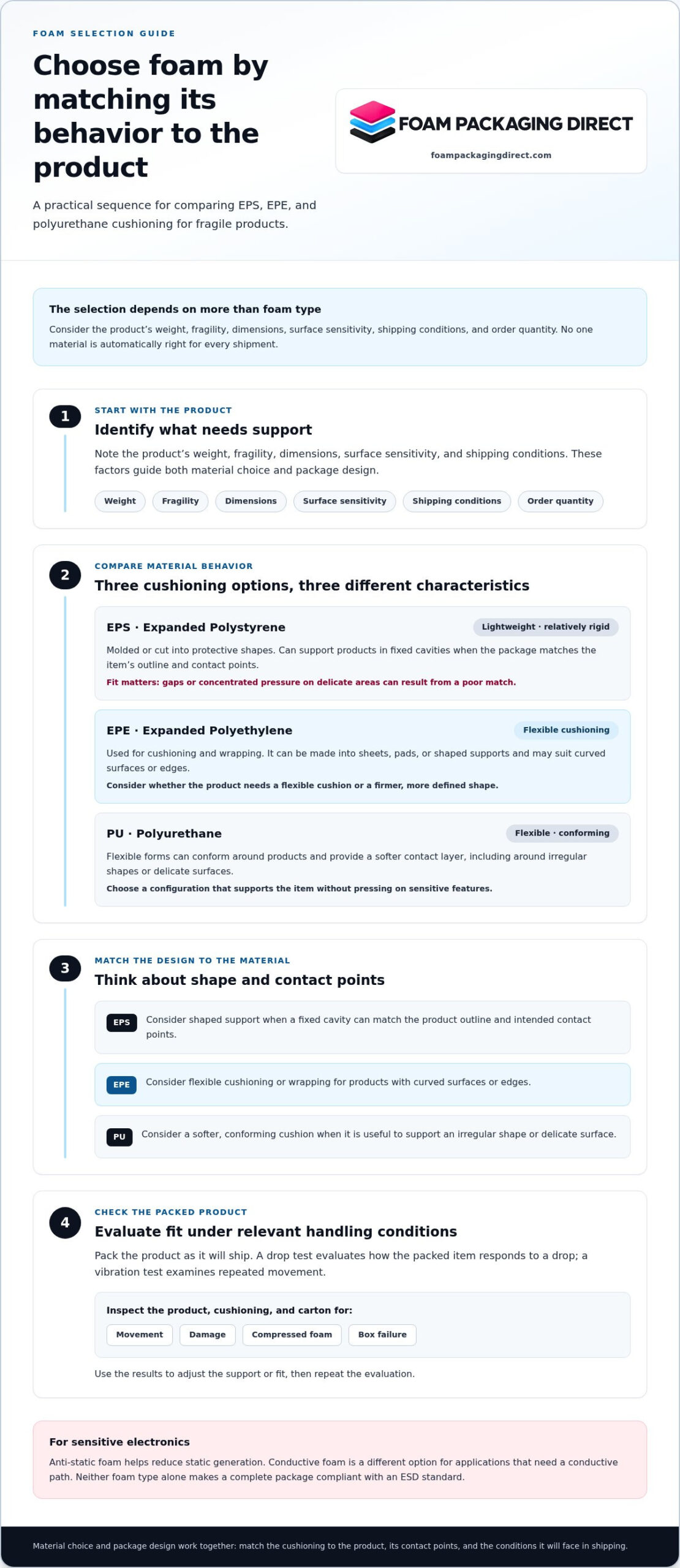
How do EPS, EPE, and polyurethane foam compare for cushioning fragile items?
Expanded Polystyrene (EPS) Foam is a lightweight material molded or cut into protective shapes. Its relatively rigid structure can support products in fixed cavities, such as a component held between shaped blocks. EPS works best when the package design matches the item’s outline and intended contact points. A poor fit can leave gaps or concentrate pressure on delicate areas.
Expanded Polyethylene (EPE) is a flexible polyethylene foam used for cushioning and wrapping. Its give can cushion items with curved surfaces or edges, such as a ceramic vessel. EPE can be made into sheets, pads, or shaped supports. Consider whether the product needs a flexible cushion or a firmer, more defined shape to hold it.
Polyurethane (PU) Foam is available in flexible forms that can conform around products. It can suit delicate surfaces or irregular shapes when a softer contact layer is useful. For example, a sensitive instrument may need cushioning around protruding controls. Choose a configuration that supports the item without putting pressure on those features.
Foam materials differ in structure and behavior, so compare the package design as well as the material. EPS offers shaped, relatively rigid support; EPE provides flexible cushioning; and polyurethane can conform to the product. Product weight, fragility, dimensions, surface sensitivity, shipping conditions, and order quantity all affect the choice. No one material is automatically best for every shipment.
Use this selection sequence:
- Map the product’s contact points, including fragile edges, corners, and projecting parts.
- Decide whether the item needs a firm cavity, flexible wrap, or softer surface contact.
- Match the foam shape and thickness to the product and available box space.
- Review the packed item for movement, pressure marks, and exposed areas.
For example, a rigid ceramic part may benefit from shaped support, while a delicate instrument with protruding controls may need a softer cushion placed with care. Compare the complete package configuration, not just the material names.
How do you choose the right foam density and thickness for product protection?
Foam density describes the amount of material within a given volume. It helps characterize foam structure, but density alone does not determine cushioning performance. A heavy metal component and a delicate glass part place different demands on packaging, even if both fit the same box.
Foam thickness is the distance between the two faces of a cushion. It provides space to absorb compression and movement, but more thickness does not automatically mean better protection. A thick pad may let a product shift, while a thinner, well-fitted support can hold it steadily.
Start with the product and its shipping route. Record its weight, dimensions, fragile areas, and surface sensitivity. Note the box’s interior dimensions and whether the shipment may face repeated handling or vibration. For example, a glass instrument with a delicate rim needs support that avoids pressure on that edge.
Next, match the foam’s firmness and thickness to how it contacts the item. Firmer foam may support a heavier product, while a softer cushion may suit a sensitive finish. Either way, the shape must fit. End supports should contact sturdy areas, and a fitted cavity should hold the item without forcing it into place.
Use these steps to refine the choice:
- Mark the surfaces and features that must not bear pressure.
- Identify where the foam should support the item and limit movement.
- Check the fit inside the box, including clearance around the product.
- Pack a sample and inspect for shifting, marks, or compressed areas.
For electronics, anti-static foam may help reduce static generation around sensitive components. It doesn’t replace other ESD controls. Share product dimensions, weight, box size, and special protection needs when you request a foam packaging quote. Those details help guide a suitable combination of foam structure, fit, and thickness.
Foam Packaging Direct: Custom Foam Inserts
Foam Packaging Direct designs custom foam inserts around products to help businesses protect fragile shipments. Consider a custom insert when standard cushioning allows too much movement or when components need separate, organized spaces.
Foam end caps support exposed areas, while Foam Sheets & Pads can add separation or fill space. The right format depends on the product, container, and packing process. Foam Packaging Direct’s nationwide manufacturing capabilities can help reduce freight expenses and turnaround times for businesses across the country.
To request a quote, provide product dimensions, weight, quantity, shipping ZIP code, and available drawings or photos. Include existing box dimensions and any special protection requirements.
Make Protection Part of Your Packing Process
Protective packaging works best when it fits the way your team packs and ships. Before finalizing a design, consider how staff position the item, close the box, and confirm that the product is secure. A repeatable packing method makes it easier to identify fit issues and keep components organized across shipments.
Use those workflow details to guide your packaging decision. Foam packaging for fragile products should support both the item and the packing process, with clear placement for staff. If your current setup leaves uncertainty about fit or positioning, request a quote for a custom design.
Share your product details and packaging needs to get started. Request a quote for your foam packaging and move ahead with a clearer plan for protecting your products.
Frequently Asked Questions
How do you design custom foam inserts for fragile products?
Design starts with the product’s dimensions and weight, the container size, and the protection requirements. Drawings or photos can show delicate features and where separate components need to sit. For example, a device with a removable cable can have distinct pockets for the device and cable. The insert is cut to the required pocket shapes and depths, then a prototype is reviewed and approved before production. Designs are kept on file for consistent reorders.
How much does custom foam packaging cost per unit in the United States?
There is no fixed per-unit price. Cost depends on the material, product and insert dimensions, cutting method, and order quantity. A simple pad and a multi-pocket insert involve different material and fabrication. Request a quote with the product dimensions and weight, box size, and quantity. Exact pricing is provided only after a quote is issued, based on the packaging design you need.
What are the environmental impacts and recycling options for foam packaging in the United States?
Recycling options depend on foam type and local collection practices. Where local guidance allows, separate clean packaging by material and reuse sound end caps or inserts. Follow local disposal guidance for contaminated or damaged foam.