
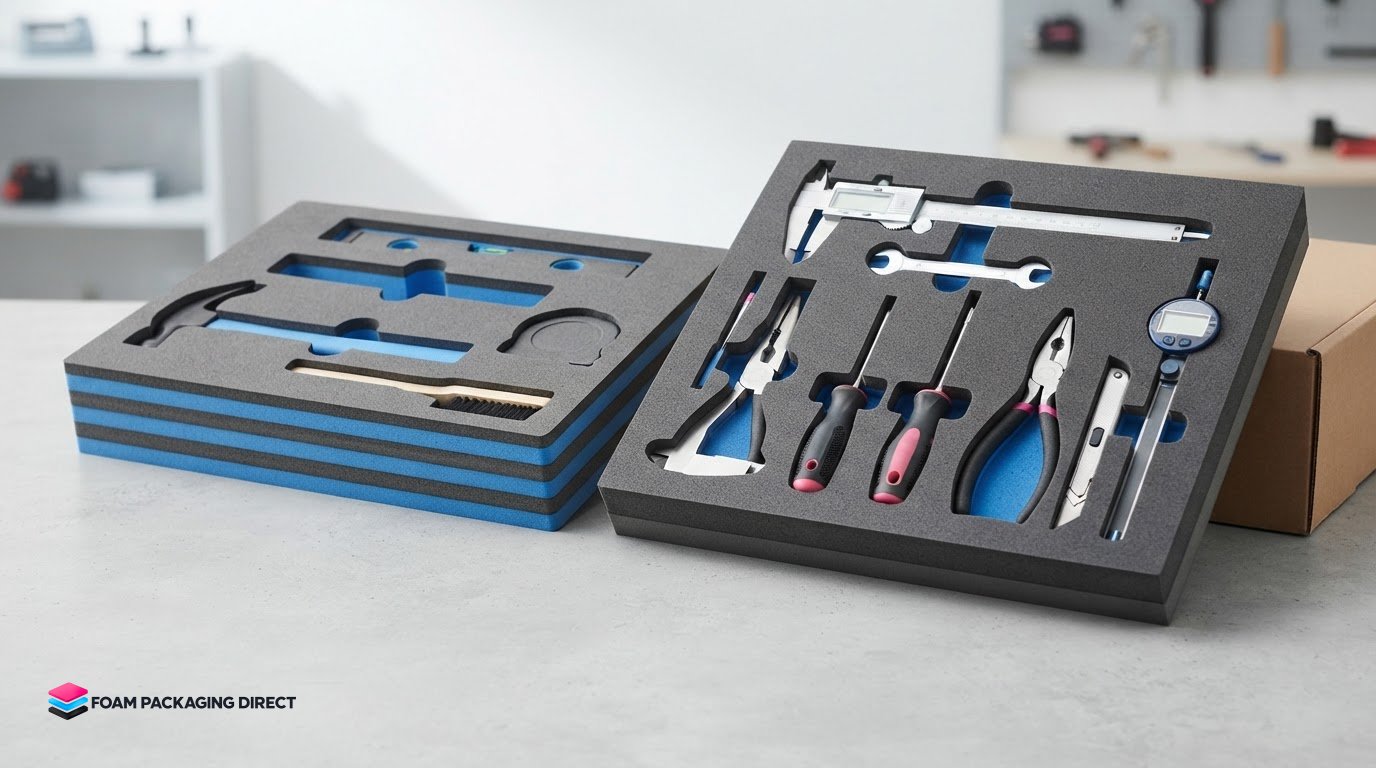
The most detailed foam layout isn’t always the best fit. Kaizen foam vs. custom CNC-routed foam comes down to the job: choose peelable Kaizen foam for straightforward tool layouts you can shape by hand, and CNC-routed foam when complex shapes, precise fit, repeatability, or a polished presentation matter more.
Both approaches can organize and protect items, but they suit valuable, fragile, or unusually shaped products in different ways. Consider not just the cutout, but how often you’ll need to reproduce it and how the foam will hold up in use.
This guide explains how complexity, scalability, presentation, item value, fragility, dimensions, and durability affect the choice. You’ll also find a practical comparison and decision guide to help match the foam approach to your product and packaging needs.
Key Takeaways
- Use hand-shaped foam for straightforward layouts that are easy to adjust; choose routed pockets when precise shapes and consistent repeats matter.
- Match the insert to each item’s weight, fragility, surface sensitivity, and dimensions, as well as the space available in its case or box.
- Consider how often the foam will be used and how it may wear under repeated pressure before settling on a design.
- For a tailored packaging option, provide product measurements and packaging details when requesting a quote for custom foam inserts.
Comparing complexity, scalability, and presentation
Kaizen foam suits simpler layouts shaped by hand, while CNC routing is better for complex pockets and repeatable presentation. The right choice depends on how many item shapes the layout must hold and how consistently you need to reproduce it.
Custom CNC-Routed Foam Preparation
Custom CNC-routed foam is cut by a computer-controlled router to create pockets shaped for specific items. A planned layout guides the cutting, producing defined edges that are easier to reproduce than pockets peeled by hand from Kaizen foam’s layers. For example, a tray holding components with different outlines can have a distinct pocket for each item.
Repeatability matters for production runs: an approved CNC layout can reproduce the same pocket across multiple trays. Hand-cut Kaizen foam may take longer to shape for complex layouts, and the finish can vary depending on who cuts it.
Custom CNC-Routed Insert Design and Ordering
To plan an insert, map the items and their arrangement, then provide their dimensions and the container’s usable interior dimensions. Include the item count and note any shapes or clearances that affect pocket placement. Drawings or photos can help clarify the layout. These details give the design a defined basis before the foam is cut.
Unlike peeling Kaizen layers as needed, a CNC layout is prepared for consistent repeat orders. Review the proposed pocket arrangement before production, especially when a tray holds several components or needs a clean presentation for valuable equipment.
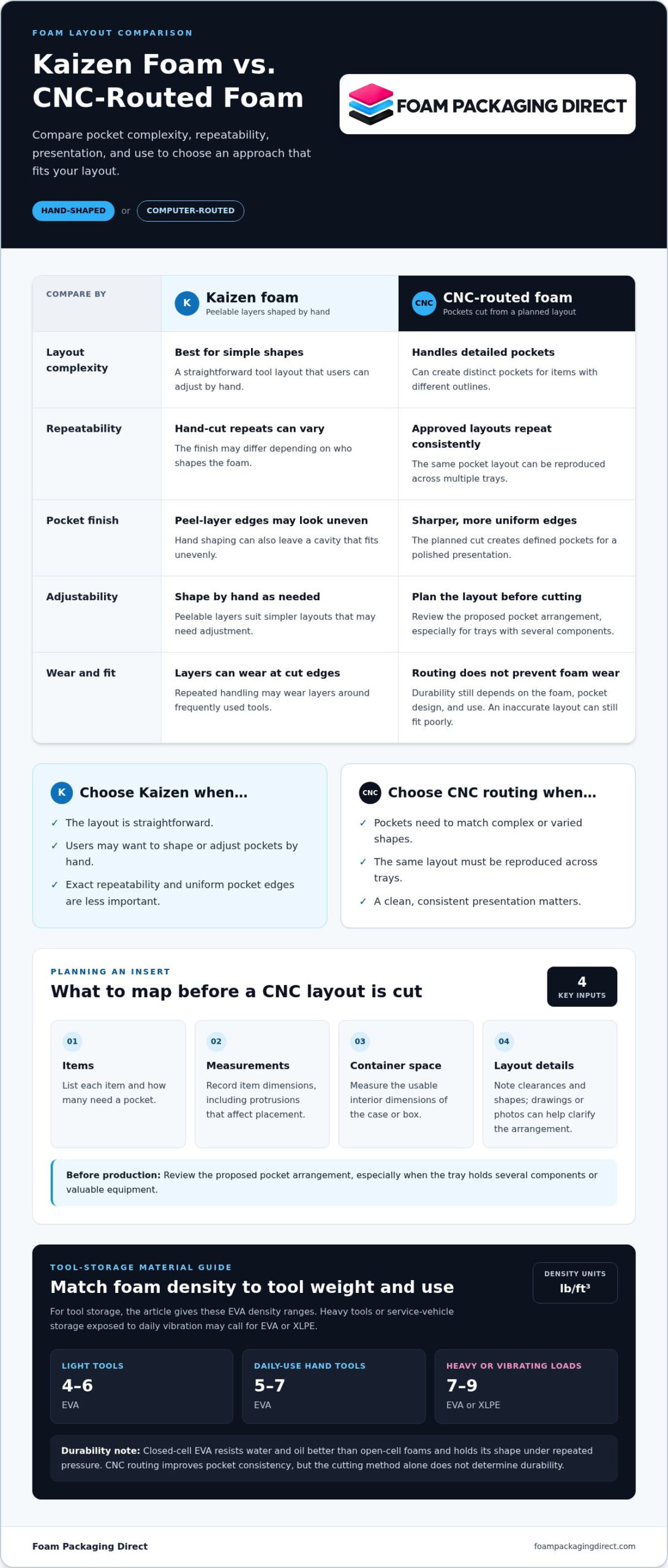
| Option | Complexity | Scalability | Presentation |
|---|---|---|---|
| Kaizen foam | Best for simple shapes | Hand-cut repeats can vary | Peel-layer edges may look uneven |
| CNC-routed foam | Handles detailed pockets | Approved layouts repeat consistently | Sharper, more uniform edges |
For installation, low-exotherm contact adhesives or mechanical fasteners are safer choices, especially in plastic toolboxes, than adhesives that generate more heat. Choose Kaizen foam for a straightforward layout users can adjust by hand; choose CNC routing when complex pockets, repeatable trays, or a polished presentation matter.
Choosing foam based on item value, fragility, and dimensions
Start with the product, not the foam. A camera lens, scientific instrument, and metal component differ in fragility, weight, and surface sensitivity. Those differences affect pocket shape, support points, and how much movement to control inside a case or shipping box. For a valuable item, consider a fitted layout that separates components and organizes accessories. The kaizen foam vs custom CNC-routed foam decision should reflect how much protection and precision the product needs.
Measure each item and the container’s usable interior. Record length, width, height, and any protrusions that affect placement, then compare those measurements with the available case or box space. A routed insert can be designed around both the stored items and the container. Kaizen foam can suit simpler arrangements, while complex outlines or multiple components are harder to cut consistently by hand. This distinction helps match the cutting approach to the layout.
Fragility and intended use matter as much as shape. A delicate instrument shipped by parcel needs support that limits shifting. A component stored in a drawer may instead need accessible, organized pockets. Weigh the item and consider contact surfaces together: a heavy product can press harder into its cavity, while a sensitive finish may need a suitable contact layer. For electronics, anti-static foam offers cushioning with static-control properties, but foam alone doesn’t make a complete package compliant with an ESD standard.
Before selecting a layout, assess these factors:
- Item value and fragility: Determine the support and separation each product needs.
- Dimensions and count: Map every item against the container and planned pocket arrangement.
- Use and repetition: Account for shipping conditions, daily handling, and repeat orders.
- Presentation: Note color or branding needs for samples, demonstration sets, or sales kits.
This assessment helps narrow the options: a simple layout may be shaped by hand, while valuable, delicate, or complex items may call for precisely fitted pockets.
Compression recovery and durability
Durability depends on the foam material, pocket design, and how often tools are removed and replaced. Kaizen layers can wear at cut edges. CNC routing improves pocket consistency, but it doesn’t make foam immune to compression or damage.
Kaizen Foam Durability and Tool Fit
Kaizen foam’s peelable layers let users shape tool cavities, but repeated handling can wear those layers around frequently used tools. A single-layer insert holding light hand tools may last a couple of years of regular use before wear appears. Hand-cut pockets can also fit unevenly, allowing tools to shift if the cavity is too large.
CNC-Routed Foam Durability and Tool Fit
CNC routing creates defined pockets, but durability depends on the foam selected, not the cutting method alone. Closed-cell EVA resists water and oil better than open-cell foams and holds its shape under repeated pressure. A precisely routed pocket can still be a poor fit if the tool dimensions or insert layout are wrong.
For tool storage, match density to weight and use. Light hand tools generally suit EVA foam at 4 to 6 lb/ft³. Daily-use wrenches, sockets, and screwdrivers call for 5 to 7 lb/ft³. Heavy tools or service-vehicle storage exposed to daily vibration call for EVA or XLPE at 7 to 9 lb/ft³.
- Light tools: Consider 4 to 6 lb/ft³ EVA.
- Daily-use hand tools: Consider 5 to 7 lb/ft³ EVA.
- Heavy, vibrating loads: Consider 7 to 9 lb/ft³ EVA or XLPE.
For a service vehicle, a 7 to 9 lb/ft³ base with a softer contact layer can support heavy tools. Check pocket fit and foam condition during routine tool checks, especially around cavities used every shift.
What is Kaizen foam and how is it made?
Kaizen-style foam is typically polyethylene made in thin, differently colored layers. Users shape tool cavities by peeling away layers instead of cutting a permanent layout with a CNC router.
To make a hand-shaped insert, place each tool on the foam and trace its outline. Cut around the marked shape, then remove layers gradually until the tool sits in its cavity. Test the fit as you go. Removing too much foam can leave a pocket loose, while a tight cavity can make tools harder to lift out.
The layered construction lets users adjust a layout without specialized cutting equipment. In a toolbox holding a wrench, screwdriver, and pliers, each cavity can follow the tool’s outline. This works best when shapes are straightforward and the layout doesn’t need exact duplication across multiple trays.
- Plan the layout: Arrange the tools on the foam and leave space between their outlines.
- Mark each position: Trace the tools so their handles and working ends remain easy to identify.
- Remove material gradually: Peel layers in stages and test each tool’s fit before continuing.
- Inspect the edges: Check for loose pieces or rough cuts that could affect tool placement.
Compared with CNC-routed foam, Kaizen foam relies on the user’s cutting skill. Hand-cut edges can vary, and peeled layers leave stepped pocket walls rather than the defined edges produced by routing. Complex shapes can take longer to form and may be harder to reproduce consistently. A planned CNC layout can be cut again for matching trays, while each hand-shaped insert must be recreated carefully.
Choose layered foam for a simple toolbox layout that may change over time. For repeatable cavities or a more uniform finish, a routed design may fit better. Request a quote for a foam insert with your item dimensions and layout details.
Foam Packaging Direct: Custom Foam Inserts
Foam Packaging Direct designs and manufactures custom foam inserts around product dimensions and packaging needs, helping organize components and limit movement during shipping. A custom insert is a practical next step when a hand-shaped layout won’t provide the fit, repeatability, or presentation your products require.
Share each item’s dimensions and weight, the order quantity, shipping ZIP code, and existing box dimensions. Drawings or photos can help show pocket shapes, surface sensitivities, and special protection needs. Foam sheets and pads, rolls and wrap, tote and tray inserts, and foam-and-box packaging can also suit different applications.
Request a quote from Foam Packaging Direct with your product and packaging details to discuss a suitable custom foam insert.
Set a Clear Packaging Specification
Make the insert decision part of the packaging specification, not an isolated purchase. Record the product configuration, container dimensions, and protection priorities alongside the selected foam approach. That gives your team a useful reference when a product changes, a component joins the kit, or packaging moves to another case. Review the specification before repeating a design, since layout changes can affect fit and handling.
For a new or changing package, use the kaizen foam vs. custom CNC-routed foam decision to clarify whether the insert needs to remain adjustable or hold a defined arrangement. Share that priority along with any special protection requirements.
Provide product dimensions, weight, order quantity, shipping ZIP code, existing box dimensions, and available drawings or photos. Request a quote from Foam Packaging Direct with those details to establish a practical starting point for your packaging needs.
Frequently Asked Questions
How much does Kaizen foam cost compared with CNC-routed foam?
There’s no fixed price comparison: material, dimensions, cutting method, and order quantity affect the quote. Kaizen foam is purchased as layered stock for hand-cut layouts, while a routed insert is designed around the product and container. For a project comparison, provide the same item list and box dimensions for both options. Exact pricing for custom inserts is provided only after a quote is issued.
Which foam is better for frequently changing tool layouts?
Kaizen foam is often more practical when tools regularly change positions, because users can reshape its peelable layers by hand. A maintenance kit with tools added or removed between jobs, for example, may benefit from an adjustable layout. A CNC-routed insert is more suitable when the arrangement should stay fixed, such as a standard kit issued to multiple workstations.
How long do Kaizen foam and CNC-routed inserts last in shop or industrial use?
Service life varies with material, handling, tool weight, and how often items are removed. A single-layer Kaizen insert for light hand tools may provide a couple of years of regular use before peel layers show wear. CNC routing describes how pockets are cut, not how long the foam lasts. For repeat-use inserts, polyethylene and EPP are durable material options.
Where can you buy Kaizen foam or order CNC-routed inserts in the United States?
Kaizen foam is generally sold as layered sheets for users to shape themselves. For a custom CNC-routed insert in the United States, Foam Packaging Direct accepts quote requests for custom foam inserts. Include product dimensions, weight, quantity, box or carton size, and available drawings or photos. Those details help define the insert around your products and packaging setup.