
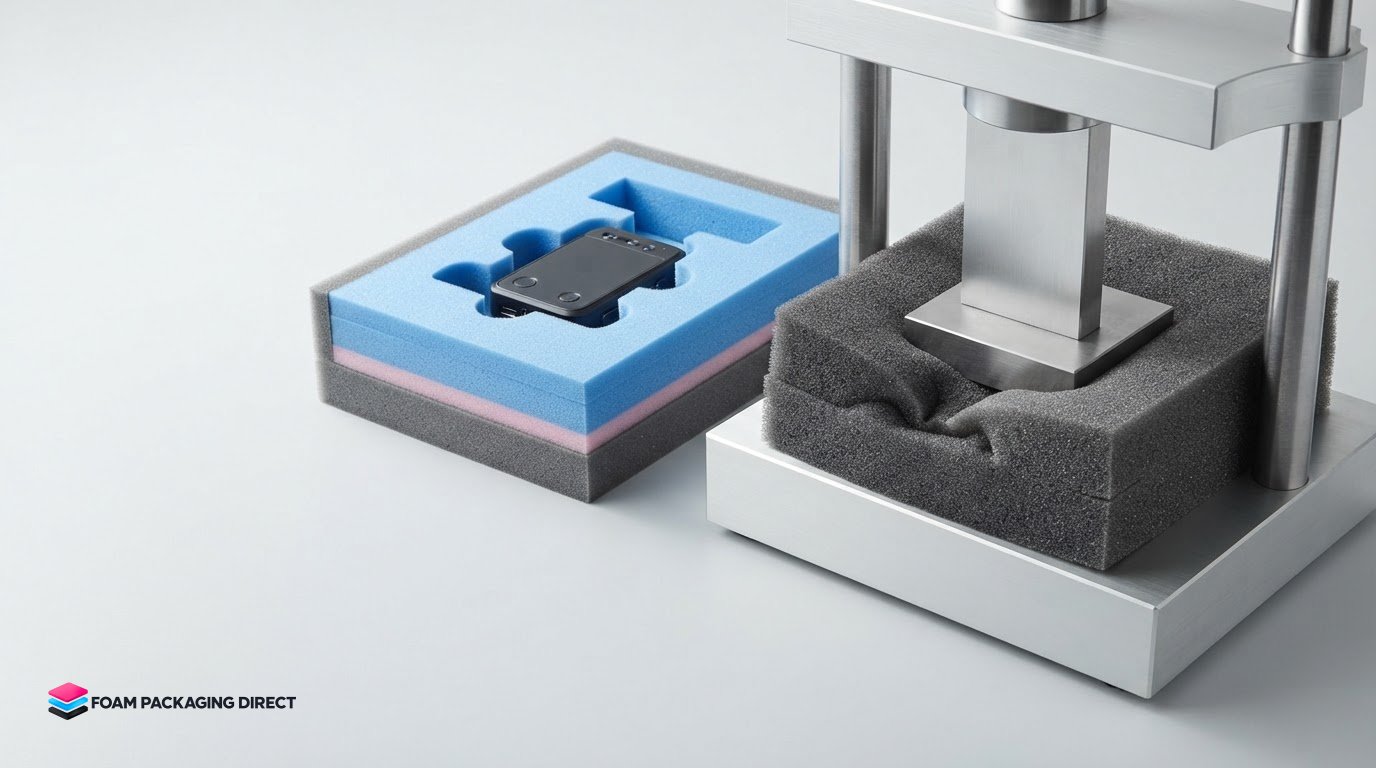
A higher IFD value can indicate firmer foam, but firmness alone doesn’t show whether a package will protect its product. Indentation force deflection (IFD) measures the force needed to compress foam to 25% of its original thickness. Compression deflection describes compressive stress at a defined level of compression. The distinction helps make sense of foam specifications and what they can tell you about cushioning.
It’s reasonable to want a clear number when comparing packaging materials. Indentation force deflection (IFD) provides a useful measure of firmness, but choosing packaging foam also means considering the product’s weight, fragility, dimensions, surface sensitivity, and shipping conditions. A foam that feels firm isn’t automatically the right fit for every item or shipment.
This guide explains how IFD testing works, how firmness relates to cushioning, and why test conditions matter when comparing ratings. It also explains how foam supports a product against pressure and impact during shipping, helping you understand which material properties matter for your packaging application.
Key Takeaways
- Compare IFD ratings only when the test conditions and specimen details align.
- Use firmness data as one input, alongside the product’s weight, fragility, and shipping demands.
- Consider how cushioning supports the item and limits movement inside its package.
- Learn how foam inserts, end caps, sheets, and wrap can fit different packaging needs.
What is Indent Deflection in Foam?
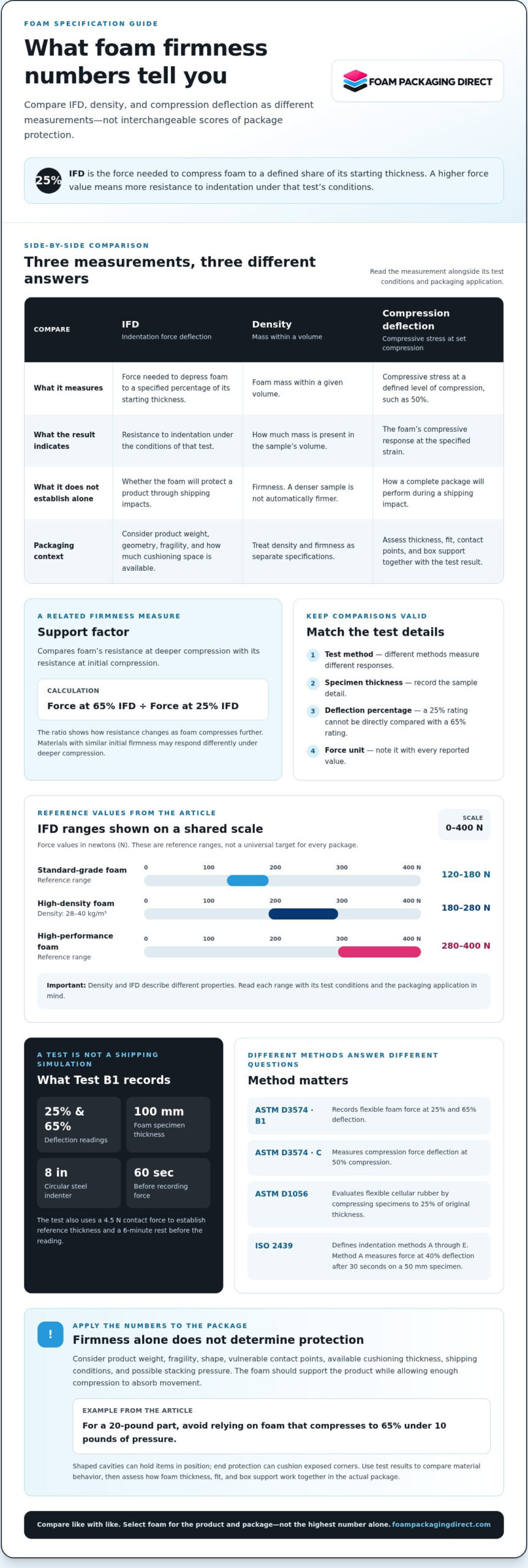
Indentation force deflection (IFD) testing measures the force needed to depress foam by a defined share of its starting thickness. Under ASTM D3574-25, Test B1 records flexible foam force at 25% and 65% deflection. The standard identifies 25% as a primary comfort rating for seating foam. The result describes resistance under a controlled platen, not a complete prediction of package protection.
Test B1 uses a circular steel indenter with an eight-inch diameter and a 100 mm-thick foam specimen. A 4.5 N contact force establishes the specimen’s reference thickness. After a 6-minute rest, the test records indentation force at the target deflection after 60 seconds. Comparing readings requires matching test method, foam thickness, and deflection level. Otherwise, the numbers may describe different conditions.
Other methods answer different questions. ASTM D3574 Test C measures compression force deflection at 50% compression. ASTM D1056 evaluates flexible cellular rubber by compressing specimens to 25% of their original thickness. ISO 2439:2008 defines five indentation methods, A through E. Method A measures force at 40% deflection after 30 seconds on a 50 mm specimen. These standards don’t make results interchangeable; the method and material type matter.
Equipment setup affects the reading. Before testing, confirm that the force-measuring system and platen movement are calibrated, and that the indenter sits squarely over the specimen. Record the material, thickness, test method, and measured deflection with the force result. ASTM D3574-25, published in December 2025, specifies procedures for flexible foam testing. Following one method consistently makes specifications easier to compare across applications.
For packaging, IFD describes how foam may respond when a product presses into it or when cushioning faces internal pressure. It doesn’t directly measure impact protection in a shipment. Product weight, geometry, fragility, and package design still affect material selection. Polyurethane foam IFD data can help inform the choice, but read the rating alongside the test conditions and packaging application.
Indent force deflection (IFD) and foam firmness
IFD describes how foam resists compression, but the value only makes sense alongside its test conditions. Understanding how indentation force deflection (IFD) relates to packaging foam firmness helps teams interpret ratings without treating results from different tests as equivalent.
IFD as a Measure of Firmness
IFD is the force required to compress foam to a specified percentage of its starting thickness. A higher force value indicates greater resistance to indentation under that test’s conditions. For example, a rating measured at 25% deflection can’t be directly compared with one measured at 65% deflection. Check the test percentage, sample thickness, and force units before using values to compare firmness.
Support Factor and Firmness
Support factor compares foam’s resistance at deeper compression with its resistance at initial compression. It’s calculated as the force at 65% IFD divided by the force at 25% IFD. This ratio shows how resistance changes as foam compresses further. For packaging, it can distinguish materials that feel similar initially but respond differently as pressure increases.
Density Compared with Firmness
Density measures foam mass within a volume; firmness measures resistance to indentation. They describe different properties, so a denser sample isn’t automatically firmer. For example, high-density foam is listed at 28-40 kg/m³ with IFD values of 180-280 N. Treat density and IFD as separate specifications. Consistent test conditions also matter: one protocol conditions specimens at 23°C ± 2°C for at least 16 hours.
Typical IFD Values for Packaging
Reference ranges include 120-180 N for standard-grade foam and 280-400 N for high-performance foam. These figures provide context, not a universal target for every package. Record the test method, sample thickness, deflection percentage, and force unit with each value. Compare like with like, then weigh product fragility and available cushioning space.
Packaging cushioning and product impact protection
Choose IFD by considering product weight, fragility, shape, available cushioning thickness, and shipping conditions together. For a 20-pound part, avoid relying on foam that compresses to 65% under 10 pounds of pressure.
The goal is not simply to select the firmest material. Cushioning needs to support the product while allowing enough compression to absorb movement during handling. If foam compresses too easily, the product may shift or contact the box. If it offers too much resistance for the package design, it may not provide the intended cushioning. The initial IFD value describes resistance, but package geometry and contact points matter too.
Consider how the product sits inside the package. A heavy component supported across a broad base places a different load on foam than a small, fragile part resting on narrow edges. Shaped cavities can hold items in position, while end protection can cushion exposed corners. The material should support the product against internal pressure and resist external pressure, including pressure from stacked boxes.
IFD testing and compression load deflection describe related but different responses. IFD records force at a defined indentation; compression deflection expresses compressive stress at a specified strain, such as 50% compression. Neither value alone recreates a shipping impact. Use the test result to compare material behavior, then assess how thickness, fit, and box support work together in the actual package.
A practical evaluation starts with the product’s weight and vulnerable areas. Review how much foam can fit around and beneath it, and whether the box may face stacking pressure. Then compare material specifications measured under consistent test conditions. For a delicate instrument, controlling movement and cushioning sensitive surfaces may be critical. For a dense part, broad support and resistance to compression may matter more. Select the foam and package as one protective system, not as isolated specifications.
What are typical IFD values for packaging foam applications?
Packaging foam doesn’t have one IFD value that suits every product. Reference ranges include 120-180 N for standard-grade foam and 280-400 N for high-performance foam. These figures help compare material specifications, but they aren’t universal selection targets. A suitable value depends on product weight, fragility, contact area, foam thickness, and package design.
Check the deflection level before comparing any two figures. Common IFD values are measured at 25% and 65% of the foam specimen’s initial height. A force recorded at 25% compression describes a different point in the test than force at 65%. A specification that says only “35 ILD” lacks enough measurement context for meaningful comparison. The test percentage and specimen thickness are essential details.
Also separate IFD from compression deflection. IFD records the force needed to indent a specimen; compression deflection expresses compressive stress at a defined strain. For example, compression deflection may be reported as 4.0 kPa at a specified compression percentage. That unit and test basis differ from an IFD value reported in newtons. Don’t treat the numbers as interchangeable firmness ratings.
Use IFD ranges as a starting point, then relate the test data to the package. A heavier product may need foam that resists compression, while a fragile item may need cushioning that absorbs movement without transferring excessive force. Dimensions, vulnerable edges, available foam space, and stacking pressure all shape the choice. Foam density describes a separate property, so it shouldn’t replace IFD in the specification.
For a useful comparison, record the material, test method, specimen thickness, deflection percentage, and force unit together. Compare candidates under matching conditions, then consider how the foam will support the product inside its box. This makes typical IFD values a practical screening tool, rather than a standalone promise of shipping protection.
Foam Packaging Direct: Custom Foam Inserts
Foam Packaging Direct helps businesses turn product dimensions and protection requirements into practical foam packaging. Custom foam inserts hold products and components in place, while foam end caps cushion exposed ends. Foam sheets and pads add separation or surface protection, and foam rolls and wrap help protect items with varied shapes.
Consider custom inserts when products need consistent placement inside a box or loose components need organized compartments. End caps can suit items that need focused protection at their ends. The right format depends on the product’s shape, weight, surface sensitivity, and shipping conditions.
For a quote, provide product dimensions, weight, order quantity, shipping ZIP code, and any available drawings or photos. Include existing box dimensions and special protection requirements if you have them. Request a quote from Foam Packaging Direct to discuss a suitable foam packaging approach.
Turn Foam Specifications Into a Packaging Plan
Understanding indentation force deflection (IFD) for packaging foam gives you a useful starting point, not a complete package specification. The next step is to connect material behavior to the way your product will sit, move, and bear pressure inside its box. Clear product details make that decision easier and help shape a practical packaging approach.
Foam Packaging Direct offers custom foam inserts, foam end caps, and foam sheets and pads for different cushioning needs. Share the product’s dimensions and weight, order quantity, shipping ZIP code, and any available drawings or photos. Include existing box dimensions and special protection requirements when relevant.
Request a quote from Foam Packaging Direct to discuss packaging for your product. A well-defined starting point can help move your specification toward a suitable design.
Frequently Asked Questions
What Is foam IFD testing?
Foam IFD testing provides a controlled way to compare foam samples or production batches. For packaging decisions, use the result as an initial screening measure, then consider how the material fits around the actual product. A rating cannot show whether a cavity is shaped correctly or whether contact points protect vulnerable edges. Those details belong in the package design and packout review.
What is ILD/IFD and Why Does it Matter for Packaging?
ILD and IFD are labels for foam indentation ratings. They matter in packaging because the rating can help narrow material choices before you assess the full package. For example, an insert for several components may need to hold each item in a consistent position, while a pad may need to separate broad surfaces. Shape, fit, and surface sensitivity remain important alongside the rating.
What is ILD/IFD?
ILD means indentation load deflection, and IFD means indentation force deflection. Both terms refer to the same type of foam rating. The different wording doesn’t identify a foam material or tell you whether it suits a specific product. For a clear purchasing specification, pair the label with the test conditions and describe the part, container, and protection needs the foam must accommodate.
How is foam IFD measured and what test standard is used?
ASTM D3574 is a standard used for flexible foam IFD testing, and ISO 2439 is another indentation-testing standard. The test name alone doesn’t tell a packaging team how the foam will perform in a particular design. Use the reported result to compare materials under matching conditions, then consider the package’s internal layout, product contact points, and shipping environment.
What is the difference between IFD and ILD in foam testing?
In foam terminology, IFD and ILD refer to the same kind of indentation rating, with “force” and “load” used in the names. The terms don’t indicate different packaging uses. If supplier documents use different labels, compare their stated test conditions rather than relying on the abbreviation. Consistent terminology across specifications also makes material reviews easier to follow.
How does foam thickness affect IFD measurements?
In a package, foam thickness affects how much cushioning material sits between the product and the box or another object. The available space must also allow the product to fit securely without unwanted movement. For example, a thin pad beneath a component serves a different layout purpose from a shaped insert surrounding its sides. Consider thickness alongside the product dimensions and box interior.