
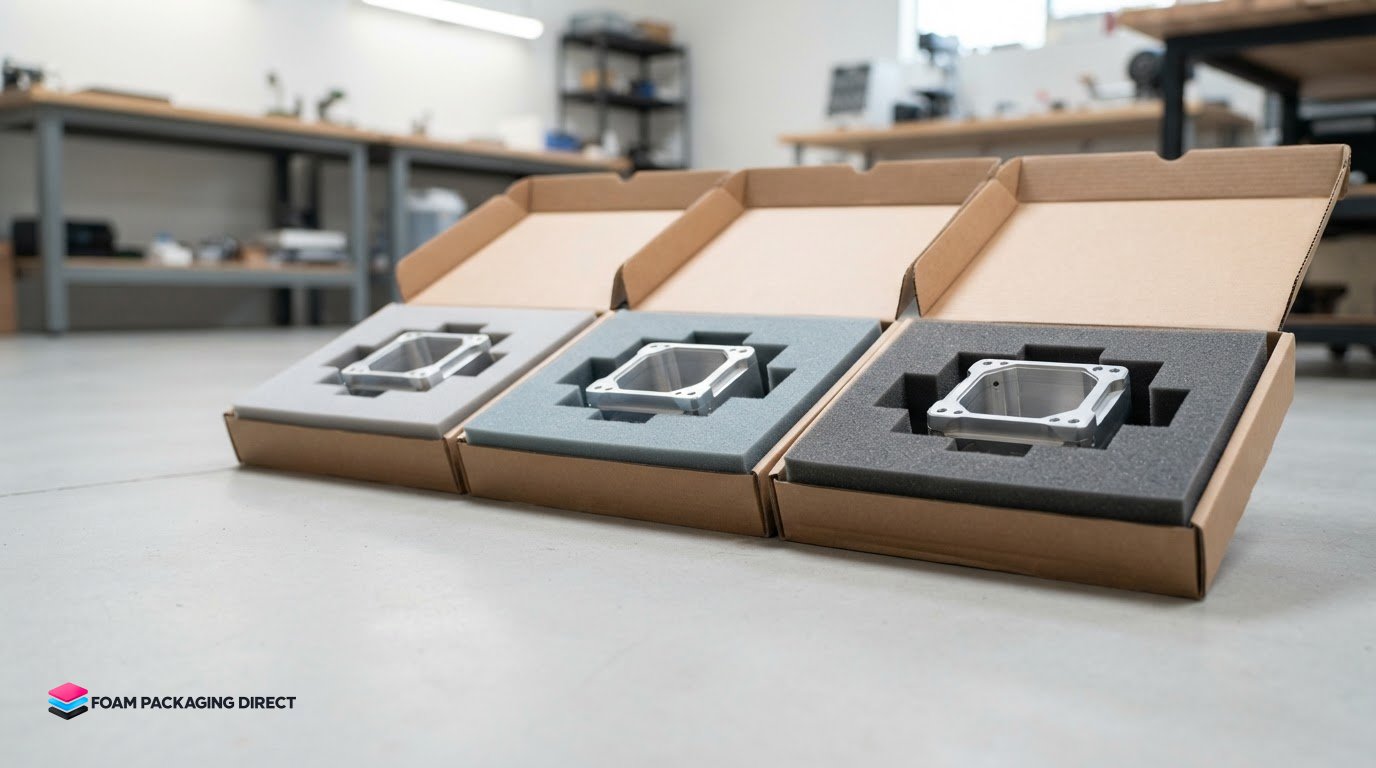
Foam density is the weight of foam material per unit of volume, measured in pounds per cubic foot. A 2.0 PCF polyurethane foam weighs 2 pounds per cubic foot when fully cured. Choosing low-density versus high-density polyurethane foam cushioning is about balancing material weight and durability, not simply choosing soft or firm foam.
It’s easy to assume denser foam must feel harder, but density and firmness are different properties. Density can help indicate how well foam holds up under repeated use, while firmness is measured separately.
This guide explains what density means, how it relates to cushioning durability, and how low-, medium-, and high-density polyurethane foams compare. You’ll also learn how density is measured and why it matters when choosing cushioning for packaging.
Key Takeaways
- Use density to assess how much foam material is packed into a volume, not to predict how soft or firm the cushion will feel.
- Consider how often and how heavily a cushion will be used when weighing durability needs against material choice.
- Treat low-, medium-, and high-density labels as context-dependent categories, since classification ranges can vary by application.
- Learn how density testing works so you can interpret foam specifications and compare cushioning options more confidently.
What is Foam Density?
Foam density is the weight of material within a given volume. For polyurethane cushioning, it describes how much material occupies that space, not how firm the cushion feels. Choosing between low-density and high-density polyurethane foam cushioning starts with understanding this distinction.
Density and Firmness
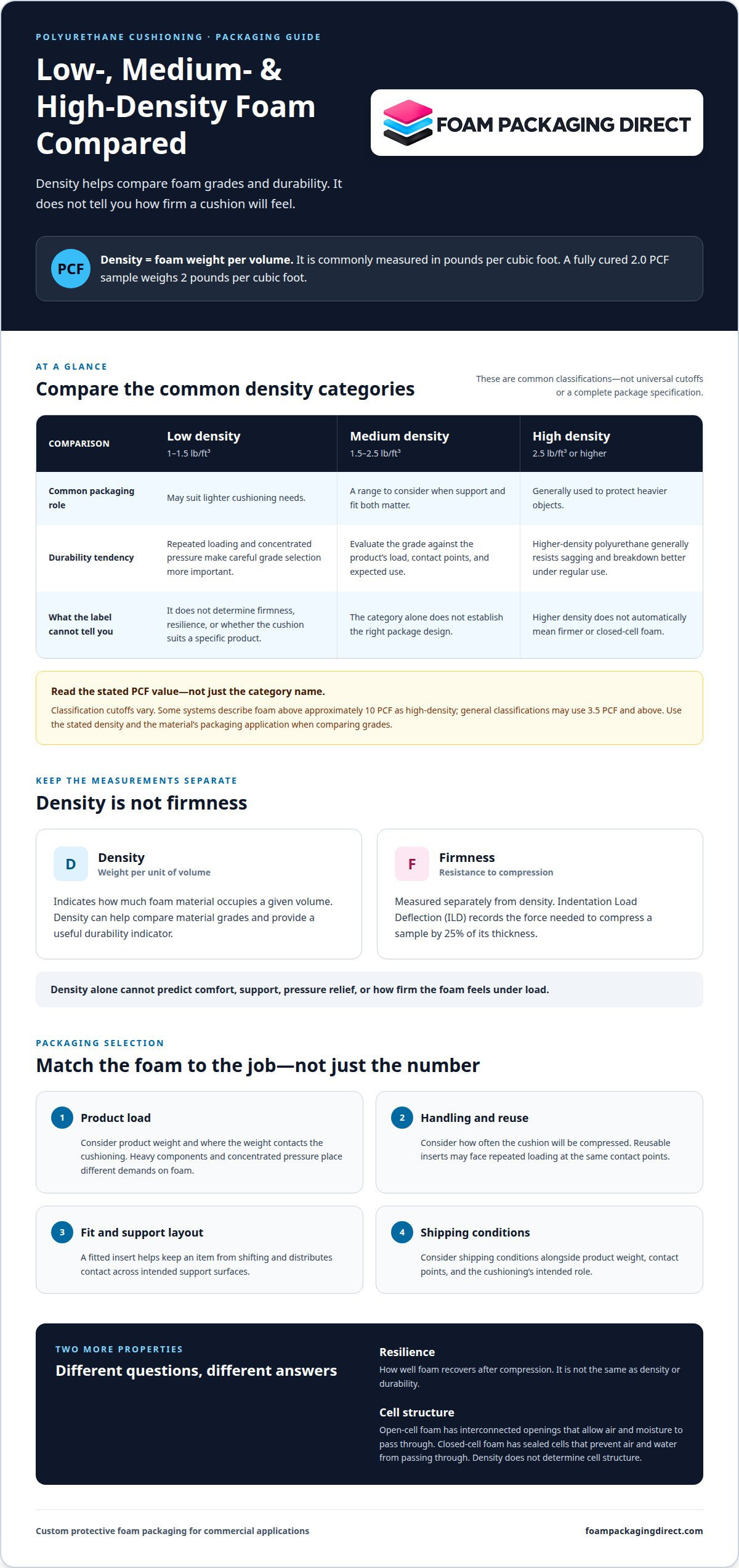
Density is foam weight per unit of volume, commonly stated in pounds per cubic foot. A fully cured 2.0 PCF foam sample weighs 2 pounds per cubic foot. Firmness describes resistance to compression, so these measurements answer different questions about a cushion.
Indentation Load Deflection, or ILD, measures firmness by recording the force needed to compress a sample. In the described ILD test, the sample is compressed by 25 percent of its thickness. Density alone cannot predict comfort, support, or pressure relief. Cushion design and firmness also affect how the foam feels under load.
Prices for low- and high-density polyurethane foam vary based on factors such as dimensions, density, order quantity, and cutting requirements. Request a quote for exact pricing. Comparing these details helps match material to the specific cushion design.
Foam Structure and Resilience
High-resilience foam describes foam’s ability to recover after compression; density describes its weight relative to volume. Conventional polyurethane foam is a broad material category, and much of it is open-cell. A typical density range for conventional open-cell foam is 1-3 lb, but that range does not define firmness or resilience.
Cell structure is separate from density. Open-cell foam has interconnected openings that allow air and moisture to pass through. Closed-cell foam has sealed cells that prevent air and water from passing through. Higher density does not automatically mean a closed-cell structure.
These distinctions guide material selection. For example, open-cell foam may suit filtration, while closed-cell foam can suit gasketing. Density, cell structure, and resilience describe different material characteristics, so one measurement cannot replace the others when matching foam to an application.
Foam density and durability
For packaging, durability means cushioning can continue supporting a product through repeated handling and compression. Density helps compare material grades, but product weight, contact points, and shipping conditions also affect performance.
Density as a Durability Measure
Higher-density polyurethane generally resists sagging and breakdown better under regular use, making density a useful durability indicator. It is not a stand-alone prediction of package life. A difference of 0.5 lb, or even 0.1 lb, can affect how foam responds to pressure and retains its shape, so small grade changes may matter in a closely fitted insert.
When a package carries a heavy component, repeated compression can gradually reduce cushioning support. Foam’s resistance to tensile and tear forces also matters if an insert is removed and replaced during handling. Density comparisons are most useful when the foams serve the same packaging function and are evaluated alongside the product’s weight and support layout.
Resilience and Foam Lifespan
Resilience describes how well foam recovers after compression, while durability describes its ability to keep functioning through use. As polyurethane density increases, compression set generally decreases, meaning the foam is less prone to permanent thickness loss after sustained pressure.
That distinction matters when designing protective packaging for parts that are packed and unpacked repeatedly. A reusable insert may face ongoing compression at the same contact points, while a one-way shipment may place different demands on the cushioning. Low-density foam can suit lighter-duty applications, but repeated loading and concentrated pressure make careful grade selection more important.
Durability also depends on package fit. If an item shifts, its weight may concentrate on a small area instead of the intended support surfaces. Matching the insert’s shape to the product helps distribute contact and maintain placement during transit. Consider the handling cycle, expected reuse, and product contact points alongside foam density. Together, these details offer a more practical basis for choosing cushioning than density alone.
Low-, medium-, and high-density polyurethane foam
Density classifications offer a starting point for comparing foam grades used in commercial packaging. The ranges are conventions, so consider the material’s role in the package as well as its label.
Density Ranges
One common classification places low-density foam at 1-1.5 pounds per cubic foot, medium-density foam at 1.5-2.5, and high-density foam at 2.5 or higher. The shared boundary values show why labels alone may not identify a precise grade.
Other classification systems use different cutoffs. For example, some describe polyurethane foam above approximately 10 PCF as high-density, while general classifications may use 3.5 PCF and above. When comparing packaging materials, use the stated PCF value and application rather than relying only on “low,” “medium,” or “high.”
These figures describe material categories, not a complete package specification. Cushioning design also depends on the product’s shape, weight, and contact points, as well as the space available in the package.
Uses Across Density Levels
Density levels can help narrow options for different packaging jobs. Lower-density foam may suit lighter cushioning needs, while higher-density polyurethane is generally used to protect heavy objects. Medium-density grades offer another range to consider when the product and package call for a balance of support and fit.
A fragile, lightweight component and a heavy industrial part, for example, place different demands on cushioning. The first may need carefully shaped support to prevent movement; the second may require foam that can handle greater loading. Density category alone does not determine the right design.
Packaging engineers can use density as one comparison point alongside product weight, fragility, dimensions, surface sensitivity, shipping conditions, and order quantity. A compact insert with defined contact areas differs from a larger pad separating components. Matching the foam grade to the package’s actual job helps avoid choosing material just because its classification sounds more protective.
How polyurethane cushion foam density is measured
Density is measured by comparing a foam sample’s weight with its volume. The result is commonly reported in pounds per cubic foot, or PCF. For example, a fully cured 2.0 PCF polyurethane foam weighs 2 pounds per cubic foot.
To understand a density figure, identify the sample’s volume and weight. Calculate volume from the sample’s dimensions and measure its weight on a scale. Divide the weight by the volume to get density. Use consistent units: the result must be expressed as pounds per cubic foot to compare it with a PCF specification.
This measurement describes the foam material, not the firmness of a finished cushion. A cushion’s overall weight also depends on its dimensions. Density data helps compare material grades, while separate measures assess firmness and other performance properties. A foam sample’s PCF value alone does not explain how it will feel or perform in every design.
Use the figure in context. For example, a packaging engineer choosing cushioning can compare the foam’s measured density with the product’s weight, fragility, and shipping conditions. Thickness and how the foam supports the item also affect the finished package. A higher PCF number alone is not a complete selection rule for seating, an occasional-use pillow, or protective packaging.
Health, fire-safety, and emissions requirements in the United States depend on the product and its intended use. A foam density measurement does not establish whether the finished product complies with those requirements.
For a packaging quote, provide the product’s dimensions and weight, order quantity, shipping ZIP code, and any drawings or photos. These details help connect a density specification to the cushioning application.
Foam Packaging Direct: Polyurethane Foam
Foam Packaging Direct helps businesses turn foam selection into practical cushioning for products in transit. When a shipment needs shaped support, custom polyurethane foam inserts can hold items in position and help reduce movement inside the box.
Foam End Caps can cushion product edges, while Foam Sheets & Pads can separate or protect surfaces. The right format depends on product weight, fragility, dimensions, surface sensitivity, shipping conditions, and order quantity. Density is one part of the decision; package design and product fit matter too.
To request a quote, contact Foam Packaging Direct with your product dimensions, weight, quantity, shipping ZIP code, and any available drawings or photos. Include existing box dimensions and special protection needs if they apply.
Choose cushioning around the shipment
Start with the product and its packaging needs. Consider how it will sit in the package, where it needs support, and what could shift during transit. This keeps the low-density vs. high-density polyurethane foam cushioning choice tied to the job, not just the label.
Foam Packaging Direct can help translate those requirements into a practical packaging design. Share the product dimensions and weight, order quantity, shipping ZIP code, and any drawings or photos. Existing box dimensions and special protection needs can also help shape the quote.
Request a quote from Foam Packaging Direct to discuss cushioning for your shipment. A clear description of the product and its packaging needs is a useful starting point, and the right design can make packing more straightforward.
Frequently Asked Questions
Does higher density mean heavier cushions?
Yes. If two cushions have the same dimensions, the one made with higher-density foam weighs more because it contains more foam material in the same space. For procurement, compare cushions with matching length, width, and thickness; otherwise, size differences can also affect total weight. This matters when estimating packed shipment weight or handling requirements, since foam density is only one factor in the finished cushion’s weight.
What is the difference between low-density and high-density polyurethane foam?
Low-density foam has less material in a given volume, while high-density foam has more. Higher-density polyurethane generally resists sagging and breakdown better under regular use, so it may be worth considering for cushions exposed to frequent loading. Density labels don’t indicate whether a particular grade is soft or firm, though. Compare the intended use and firmness specification before choosing.
How is polyurethane foam density measured in pounds per cubic foot?
Density in pounds per cubic foot is calculated by dividing a foam sample’s weight in pounds by its volume in cubic feet. Use the same units when comparing specifications, and make sure the stated value applies to the foam grade being considered. Cushion dimensions affect total weight, but not the material’s density rating.
How do foam density and firmness (ILD or IFD) differ?
Density describes the amount of foam material in a given volume; ILD or IFD describes resistance to compression. These measurements answer different selection questions. For example, two cushioning grades with similar density but different ILD values can feel different under pressure. Compare density when assessing material content and durability, then use the firmness rating to judge how much support the cushion provides.
What are typical density ranges for low-, medium-, and high-density cushioning foam?
One common convention calls 1-1.5 pounds per cubic foot low-density, 1.5-2.5 medium-density, and 2.5 or higher high-density. Categories can overlap because furniture and other applications use different classifications. Treat these ranges as a guide rather than universal boundaries. For a meaningful comparison, use the application and the foam’s specific density rating, not its low-, medium-, or high-density label alone.
How long does low-density versus high-density polyurethane foam last in cushions?
Typical estimates for mass-market furniture foam are 2-5 years for 1.5-1.8 lb/ft³ foam and 8-15 years for 2.5-2.8 lb/ft³ foam. These ranges describe furniture use, not shipping cushions or every foam formulation. Cushion design, frequency of compression, and loading affect wear, so use lifespan figures as context when comparing materials for a particular seating application.