
The closest match isn’t automatically the best fit. When comparing Plastifoam custom foam competitors, consider how well each company can shape cavities to your product, select a suitable foam, and fabricate the insert. The right solution depends on the item’s weight, fragility, dimensions, and shipping conditions.
It’s reasonable to expect a custom insert to hold products securely and make packing straightforward. This guide explains how fitted cavities reduce movement, what differences between foam materials mean in practice, and how to compare custom foam insert companies on fabrication options and application fit. You’ll also see how methods such as CNC routing, die cutting, and waterjet cutting relate to different packaging needs, so you can focus on the criteria that matter for your product and order.
Key Takeaways
- Match cavity dimensions and foam characteristics to the product’s weight, fragility, surface sensitivity, and shipping conditions.
- Compare custom foam insert companies by material options, fabrication methods, order needs, and how well their approach fits your packaging design.
- Understand when CNC routing, die cutting, or waterjet cutting may suit a particular insert design and production requirement.
- Consider production location and shipping destination when weighing supplier options, then explore inserts, end caps, sheets, and wrap for your application.
Custom-fit foam cavities and product security
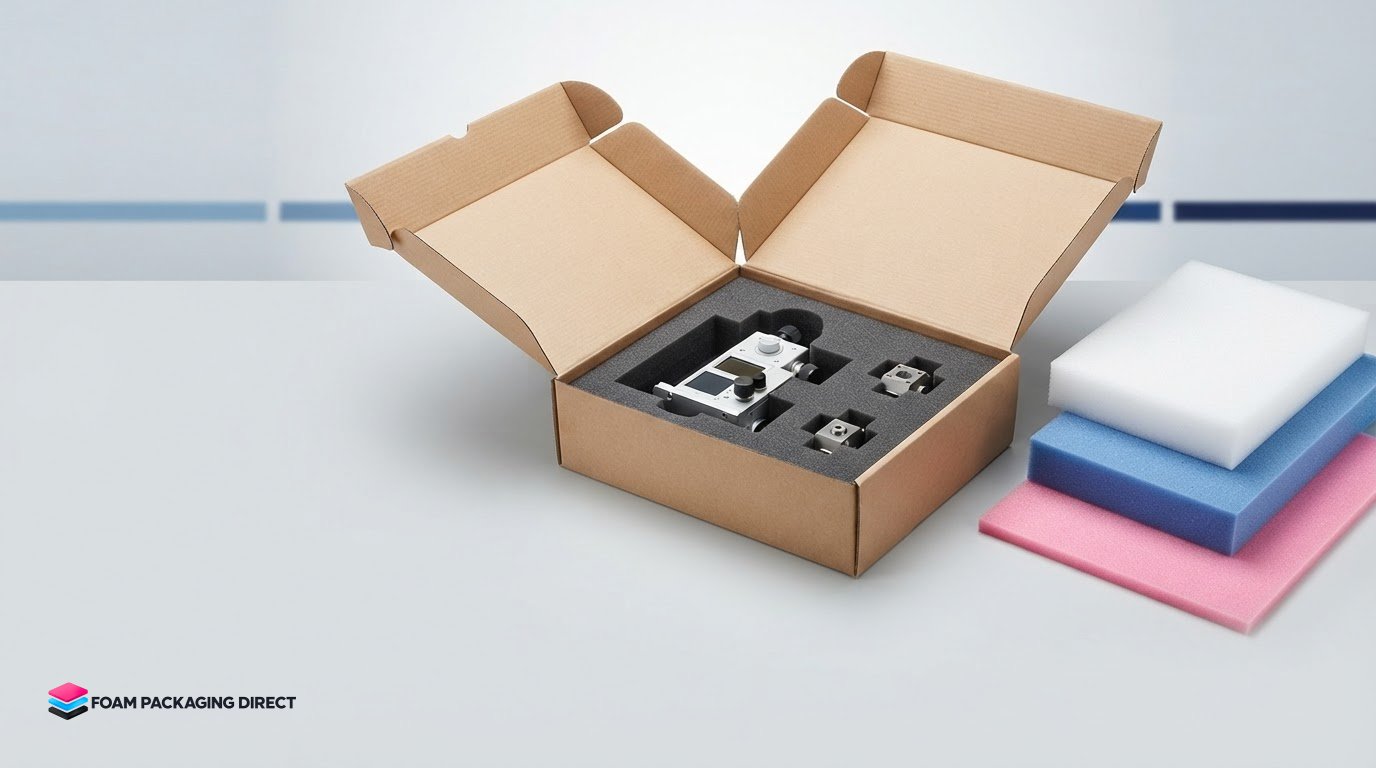
A fitted cavity gives each product a defined position inside its package. Its shape supports the item and limits movement that could bring it into contact with box walls or nearby components. Generic foam may leave gaps, prompting packers to add loose padding or fillers. For a machined component with protruding fittings, a cavity can support the main body while leaving space for those features.
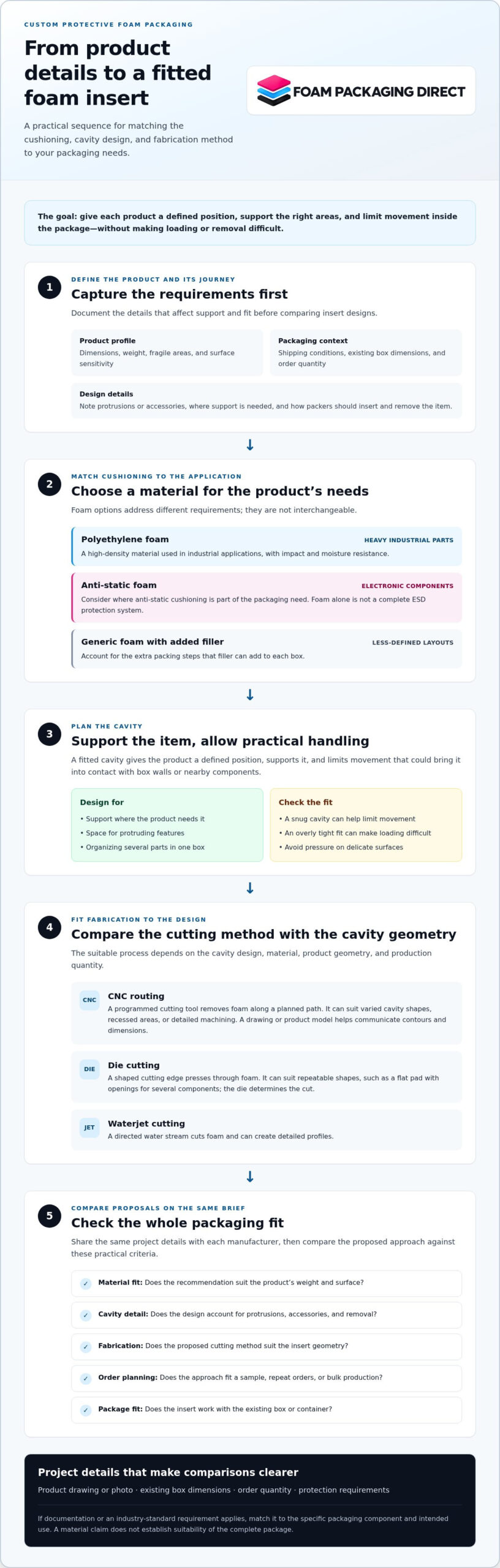
Start the design by documenting the product’s dimensions, weight, fragile areas, and surface sensitivity. Decide where the foam should support it and how packers should remove it. A snug cavity can organize several parts in one box, but an overly tight fit can make loading difficult or put pressure on delicate surfaces.
- Heavy industrial part: Consider polyethylene foam, a high-density material used in industrial applications with impact and moisture resistance.
- Surface-sensitive item: Identify areas that should not rub against the cavity during insertion, removal, or transit.
- Electronic component: Consider anti-static foam cushioning where static control is part of the packaging need. It is not, by itself, a complete ESD protection system.
These options address different packaging requirements and are not interchangeable. The comparison below links each approach to a practical decision.
| Option | Best suited to | Quantity consideration |
|---|---|---|
| Custom cavity in polyethylene | Industrial parts needing defined support | Compare setup needs with planned run size |
| Custom cavity in anti-static foam | Components requiring anti-static cushioning | Align cavity design with shipment frequency |
| Generic foam with added filler | Less defined product layouts | Account for extra packing steps per box |
Choose a material and cavity style that suit the product’s protection needs, then consider how the design will work for the order quantity and future production runs.
Small-batch and bulk orders call for different planning questions. For a limited run, prioritize accurate dimensions and straightforward packing. For recurring or larger orders, consider whether the cavity layout can be reproduced consistently. Share product drawings or photos, existing box dimensions, and order quantity so the design reflects both the item and its production needs.
Custom foam insert company comparisons
When choosing a custom foam manufacturer, compare material selection, cavity design, fabrication options, order flexibility, and fit with your package. Plastifoam custom foam competitors may differ in process and material options, so assess each proposal against the product’s weight, fragility, surface sensitivity, shipping conditions, and order quantity. The right capabilities are those that match your packaging requirements.
For a fair comparison, provide the same project details to every company: a product drawing or photo, existing box dimensions, order quantity, and protection requirements. Then assess each proposal using consistent criteria:
- Material fit: Does the recommendation suit the product’s weight and surface?
- Design detail: Does the cavity account for protrusions, accessories, and removal?
- Fabrication: Does the proposed cutting method suit the insert geometry?
- Order planning: Does the approach fit a sample, repeat orders, or bulk production?
- Package fit: Does the insert work with the existing box or container?
Certification and industry-standard requirements vary by material, facility, and application. No single certification establishes suitability for every insert. Match any required documentation to the specific packaging component and its intended use, and distinguish claims about a material from claims about a complete package.
For example, an electronics shipment may require anti-static cushioning, while a heavy mechanical part may need a different material and cavity design. Anti-static foam can help control static charge, but foam alone does not make the complete package compliant with an ESD standard. Specify these requirements separately.
Use a scorecard to compare proposals against required materials, cavity details, cutting method, order quantity, and box dimensions. Note trade-offs, such as an insert that organizes components but requires a different box footprint. A shared project brief makes it easier to compare Plastifoam custom foam competitors based on the same requirements, rather than broad capability claims, and gives your team a practical basis for choosing a manufacturer.
Which Plastifoam competitors offer CNC cutting, die cutting, or waterjet foam fabrication?
Custom foam packaging can be fabricated with CNC routing, die cutting, or waterjet cutting. These methods shape foam differently, so a company’s suitable option depends on the cavity design, material, product geometry, and production quantity. When comparing Plastifoam’s custom foam competitors, look for a clear match between the proposed process and the insert you need, rather than assuming every manufacturer uses all three methods.
CNC routing uses a programmed cutting tool to remove foam along a planned path. It can suit inserts with varied cavity shapes, recessed areas, or layouts that need detailed machining. A drawing or product model helps communicate the required contours and dimensions.
Die cutting presses a shaped cutting edge through foam. It can suit repeatable shapes, such as a flat pad with openings for several components. Because the die determines the cut, this method is relevant when the same layout needs to be produced consistently.
Waterjet cutting uses a directed water stream to cut foam. It can create detailed profiles without relying on a shaped die. The part’s outline, foam thickness, and cavity detail help determine whether this process suits the design.
- For a changing design: Compare CNC routing and waterjet cutting for the required cavity geometry.
- For repeated flat shapes: Consider whether die cutting matches the layout and planned quantity.
- For a complex part: Provide a drawing or photo that shows contours, protrusions, and areas needing support.
To compare manufacturers fairly, describe the same packaging project to each one. Include product dimensions, weight, existing box size, material needs, and order quantity. Record the fabrication methods each company proposes for that design and whether the process suits your production plans. A method name alone does not show that a particular cavity will fit the product.
For electronics, also describe any static-control requirements; cutting method and foam function are separate design decisions. That distinction helps buyers compare fabrication capability without treating CNC routing, die cutting, and waterjet cutting as interchangeable.
Which custom foam companies serve customers near Plastifoam locations?
A company’s production locations and the shipment route affect the geographic side of a comparison. Foam Packaging Direct supplies businesses nationwide. Compare how a manufacturer’s production setup aligns with your shipping needs, rather than relying on a company’s office address. This matters when a product ships from one part of the country to a customer elsewhere.
Use each manufacturer’s stated production footprint to build a location-based shortlist. Then compare how its facilities align with your origin, destination, and order schedule. Regional production can reduce the distance foam travels, which may help control freight expenses and delivery time. Those outcomes depend on the specific order, route, and production location.
Review these location factors for each company:
- Manufacturing footprint: Identify whether production occurs near your shipping point, destination, or both.
- Service coverage: Check whether the company serves your delivery ZIP code, including for repeat orders.
- Product fit: Compare its foam materials, insert design, and fabrication options against your packaging specification.
- Shipment details: Provide box dimensions, order quantity, and destination ZIP code for a useful comparison.
A nearby facility alone does not establish the best fit. For a delicate instrument, cavity geometry and material suitability still affect protection. For recurring shipments of standardized components, consistent production and a practical delivery route may matter more than office proximity. Weigh location alongside product requirements, not as a substitute for them.
Apply the same project information to every Plastifoam alternative you evaluate. Record the proposed production setup, shipment destination, material, fabrication method, and order quantity. This makes geographic comparisons more useful than a list of company addresses and helps you assess nationwide supply in relation to your shipment.
For a location-aware quote comparison, provide your shipping ZIP code, product dimensions and weight, order quantity, and available drawings or photos. Include existing box dimensions and any special protection requirements. These details connect the packaging design to the actual route and order, helping you assess regional production alongside the fit of the foam solution.
Foam Packaging Direct: Custom Foam Inserts
Foam Packaging Direct helps businesses match packaging needs with custom foam inserts, end caps, sheets, pads, and rolls. Choose a fitted insert when products need shaped cavities to stay organized and limit movement inside a box. Foam end caps protect product ends, while sheets, pads, and rolls offer other ways to cushion items or separate components.
Share the product’s dimensions and weight, order quantity, shipping ZIP code, and available drawings or photos. Include existing box dimensions and special protection requirements. These details help shape a packaging design around the product and shipment, whether you need an insert for one component or an organized layout for several parts.
Request a quote from Foam Packaging Direct with your product and shipping details to discuss a custom foam packaging solution.
Turn your comparison into a packaging plan
A useful supplier comparison ends with a clear packaging specification, not just a shortlist. Decide what the insert must support, how products should sit inside the box, and which details packers need to identify quickly. Then use the same requirements to compare proposed designs and choose a practical next step.
Foam Packaging Direct offers custom foam inserts, foam end caps, and foam sheets and pads for different packaging needs. As you compare Plastifoam and other custom foam competitors, consider which format best suits your product and packing process. A drawing or photo can show the desired cavity layout, while existing box dimensions clarify how the packaging should fit.
To start a quote request, gather product dimensions, weight, order quantity, shipping ZIP code, and any available drawings or photos. Add box dimensions or special protection requirements if they apply. Contact Foam Packaging Direct today to discuss your custom foam packaging needs and move toward a design that fits the shipment.
Frequently Asked Questions
Who are Plastifoam’s main custom foam competitors in the United States?
Foam Packaging Direct is one option for custom protective packaging. There is no universal ranking, since suppliers differ in design process, product range, and production approach. Build a shortlist around manufacturers that serve commercial packaging needs and can address your application. Compare how each handles design approval, repeat orders, and the packaging format you require.
Which companies compete with Plastifoam in custom foam packaging and inserts?
Foam Packaging Direct is one company in the custom foam insert market. Its process includes cutting a prototype or sample for approval before full production, giving buyers a chance to review the proposed design first. That step can be useful when packaging must fit a new product or when a team wants to approve the layout before placing a production order.
How do Plastifoam competitors compare on foam materials, fabrication, and customization?
Compare customization by looking at how each company moves from an initial design to an approved production version. Foam Packaging Direct keeps approved designs on file to support consistent reorders. This helps purchasing teams repeat a packaging specification without rebuilding it from scratch. If a product or package changes, include those revisions in the next design approval.