
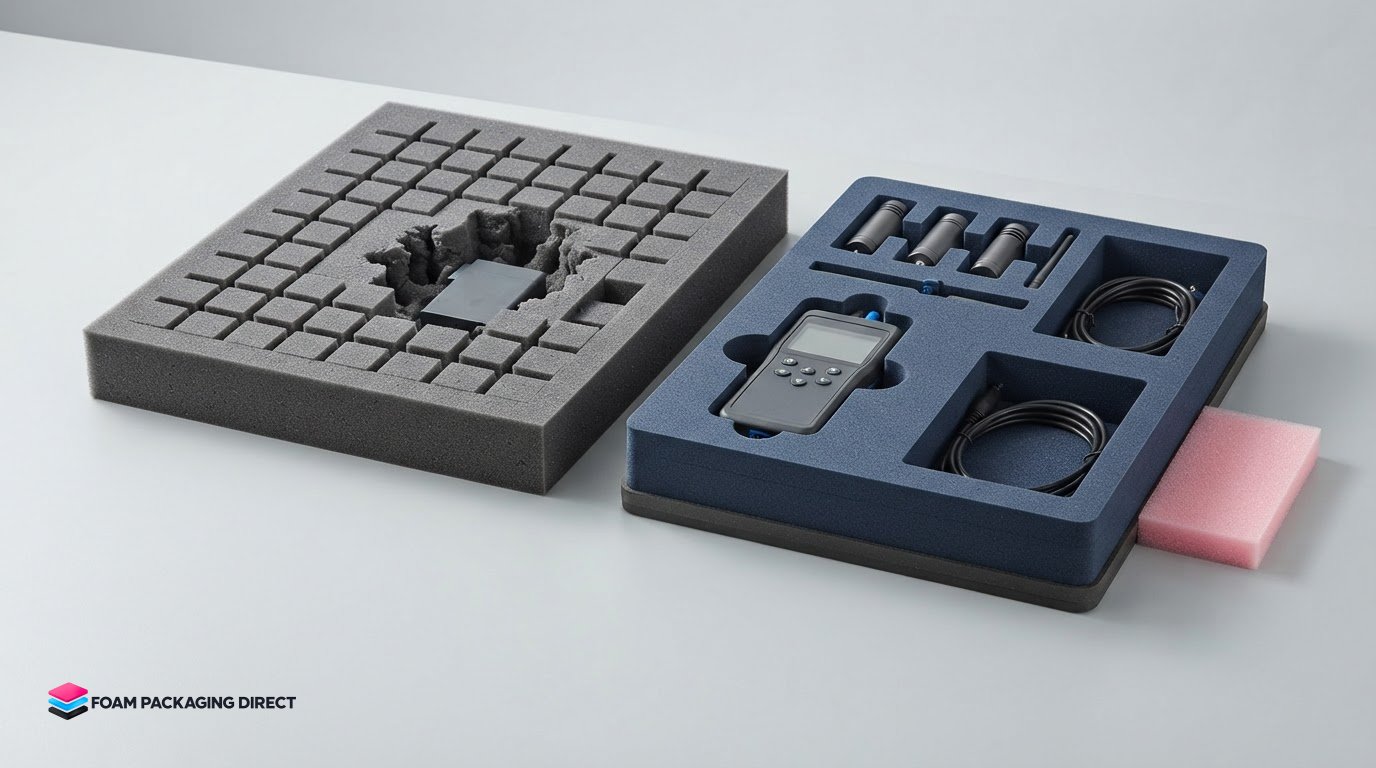
Pick-and-pluck foam is practical when contents change often or you need a quick, adaptable layout. For products that need dedicated pockets, closer support, or repeatable packing, custom engineered foam is usually the better fit. The choice depends on the product and how it will be packed, handled, and shipped.
Pick-and-pluck foam can be appealing because you can shape its grid by hand. But that flexibility has limits: the cutout may not support each product as closely as a purpose-designed insert. This comparison explains how Pelican pick-and-pluck foam versus custom engineered foam differs in material options, product fit, packaging performance, and design limitations.
You’ll see when a removable-cube layout is sufficient and when a fitted insert can better organize components and limit movement. We’ll also cover product weight, fragility, surface sensitivity, shipping conditions, and order quantity to help you choose a practical packaging option.
Key Takeaways
- Match foam material to the product’s weight, fragility, surface sensitivity, and shipping conditions rather than choosing by appearance alone.
- Use removable-cube foam for flexible layouts; choose dedicated pockets when repeatable packing and controlled product movement matter more.
- Consider how repeated use, vibration, and heavier components can affect perforated foam over time.
- For a tailored insert, prepare product dimensions, weight, quantity, and any available drawings or photos when requesting a quote.
Foam material and performance options
Foam type affects firmness, recovery, cushioning, and static resistance. Compare the material and cutout design together, rather than treating them as separate decisions.
Pick-and-Pluck Foam
Pick-and-pluck foam uses pre-scored cubes that you remove by hand to create a rough gear-shaped cavity. Replacement cost varies by Pelican case model and foam-set configuration, so identify the exact model before comparing options. The grid is convenient for changing contents, but cube spacing limits the shape and support you can create. Black polyethylene foam at 2-pound density is one common custom-foam option, but it isn’t interchangeable with every scored insert.
Custom-Engineered Foam
Custom-engineered foam is cut to match specific products and their arrangement inside a case. To measure gear, record each item’s length, width, and height, including protrusions, then note the case’s usable interior dimensions. Provide those measurements, product weights, quantity, and drawings or photos when ordering. Dedicated pockets can support components more closely than a hand-removed grid, while material and density are selected for the application.
| Option | Fit | Material choice | Best consideration |
|---|---|---|---|
| Pick-and-pluck | Grid-shaped cavities | Existing scored foam | Flexible contents |
| Custom-engineered | Product-specific pockets | PE, XLPE, PU, or other grades | Repeatable positioning |
PE is commonly used for firmer protective inserts; XLPE is cross-linked polyethylene. Polyurethane (PU) comes in grades with different cushioning and recovery characteristics. Zotefoams is a named manufacturer, and its foam properties vary by grade, so compare the specific material data rather than relying on the brand name alone. Anti-static foam is static-dissipative, with surface resistivity of 10⁹-10¹¹ Ω/sq.
Temperature can affect foam firmness, while moisture exposure can influence material performance in use. Sustained compression may reduce recovery, especially when a product repeatedly presses on the same area. Consider the storage and shipping environment alongside the gear’s weight and surface sensitivity.
Choose based on the fit required, material properties, and how consistently the case needs to protect its contents.
Choosing foam based on product and packaging needs
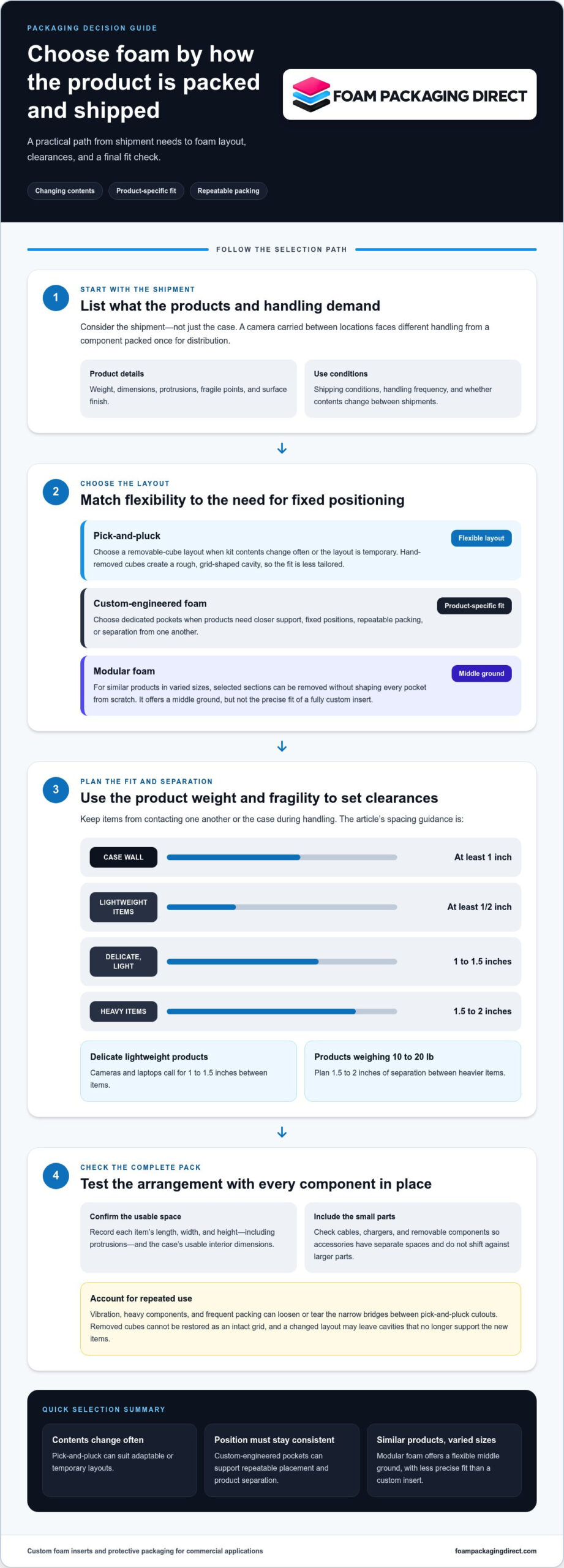
Start with the shipment, not the case. A camera carried between locations faces different handling from a component packed once for distribution. List the products, their weights, fragile points, surface finishes, and shipping conditions. Then decide whether the layout needs to change often or remain consistent across shipments.
Pick-and-pluck foam can suit kits with changing contents or temporary use. For ongoing shipments, service kits, or returnable packaging, custom pockets give each part a fixed position, which can simplify packing and limit movement. Similar products in several sizes may suit perforated modular foam, where selected sections can be removed without shaping every pocket from scratch.
- Changing contents: Choose removable sections if kit components often vary between shipments.
- Fragile equipment: Consider dedicated pockets for cameras, instruments, or delicate assemblies that need controlled positioning.
- Mixed components: Plan separate spaces for small accessories so they don’t shift against larger parts.
- Heavy products: Items weighing 10 to 20 lb need more separation than lightweight components; plan the layout around product weight.
Spacing affects protection. Leave at least 1 inch between an item and the case walls. Lightweight items need at least 1/2 inch between them, while delicate lightweight products such as cameras or laptops call for 1 to 1.5 inches. Heavier items weighing 10 to 20 lb need 1.5 to 2 inches of separation. These clearances help keep products from contacting each other or the case during handling.
Packaging dimensions matter, too. A tightly organized custom layout can reduce unused space and may allow a smaller case or carton, affecting storage and transport. Check the assembled layout with every component in place, including cables, chargers, and removable parts.
Choose pick-and-pluck for adaptable layouts that change often. Choose engineered pockets when consistent placement, reuse, and product separation matter most. For similar products in varied sizes, modular foam offers a middle ground, though it won’t match the precise fit of a fully custom insert.
Limitations of perforated cubed foam
Each removed cube breaks the grid’s original structure, so the resulting cavity has rougher edges than a precision-cut pocket. Shaping a layout can take 10-15 minutes, and careful removal matters: pulling beyond the outline can widen the opening and reduce support around a camera, meter, or other compact instrument.
Can pick-and-pluck foam be reused or repaired after removing sections? The case and remaining foam can be reused if the cutouts still hold the contents securely. Removed cubes can’t be restored as an intact grid, so a changed gear layout may leave cavities that no longer support the new items.
Repeated vibration, heavy components, and frequent packing can loosen or tear the narrow foam bridges between cutouts. A heavy tool resting on a thin strip, for example, can compress it and let the tool shift. That movement can make cushioning less consistent and gradually reduce how well the cavity holds its shape.
Contents also affect service life. A case used carefully for occasional transport puts different demands on its foam than a kit opened and closed for regular field work. One reported Pelican case user discarded pick-and-pluck foam after 8 months; that example illustrates a possible outcome, not a lifespan that applies to every case.
Pick-and-pluck foam also limits layout detail. Its grid suits broad, simple outlines, but small accessories or irregular parts may need narrow channels that cross several cubes. Removing those cubes can leave thin walls between neighboring cavities. The result may be less organized and less polished than a fitted insert with dedicated pockets.
Before cutting, place every item on the foam and mark its outline. Remove cubes gradually, then test the fit with the case open and closed. If the product moves, the pocket is too loose. If the foam compresses heavily around it, too little support may remain.
How does Pelican pick-and-pluck foam work?
Pelican Pick N Pluck foam has layers scored into small cubes, typically measuring half an inch. Remove selected cubes to form a cavity for your gear. The grid lets you shape a case interior without cutting every edge with a knife, but the finished outline follows the cube pattern rather than the item’s exact contours.
Prepare the gear and case before removing foam. A camera with a lens attached, for example, needs a cutout that accommodates both together. Keep accessories such as batteries in separate spaces so they don’t press against the camera during transport.
- Arrange the contents. Place each item on the foam and check the layout against the case interior.
- Mark the outlines. Use a marker or chalk to trace each item, leaving room for the foam walls.
- Remove cubes gradually. Pull out cubes inside the marked lines, checking the cavity as it takes shape.
- Test the fit. Return the foam to the case and place the gear in its cutout before closing the lid.
Work in small sections. Removing too many cubes at once can make a cavity wider than intended, especially around narrow parts such as a handle or connector. Test an irregular item in the opening as you go, and remove more foam only where the fit needs adjustment.
Pick-and-pluck foam differs from Kaizen foam, a solid sheet cut with a knife. The pre-scored grid simplifies hand shaping, while a knife-cut sheet gives more control over curves and narrow channels. Both approaches require careful layout, but the cube grid sets the smallest practical adjustment.
After shaping, check that the gear sits securely and separate items don’t touch. A layout for a camera, charger, and cable should give each component its own space. Recheck the fit whenever the kit changes, since a new accessory may need a different cavity.
Foam Packaging Direct: Custom Foam Inserts
Foam Packaging Direct makes custom foam inserts for products that need consistent positioning and protection during shipping or repeated use. A tailored layout gives each component a defined place, helping teams pack kits more consistently than with a hand-shaped grid. Foam end caps, sheets and pads, and foam rolls and wrap can also support product-specific packaging needs.
For a quote, share product dimensions and weight, order quantity, shipping ZIP code, and any available drawings or photos. Include existing box dimensions and special protection requirements if they affect the design.
Request a quote from Foam Packaging Direct to discuss a custom foam packaging option for your product.
Set Up Your Next Packaging Decision
Use your packing routine to guide the next step. Note who loads the case, how often its contents change, and where products shift or packing slows down. These details help determine whether your current layout fits the work or needs a different design.
For a quote, contact Foam Packaging Direct with product dimensions, weight, quantity, shipping ZIP code, and any available drawings or photos. Include existing case or box dimensions and special protection requirements so the packaging can be considered in context.
Clear product details give the design process a practical starting point. Build on what works and identify the parts of packing that need improvement.
Frequently Asked Questions
Pick-n-Pluck Foam vs Custom Foam Inserts: Which Is Right for Your Packaging?
Pick-and-pluck foam is practical when a case carries changing combinations of equipment. Custom inserts suit a stable kit that needs the same arrangement each time. For example, a field technician who swaps tools between jobs may value flexibility, while a company shipping the same instrument kit can benefit from consistent component placement and a clear visual check before closing the case.
So, Which Should You Choose?
Choose the format that matches your packing routine. If staff regularly add or remove items, a flexible cavity may be easier to adapt. If the case has a fixed inventory, dedicated spaces can make missing parts easier to spot. Consider who packs the case, how often its contents change, and whether the package is reused or sent through a regular shipping process.
Pick-and-Pluck Foam vs Custom Foam: How Do Protection and Fit Compare?
When comparing Pelican pick-and-pluck foam with custom engineered foam, consider how each layout accommodates your product’s shape and accessories. A grid may leave extra space around an irregular item, while a tailored pocket can account for protrusions or attachment points. For a device shipped with a detachable sensor, a separate pocket can help keep the sensor from pressing against the main unit.
What Foam Types Are Used in Pelican Cases, and What Are Their Properties?
Packaging foam options include Polyethylene (PE) Foam for heavy or sharp-edged parts, Cross-linked PE (XLPE) Foam for a clean finish, and Polyurethane (PU) Foam for delicate, lightweight items. Anti-Static Foam is used to cushion electronics. Expanded Polypropylene (EPP) Foam suits returnable packaging, while Expanded Polystyrene (EPS) Foam provides rigid protection. Choose the material based on the product and shipping requirements.
What Are the Risks of Pick-and-Pluck Foam for Heavy or Fragile Equipment?
Heavy items can press down on the narrow foam strips between cutouts, and rough handling can tear them. A fragile product may then shift or contact another component. For example, a test instrument packed with loose adapters could be scratched if the accessories move during transit. After use, check for crushed areas, loose cubes, or openings that no longer hold items in place.