
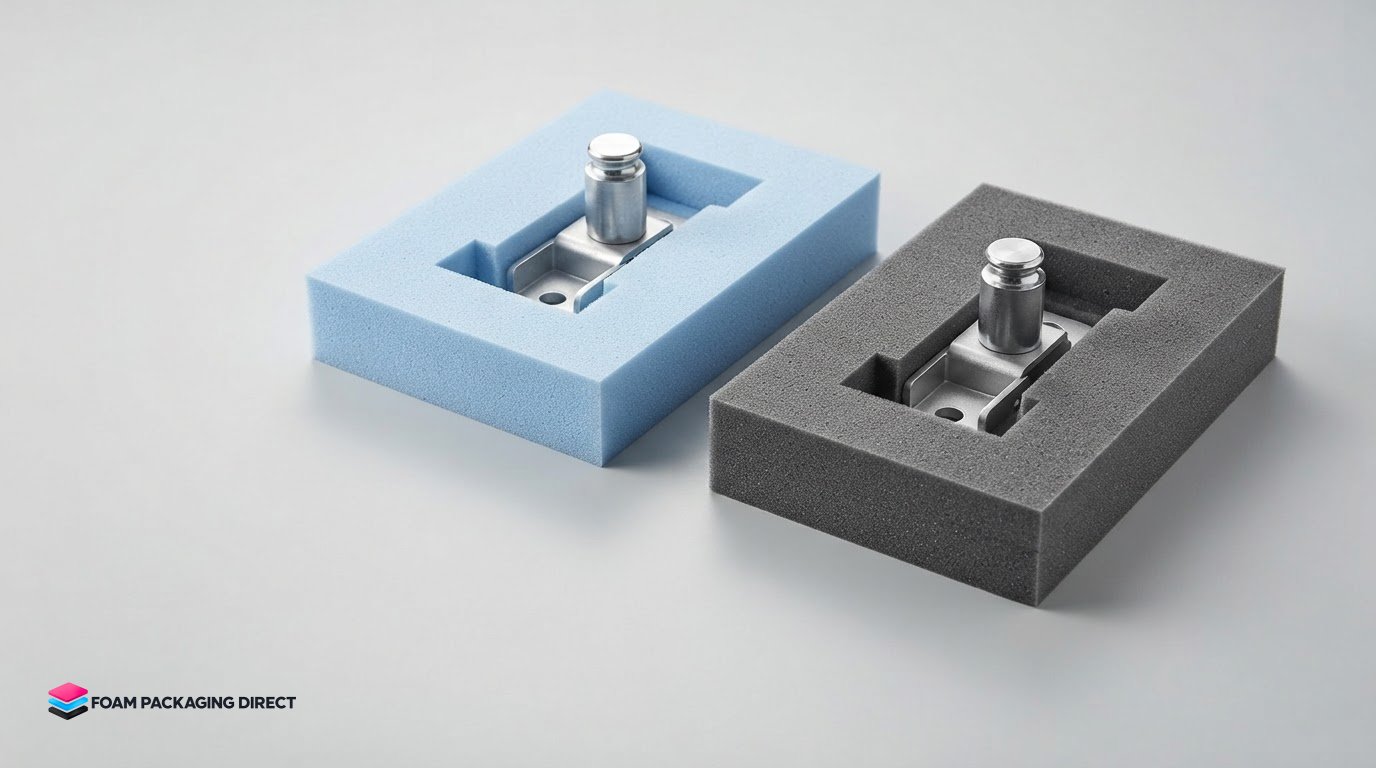
For the same polyethylene foam type, 2.2 lb density is generally firmer and more resistant to compression than 1.7 lb density. The 1.7 lb vs 2.2 lb polyethylene foam density comparison helps narrow the choice, but density alone doesn’t determine how a package will protect a product. Firmness describes how much force it takes to compress foam, while cushioning performance also depends on the product and packaging design.
If you’re weighing foam options, it makes sense to look beyond the density label. This guide explains how density relates to firmness and compression resistance, where each option may fit, and how to estimate foam weight from its dimensions and density. You’ll also see why product weight, fragility, and shipping conditions matter when choosing foam for inserts, pads, or bracing.
Key Takeaways
- Match 1.7 lb foam to suitable medium-weight components and consider 2.2 lb foam for demanding bracing needs.
- Estimate foam weight by combining the piece’s volume with its density rating.
- Account for product weight, fragility, dimensions, and shipping conditions when selecting cushioning.
- For reusable packaging, consider how repeated compression may affect the foam’s shape and recovery over time.
Density effects on firmness and compression resistance
For the same polyethylene foam type, 2.2 lb density is generally firmer and more compression-resistant than 1.7 lb. Load capacity also depends on thickness, supported area, and how much compression the package can tolerate.
Density and Firmness
Density measures foam weight per cubic foot, while firmness describes resistance to compression. Higher-density polyethylene foam has a tighter cell structure and is generally harder, but density and firmness aren’t interchangeable specifications. Indentation load deflection, or ILD, measures the force needed to compress foam by 25% of its original height. For example, foam requiring 36 pounds of force for that compression has an ILD of 36. Typical ratings range from approximately 8 to 70 ILD. Use density to narrow material options, then compare firmness requirements for the package.
Thickness, Firmness, and Weight
Thickness is the distance between a foam piece’s surfaces; it does not indicate density or firmness. At the same density and footprint, a thicker piece contains more foam and weighs more. Density describes weight per volume, not firmness or protective capacity. For packaging specifications, compare thickness and density separately: thickness provides cushioning depth, while density describes the material’s weight relative to its volume.
Thickness and Load Capacity
Load capacity depends on the pressure applied and how far foam can compress before the product contacts the box. A 2.2 lb polyethylene piece may resist compression better than a 1.7 lb piece of the same material, while added thickness provides more cushioning depth. Product weight, contact area, and continuous pressure affect the response. A thin, higher-density sheet can protect a heavy product more effectively than thick, low-density foam that compresses under ongoing pressure. Match density and thickness to the product’s weight and support points, then consider the remaining cushioning space under load.
1.7 Lb and 2.2 lb polyethylene foam applications
A 1.7 lb option suits medium-weight electronics and industrial components, while 2.2 lb foam is commonly used for heavy-duty bracing. The right application also depends on product shape, surface sensitivity, and shipping environment.
Application and Environment Selection
Application selection matches foam characteristics to the product’s handling and shipping conditions. For electronics, a 1.7 lb foam insert can hold medium-weight components in place, while protective supports help limit movement inside a box. Heavy equipment with concentrated support points may need stronger bracing. Consider the product’s weight, fragility, dimensions, and contact surfaces together. A canoe, for example, may use 2.2 lb polyethylene foam for flotation and occasional contact with docks, paddles, and fishing hooks. Each factor can influence the required shape and support.
Application-Specific Specifications
Application-specific specifications describe what the foam must do around a particular product. A reusable insert for a 15-pound instrument, for example, needs cavities that fit its shape and support it during repeated packing. For industrial components, the design should limit shifting while avoiding pressure on delicate edges or controls. Specify the product’s dimensions and weight, the existing box size, and areas needing extra protection. Those details help define insert thickness, cutouts, and contact points instead of relying on density alone.
Typical Applications by Density
Typical density choices indicate common uses, not a universal rule for every package. A 1.7 lb polyethylene option is identified for medium-weight electronics and industrial components. A 2.2 lb option is a standard choice for heavy-duty bracing and block-and-brace applications. These are distinct uses: an insert organizes and supports a product, while bracing blocks movement within the package. For a sensitive instrument, a fitted cavity may matter as much as the density. For a heavy shipment, the support layout and product contact points also guide the specification.
Density selection for packaging and cushioning
For commercial packaging, density is one part of the cushioning specification. Polyethylene foam densities range from 1.2 to 9 lb/ft³, so the 1.7 lb vs 2.2 lb polyethylene foam density comparison can help narrow material options. A cushion curve adds another perspective by showing how foam responds to impact under different loading conditions. Together, density and curve data help assess whether a package can absorb shock before the product contacts the box.
Read a cushion curve against the product’s weight and the foam’s contact area. A sensitive medical laser, for example, may have a G-factor target of 15. That target helps define the allowable shock level, while the package layout and foam thickness determine the cushioning space available. A higher density by itself doesn’t establish whether the design provides enough shock absorption. Consider the product’s fragility and support points alongside the curve.
Flotation requires a separate assessment because foam must displace enough water to support its intended load. Density alone cannot show how a finished foam shape will perform. The product’s weight, foam dimensions, placement, attachment, and operating conditions all affect support and stability. The shape and position of a block should help keep the object balanced, rather than simply adding more material. These factors distinguish flotation selection from standard shipping cushioning.
Keep material ratings separate. Polyurethane foam has a density range of 1 to 3 lb/ft³, but those figures aren’t interchangeable with polyethylene ratings. For heavy machinery shipments, polyethylene at 2.0 PCF or higher may be more appropriate than standard 1.2 PCF foam. The package layout, thickness, and support points still influence cushioning response. Specify the material, product load, and intended protection together so each part of the design reflects the actual packaging task.
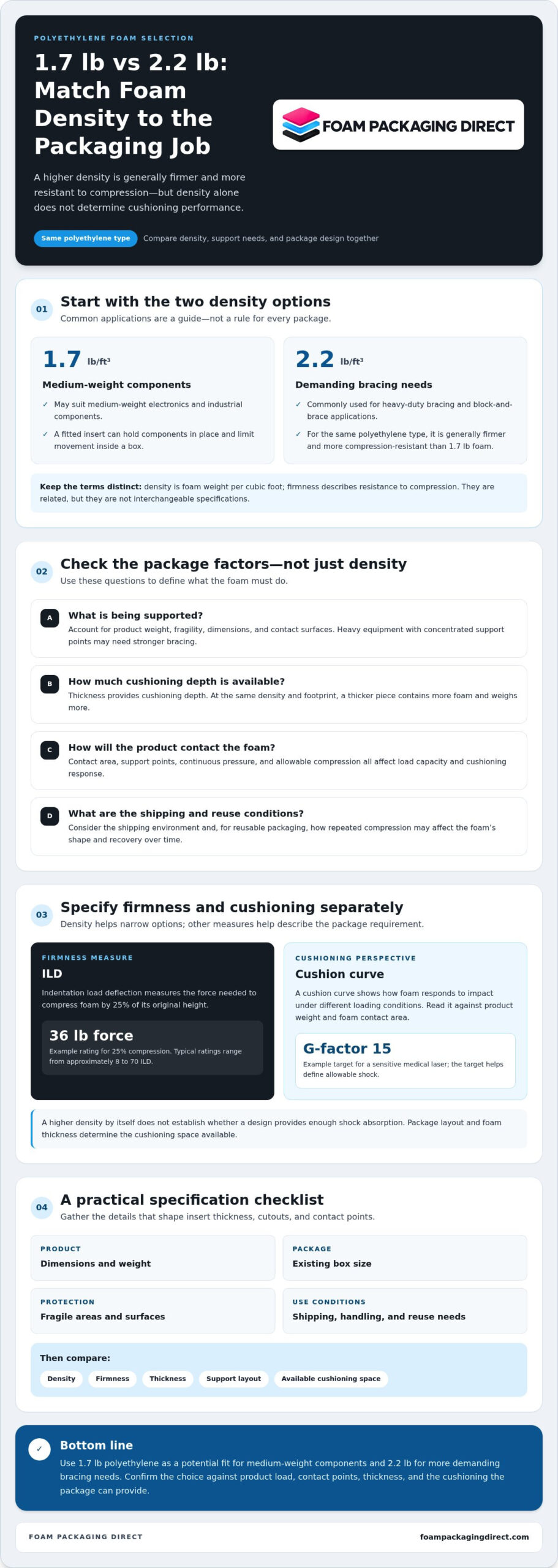
1.7 Lb vs 2.2 lb Polyethylene Foam: Durability & Lifespan
Higher density can increase compression resistance, but it doesn’t automatically establish how long a foam part will last. In a 1.7 lb versus 2.2 lb comparison, assess how the insert performs under its actual loads and packing cycle. Polyethylene’s density primarily affects impact absorption; lifespan also depends on repeated compression, contact points, and whether the package is reused.
For returnable packaging, polyethylene foam can maintain its structural integrity over hundreds of shipping cycles. That broad performance description doesn’t assign a cycle count to either 1.7 lb or 2.2 lb foam. Instead, consider whether repeated loading changes the insert’s shape, grip, or cushioning. An insert holding a heavy component in the same cavity each trip experiences a different pattern of pressure than foam used once for a shipment.
Repeated compression also matters. Foam can change in height or feel after repeated compression cycles, so recovery and fatigue performance are relevant to long-term selection. If an instrument is packed and unpacked often, check whether the foam continues to support its contact points and keep it from shifting. Changes in shape can affect fit even when the material remains intact.
Compare the densities against the job, not a presumed lifespan ranking. A 2.2 lb option may better resist compression in a demanding support role, while 1.7 lb foam may suit an application with less sustained pressure. Neither figure alone predicts service life. The product’s weight, support layout, compression frequency, and handling conditions all influence wear. For reusable packaging, define the required fit and cushioning, then evaluate the foam after repeated use. This makes durability a practical performance question rather than an assumption based on density alone.
Foam Packaging Direct: Custom Foam Inserts
Foam Packaging Direct makes custom foam inserts cut to fit product shapes and help limit movement inside shipping boxes. A fitted insert is useful when the selected density must also provide precise support for contact points, edges, and components.
Foam end caps can support and protect product ends, while foam sheets and pads provide cushioning between surfaces. Foam rolls and wrap suit applications that need flexible wrapping. Choose a format based on the product, how it will be handled, and the space available inside the package.
Request a quote with your product dimensions, weight, order quantity, shipping ZIP code, and any drawings or photos. Include existing box dimensions and special protection requirements to help describe the application.
Put the Density Choice to Work
A 1.7 lb vs 2.2 lb polyethylene foam density comparison is a useful starting point, but the next step is connecting the material choice to your packaging design. Consider how the product sits in the box, where it needs support, and whether the package will be reused. Those details help turn a density preference into a workable specification.
If your current packaging allows movement, puts pressure on sensitive surfaces, or takes too long to pack, describe those issues alongside the product dimensions and weight. Photos or drawings can help show the shape and support points that matter. Include your quantity, shipping ZIP code, existing box dimensions, and any special protection requirements so the project details are clear.
Contact Foam Packaging Direct to discuss your packaging requirements. A clear set of product and shipping details is a practical first step toward choosing foam that fits the job.
Frequently Asked Questions
What Is Foam Firmness?
Foam firmness is the resistance you feel when pressing or loading the material. It differs from density, which measures foam weight per unit volume. ILD, or indentation load deflection, is a force-based firmness rating. For packaging, firmness indicates how a foam surface responds where a product rests, while density describes the material’s weight relative to its volume. Consider both when defining the fit and support required.
What are the differences between 1.7 lb and 2.2 lb polyethylene foam?
The main difference is weight per cubic foot: a 2.2 lb grade contains more material by volume than a 1.7 lb grade. That higher density usually corresponds to a tighter cell structure and harder foam. The labels don’t specify the finished part’s thickness, shape, or exact firmness. Compare the foam grade alongside those design details to understand how the material will function in a package.
How do 1.7 lb and 2.2 lb polyethylene foam compare in firmness and compressive strength?
At comparable thickness and construction, 2.2 lb polyethylene foam is generally firmer and more resistant to compression than 1.7 lb foam. Density alone doesn’t provide an exact compressive-strength value or ILD rating. For a design review, identify where the product applies pressure, how much compression is acceptable, and whether the foam supports those areas without losing the required fit.
How do the two densities compare in cushioning and impact protection?
Both densities can cushion a product, but performance depends on the impact, foam thickness, and contact area. Higher density can affect impact absorption, but it does not automatically provide better protection for every item. The package needs enough cushioning space to manage the expected shock. Evaluate the product’s fragility and the foam layout together, especially where a narrow edge or corner concentrates impact.
What applications are best suited to 1.7 lb polyethylene foam?
1.7 lb polyethylene foam is commonly suited to medium-weight electronics and industrial components. A fitted cavity can hold a component in position and separate it from accessories or neighboring parts. It can be a practical option when the product needs organized support without the heavier-duty bracing associated with higher density. Product dimensions, delicate surfaces, and shipping conditions still shape the insert design.
What applications are best suited to 2.2 lb polyethylene foam?
2.2 lb polyethylene foam is commonly used for heavy-duty bracing and block-and-brace packaging. Blocks can fill open spaces around a product, limit movement, and support areas that carry concentrated loads. It may suit demanding shipping layouts where the foam needs greater resistance to compression. The number and placement of supports depend on the product’s shape, weight distribution, and package configuration.