
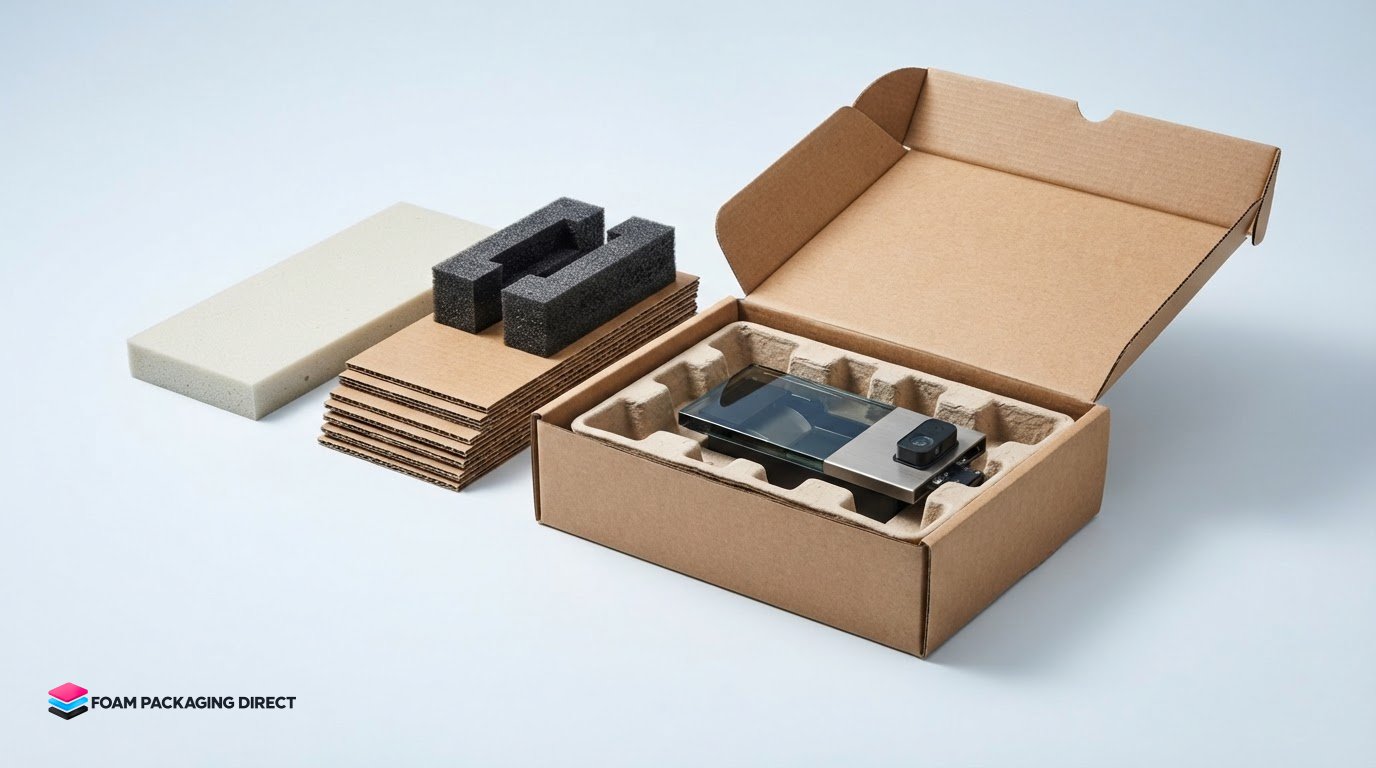
Businesses comparing alternatives for e-commerce protection can consider starch-based foam planks, layered corrugated pads, and recycled polyethylene foam. The U.S. Environmental Protection Agency has identified these as alternatives to traditional EPS cushioning. The right option depends on the product’s weight, fragility, dimensions, surface sensitivity, and shipping conditions, not simply whether a material is described as recyclable or compostable.
Looking beyond familiar materials can make sense when you’re balancing product protection with packaging waste and end-of-life options. But a different material isn’t automatically a better fit: it still needs to cushion the product and limit movement in transit. This guide compares common e-commerce cushioning options, explains how recyclable, compostable, and biodegradable claims differ, and outlines what to weigh when choosing protection for your product and package.
Key Takeaways
- Match cushioning to product weight, fragility, surface sensitivity, and shipping conditions to reduce movement and improve protection.
- Understand how recyclable, compostable, and biodegradable packaging differ, and factor local recycling acceptance into material choices.
- Compare starch-based foam planks, layered corrugated pads, and recycled polyethylene foam as possible cushioning alternatives to EPS.
- Explore how custom foam inserts, end caps, sheets, pads, and wraps can suit different product shapes and packing needs.
Packaging for e-commerce and goods protection
E-commerce packaging needs to keep a product in place from the packing bench to the doorstep. A boxed glass component, for example, needs cushioning around vulnerable edges and enough clearance to avoid contact with the box walls. Start with the product’s weight, dimensions, fragility, surface finish, and shipping conditions. Then choose a protective structure that fits the item and the packing process.
Protective packaging options include foam, paper-based cushioning, corrugated supports, and combinations of these materials. Paper pads or folded corrugated inserts can separate items and fill open spaces, making them useful for organization or light cushioning. Foam can be shaped around specific contours to reduce movement. Choose based on the product’s protection needs, not just the material label.
Paper-based protection includes molded pulp, crumpled paper, and layered corrugated pads. Depending on their design, these materials can cushion products or block them from shifting inside a box. For a shipment with several components, separate paper compartments can help prevent parts from striking one another. The packaging must still fit the products and stay in place during handling.
Furniture shipments pose a different challenge. Foam sheets, pads, and wraps can separate finished surfaces from nearby items or packaging. A shaped foam piece can provide a localized buffer for a table edge or cabinet corner. Choose protection according to surface sensitivity, product shape, and how items are packed together.
Custom protective inserts create fitted spaces around products or components. These cavities can hold items consistently and simplify packing, especially when a shipment includes multiple parts. For example, a custom insert can keep a device and its accessories in separate spaces. The design should support appropriate contact points without pressing on delicate surfaces.
Compare options by assessing fit, movement, packing steps, and disposal needs. Begin with the product and the dimensions of the existing box. Identify exposed edges, fragile areas, and surfaces that can scratch. This helps narrow the choice among paper-based protection, foam cushioning, and custom-shaped supports for commercial shipments.
Biodegradable, compostable, and recyclable packaging
Requirements vary by state, locality, destination, and packaging type, so no single rule applies to every U.S. shipment. Determine which requirements apply to the material and its use before selecting packaging. A restriction on one format, where applicable, does not automatically apply to every foam or cushioning material.
“Recyclable,” “compostable,” and “biodegradable” describe different end-of-life pathways. Recyclable packaging can be collected and processed into material for reuse, but acceptance depends on the local program. Compostable packaging is designed to break down under suitable composting conditions. “Biodegradable” is broader: the term alone doesn’t specify how quickly material breaks down or what conditions it requires.
For plastic packaging, local acceptance matters. The U.S. Environmental Protection Agency advises businesses to check which types of plastic their local recycling program accepts before choosing recyclable packaging. A plastic film or foam may carry a recycling claim yet be unsuitable for a particular curbside program. Match the claim to the collection and processing options where the package will be discarded.
Use a practical selection sequence:
- Identify where customers will dispose of the package and any local collection instructions.
- Check acceptance for the specific material and package format, not just its resin family.
- Compare the available recycling route with composting access and required conditions.
- Confirm that the selected material still cushions the product and fits the shipping process.
For example, a local program may not accept a recyclable plastic component alongside paper packaging. A compostable cushion also needs access to an appropriate composting route to follow its intended end-of-life pathway. These labels alone don’t guarantee that customers can dispose of packaging as intended.
When comparing Pregis foam packaging alternatives, separate environmental claims from protection requirements. Consider the material, package construction, local disposal route, and cushioning role together. This makes it easier to compare options for different destinations without assuming that one label or disposal route suits every shipment.
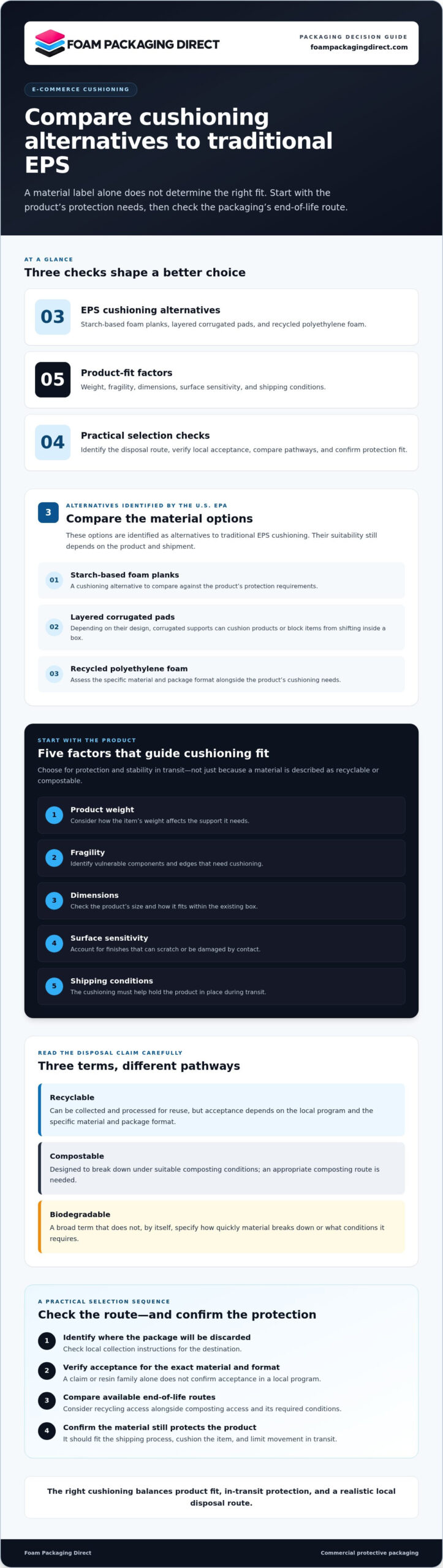
Product damage and packaging waste
A damaged parcel creates more than a replacement task. It adds product and packaging waste, increases emissions, and can weaken customer trust. For example, a cracked device may need replacement packaging and another delivery. Getting the item to the customer safely on the first delivery helps reduce waste and its environmental impact.
Start by identifying where damage occurs. A crushed corner points to weak edge protection, while a scratched finish may indicate contact with loose contents. If a product shifts inside its box, the cushioning may not hold it securely. Review returned items, customer photos, and damage patterns to find the failure point before changing materials.
Use a simple review process for each affected product:
- Record the damaged area, such as a corner, surface, connector, or fragile component.
- Compare the product’s position with the cushioning and box after transit.
- Adjust the support or separation where movement or contact caused damage.
- Review the revised pack-out with the same handling and shipping conditions.
More cushioning isn’t always the answer. A thick layer can still leave a heavy product free to move, while a misplaced pad may press against a delicate surface. For a multi-part item, separate cavities can prevent components from striking each other. For a long product, supports near its ends can help limit shifting inside the carton.
Packaging waste also comes from oversized boxes, unnecessary void fill, and discarded protective layers. A closer fit can reduce empty space, but the package still needs enough cushioning for the product’s weight and shipping conditions. Compare material use with observed damage patterns. Removing protection without reviewing that evidence can increase breakage and create more waste through replacements.
Track damage by product and shipment type after each packaging change. If one model repeatedly arrives with edge damage, focus the next adjustment on its vulnerable corners. This targeted approach links packaging decisions to actual delivery outcomes instead of adding material without identifying the cause.
Foam packaging alternatives
Alternatives to EPS include starch-based foam planks, layered corrugated pads, and recycled polyethylene foam. The U.S. Environmental Protection Agency identified these as cushioning alternatives. Each works differently: starch-based planks provide cushioning, corrugated layers create structure, and polyethylene foam cushions products in a foam format.
Choose protection by comparing product needs with package design. Corrugated pads can separate flat items or reinforce a box. Starch-based planks can provide protection when their form suits the product. Recycled polyethylene foam may suit applications that need foam cushioning. Let the product’s weight, shape, fragility, surface sensitivity, and shipping conditions guide the choice.
No foam type alone meets ISTA drop-test requirements for every fragile product. The test evaluates the complete packaged product under a selected procedure, so the package design and cushioning must be considered together. Select the relevant test conditions, then evaluate the packed product using that procedure.
To switch from foam to a more sustainable protective system, work through the packaging process in stages. First, document the product, box dimensions, cushioning layout, and known damage points. Next, choose a candidate material and design supports that limit product movement. Then evaluate the complete packed product under relevant shipping conditions. Review damage and material use before adopting the new design.
- Keep product dimensions, weight, and existing box specifications together.
- Compare candidate materials by protection, packing steps, and disposal route.
- Use sample shipments or applicable package testing to assess performance.
- Record damage and material use, then adjust the design where needed.
A change should preserve the package’s protective function and suit the intended disposal pathway. For example, a corrugated support may replace a foam component, but its position and structure must still restrain the item. Recycled polyethylene remains an option for products that need foam cushioning. Compare protection, packing workflow, and end-of-life handling together.
No alternative qualifies based on material alone. Assess the fully packed product under the selected ISTA procedure, with the cushioning and package design working together.
Foam Packaging Direct: Custom Foam Inserts
Foam Packaging Direct helps businesses match protective foam packaging to product shape, handling needs, and packing workflow. Custom foam inserts can hold individual items or organize several components inside a box. Foam sheets and pads, along with foam rolls and wrap, offer flexible ways to separate surfaces or cushion products. Tote and tray inserts can organize items for repeat handling.
Consider a custom insert when a product shifts in its box, has vulnerable contact points, or needs consistent placement during packing. Share the product dimensions and weight, order quantity, shipping ZIP code, and existing box dimensions. Drawings, photos, and specific protection requirements can also help describe the application.
To discuss a packaging fit for your products, contact Foam Packaging Direct and request a quote.
Turn your packaging choice into a clear specification
Choosing among Pregis foam packaging alternatives is a starting point, not the final packaging decision. Turn your preferred option into a clear pack-out specification: note the material, support locations, product orientation, and how components should be arranged. This gives your team a consistent reference when reviewing samples or updating packing instructions.
Separate essential protection requirements from preferences such as disposal pathway or packing convenience. Then compare candidate designs against those priorities and record the differences between versions. A clear specification makes decisions easier to communicate across purchasing, packaging, and operations, while giving future reviews a practical starting point.
Frequently Asked Questions
What are the best alternatives to Pregis foam packaging for shipping?
The best alternative depends on the product and package design. Layered corrugated supports can separate flat components, while molded pulp can hold shaped products in formed cavities. Recycled polyethylene foam remains an option when foam cushioning suits the application. For a boxed product with fragile corners, compare how each material supports those areas and keeps the item from shifting in transit.
How do paper-based protective packaging systems compare with foam on cushioning and cost?
Paper-based systems can fill voids, separate products, or create structured supports, while foam can be cut or shaped to fit a product closely. Protection depends on material design and placement, not just the material category. Compare costs by considering material use, packing time, box size, and damage outcomes. A paper wrap may suit a simple item, while a shaped support may better organize several parts.
What are molded pulp and honeycomb packaging alternatives to foam?
Molded pulp forms a shaped cradle around an item, while honeycomb paperboard uses a cellular structure for support. A molded pulp tray can hold a product in a defined position; honeycomb panels can separate items or reinforce a package. Both need to be designed for the product’s shape and handling. Consider whether the package needs a fitted cavity, flat divider, edge support, or a combination.
How do recyclable air pillows and bubble wrap compare with foam packaging?
Air pillows fill open space with air-filled chambers, while bubble wrap surrounds or separates products with small air pockets. Both can suit lightweight items that need void fill or surface separation. Foam can provide shaped support when a product needs a more fixed position. Before choosing an air-filled option, consider puncture risk, packing consistency, and whether it suits the product’s weight and shape.
Which foam packaging alternatives meet ISTA drop-test requirements for fragile products?
No foam type alone meets ISTA drop-test requirements for every fragile product. Evaluate the complete packaged product under the selected test procedure.