
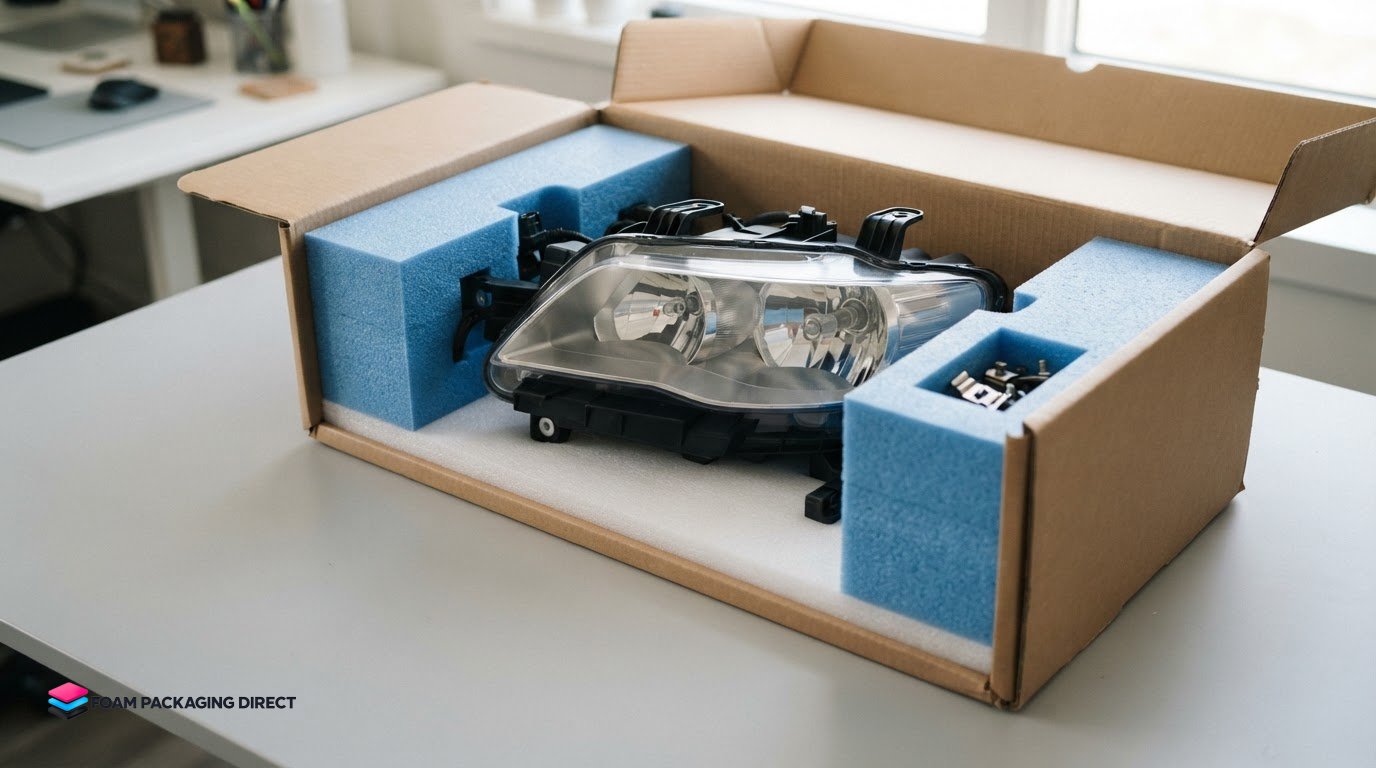
There isn’t one foam material for every foam and box packaging kit. Polyethylene (PE) and Cross-linked Polyethylene (XLPE) Foam suit different cushioning needs than flexible Polyurethane (PU) Foam, while Expanded Polystyrene (EPS) Foam and Expanded Polypropylene (EPP) Foam offer other options. The right choice depends on the product and the protection it needs in transit.
It’s easy to assume the box does most of the work, but the foam’s fit and placement matter too. Blocks, liners, sheets, end caps, and shaped inserts can limit movement, cushion surfaces, or keep components organized inside the box.
This guide explains how common foam materials differ and how they work with box dimensions and insert styles. Consider product weight, fragility, size, surface sensitivity, shipping conditions, and order quantity to understand which packaging approach fits your application.
Key Takeaways
- Match foam type to the product’s weight, fragility, and surface sensitivity rather than treating materials as interchangeable.
- Use blocks and liners to cushion products and limit movement, with the fit shaped around the item and box.
- Choose between flexible, pre-scored, and custom-cut inserts based on the level of support and fit the application needs.
- Consider how sheets, rolls, and other foam components work together to simplify packing and protect items in transit.
Expanded polyethylene and polypropylene
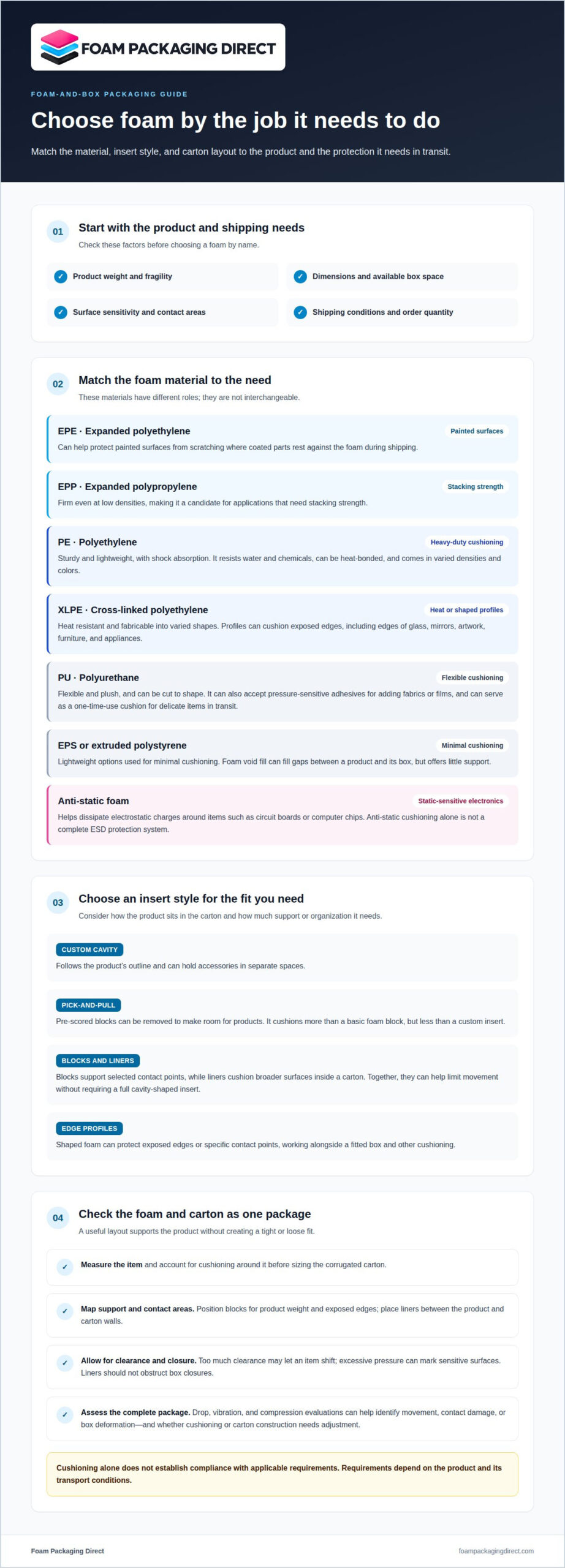
Expanded polyethylene (EPE) and Expanded Polypropylene (EPP) Foam are distinct materials, not interchangeable names for one cushioning type. EPE packaging can protect painted surfaces from scratching when coated parts rest against foam during shipping. EPP is firm even at low densities and suits applications that need stacking strength.
Polyethylene (PE) Foam is also used for heavy-duty packaging because it is sturdy, lightweight, and absorbs shock. It resists water and chemicals, can be heat-bonded, and comes in varied densities and colors. These properties help packaging teams match cushioning to product weight and handling needs, rather than choosing a material by name alone.
Cross-linked Polyethylene (XLPE) Foam offers another option within the polyethylene family. It is heat resistant and can be fabricated into varied shapes to follow product contours or protect specific contact points. Foam profiles, for example, can cushion the edges of glass, mirrors, artwork, furniture, and appliances. In a shipping kit, those edge pieces can work alongside a fitted box and other cushioning.
Choose between EPE, EPP, and XLPE by identifying what the package must do. For a painted housing, EPE can reduce scratch risk at contact points. Where stacking strength matters, EPP’s firmness is relevant. Where heat resistance or a shaped profile is needed, XLPE is a candidate. Product weight, fragility, dimensions, surface sensitivity, shipping conditions, and order quantity all influence the choice.
Then map each material to its position in the box: edge profiles shield exposed edges, while shaped foam can support the product body. Include contact areas and clearance in the drawing so the foam and carton work as one package. Box dimensions also determine the space available for protective layers. These materials serve different roles, so choosing by a label such as “polyethylene” can overlook differences between expanded and cross-linked constructions.
Foam blocks and liners
Foam blocks support products at selected contact points, while liners cushion broader surfaces inside a carton. Blocks can brace a machine housing at its corners; a liner can separate it from the box walls. Together, they help control movement without requiring a full cavity-shaped insert. Position blocks to support the product’s weight and protect exposed edges.
Fit matters. Blocks that leave too much clearance may let an item shift, while excessive pressure can mark sensitive surfaces. Liners should sit between the product and carton without obstructing closures. For example, a long component may need blocks at both ends and a liner along its broad face. Match the layout to the product’s dimensions and fragility, as well as the box’s interior space.
There isn’t one universal U.S. packaging rule for every foam-and-box shipment. Applicable requirements depend on the product and its transport conditions; cushioning alone doesn’t establish compliance with any applicable requirement.
Drop, vibration, and compression evaluations can show how a packed item responds to common shipping stresses. Assess the product, foam, and carton as a complete package, then look for movement, contact damage, or box deformation. Results can help identify whether blocks need repositioning, liners need broader coverage, or the carton construction needs adjustment.
Foam blocks and liners can be reused and recycled, but practical recycling depends on material and local collection options. Foam waste and loose fragments can create handling and disposal concerns, while static-sensitive electronics may need suitable anti-static cushioning. Anti-static foam dissipates electrostatic charges, but it isn’t a complete ESD protection system by itself. For a coordinated design, foam and box packaging can bring cushioning and carton dimensions together.
Charcoal foam can be custom cut to customer specifications. When planning blocks or liners, identify the areas that need support or cushioning and communicate the intended dimensions and placement. This keeps the cut format tied to the package layout rather than treating a block or liner as a generic component. Check the resulting arrangement within the carton, including clearance, product contact, and closure space, before relying on it for shipment.
Foam insert styles and materials
Choose an insert style by considering how the product sits inside its carton. A custom cavity can follow a device’s outline and hold accessories in separate spaces. Pick-and-pull foam has pre-scored blocks that users remove to make room for products. It cushions more than a basic foam block, but less than a custom insert.
Charcoal packaging foam comes in regular and firm options, with smooth surfaces or eggcrate texture. Pick-and-pull grids are available in charcoal and pink anti-static foam. Polyurethane foam is flexible and plush, and can be cut to shape. It also accepts pressure-sensitive adhesives for adding fabrics or films. Poly foam can serve as a one-time-use cushion for delicate items in transit.
Materials have different jobs. Expanded and extruded polystyrene are lightweight options used for minimal cushioning. Foam void fill, including packing peanuts, fills gaps between a product and its box but offers little support. For circuit boards or computer chips, Anti-Static Foam helps dissipate electrostatic charges. It doesn’t replace other ESD protections required by the complete packaging system.
Box size should follow the product and chosen insert. Measure the item, account for cushioning around it, then size the corrugated carton around the assembled package. A snug fit limits movement without forcing the product against the box. Product dimensions, weight, fragility, and shipping conditions guide the design; a tray holding several components needs different cavities than a single-item shipper.
Recycling depends on the foam material and local collection options. EPS can be recycled in industrial and most post-consumer settings, but curbside acceptance varies by community. Check local program rules for the specific material rather than assuming every foam type belongs in a curbside bin. Reuse may also suit clean blocks or liners if they remain intact and fit another shipment.
Foam materials and construction
Choose foam density and thickness by matching the cushion to product weight, fragility, and shipping conditions. A heavier item needs support that limits movement without compressing excessively. A delicate surface may need softer contact material, while exposed corners may require thicker cushioning. The right combination depends on the product and how the complete package will be handled.
Packaging foam forms when a polymer matrix traps small air or gas bubbles, then heat or pressure creates a solid structure. Polyethylene (PE) Foam is sturdy and lightweight; Polyurethane (PU) Foam is flexible and plush. Expanded Polystyrene (EPS) Foam and Expanded Polypropylene (EPP) Foam have different structures and cushioning characteristics. Additives can also create specialty options, including Anti-Static Foam for electronics.
Start material selection with the product’s weight and contact points. Then consider its shape, surface sensitivity, and whether it needs support across a broad face or only at key areas. A fragile instrument with projecting controls may need separate cavities and protection around those controls. A durable component may need support that prevents shifting without surrounding every surface.
For an insert design, record the product’s length, width, and height, along with protrusions and areas that must remain clear. Note the item’s orientation inside the carton and the existing box’s interior dimensions. Use those measurements to plan the cavity, support zones, and room for cushioning between the insert and carton. A drawing or photo can clarify unusual contours.
Review the assembled design as a system: product, insert, and box must fit together without unwanted movement or pressure points. For multiple components, assign a cavity to each part and keep them separated during packing. Request a custom foam insert quote with product dimensions, weight, quantity, shipping ZIP code, and available drawings or photos. Include existing box dimensions and any special protection requirements.
Foam sheets and rolls can cushion products alongside other foam components during transit. Expanded and extruded polystyrene foams have high R-values and are recyclable in industrial and most post-consumer settings.
Foam Packaging Direct
Foam Packaging Direct helps businesses bring cushioning and box requirements together in protective shipping kits. Turn to the team when a product shifts in transit, needs dedicated support, or includes components that must stay organized. The right design depends on product dimensions, weight, fragility, surface sensitivity, shipping conditions, and order quantity.
Custom Foam Inserts and Tote & Tray Inserts can hold products or components in defined positions. Foam End Caps, Foam Sheets & Pads, and Foam Rolls & Wrap offer other ways to cushion edges, surfaces, or contact areas as part of a packaging plan. Matching these components to box dimensions helps make packing more consistent.
To request a quote, provide product dimensions, weight, quantity, shipping ZIP code, and any available drawings or photos. Include existing box dimensions and special protection requirements if relevant.
Move Your Packaging Plan Forward
A packaging kit should fit the way your team prepares shipments, not just the product inside. Consider how the package moves through your packing workflow and whether its layout makes the next step clear for the person assembling it. This operational perspective can help shape a practical foam and box packaging plan.
If you’re ready to move from requirements to a project-specific proposal, request a quote from Foam Packaging Direct. It’s a straightforward next step toward evaluating a kit for your application.
Frequently Asked Questions
What is the Foam Used in Packaging?
Packaging foam is cushioning fabricated to support products during storage and shipment. The material and fabrication method are selected for the product and its application, including electronics, medical devices, aerospace components, and industrial parts. Fabrication can include precision cutting, routing, die-cutting, laminating, or bonding. These methods shape foam components to meet packaging requirements beyond simple cushioning.
What types of foam packaging are used in boxes?
Besides shaped inserts and end caps, packaging can use adhesive-backed foam sheets or pads to keep cushioning attached to a surface. Foam rolls are supplied in white polyethylene or pink Anti-Static Foam, in standard and perforated formats. Perforations create tear-off sections for hand separation. Contrasting foam layers can also help distinguish component positions during packing.
What is the difference between foam-in-place, foam inserts, and molded foam packaging?
Foam-in-place forms cushioning around an item inside its package, while an insert is prepared separately and placed into the box. Molded foam is shaped in a mold to create a specific form. These methods differ in how cushioning is made and added. Inserts suit repeatable package layouts; foam-in-place forms around the item during packing.
Where can businesses buy custom foam inserts and boxes in the United States?
Foam Packaging Direct supplies custom foam packaging nationwide, including foam paired with corrugated or rigid boxes. Its capabilities serve applications involving electronics, medical devices, aerospace components, and industrial parts. Businesses seeking a coordinated kit can source foam material, design, cutting, and delivery through one supplier instead of coordinating those elements separately.
What are the environmental and safety risks of foam packaging?
Foam waste and loose fragments can create handling and disposal concerns, and recycling options vary by material and local collection programs. Static-sensitive electronics may need Anti-Static Foam, which dissipates electrostatic charges but is not a complete ESD protection system.