
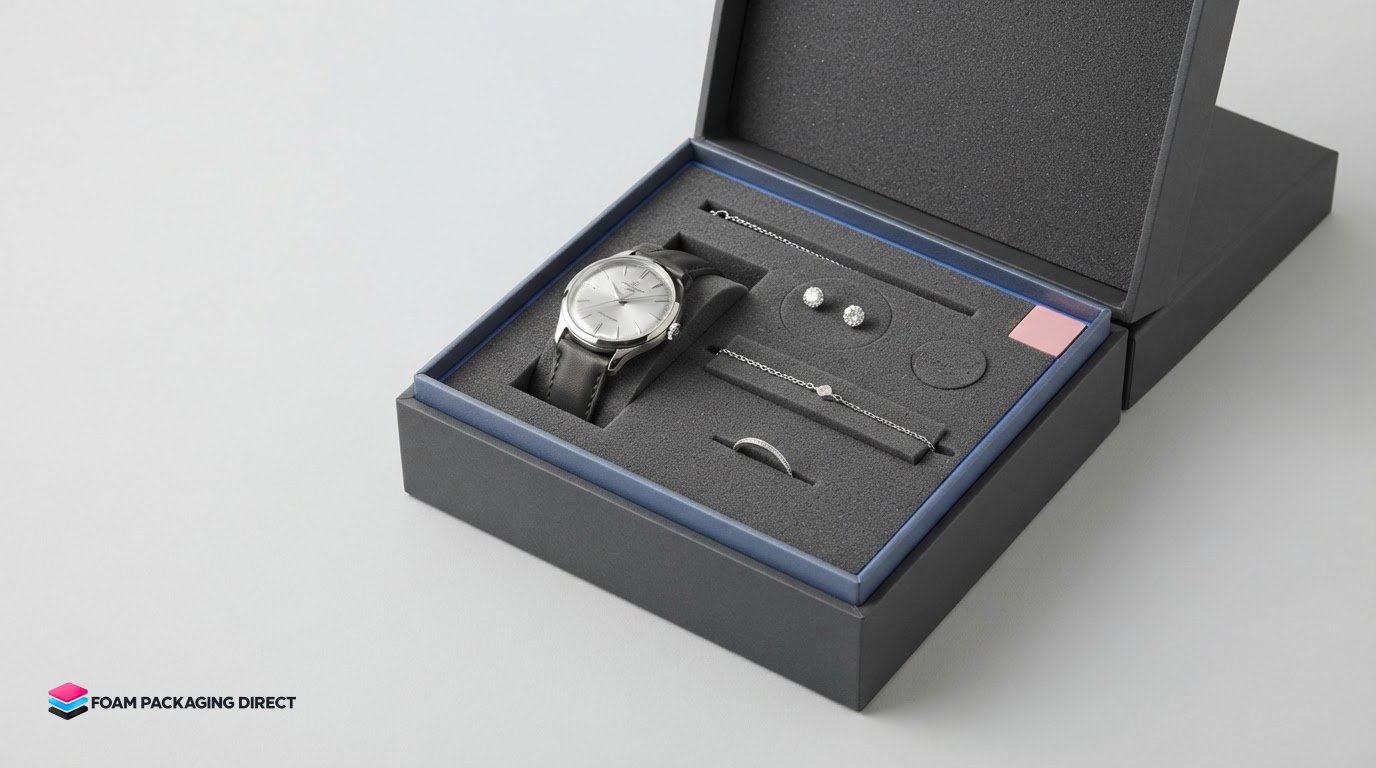
A polished retail presentation starts with controlled movement. Luxury watch and jewelry retail presentation foam inserts cushion each piece, help prevent items from touching, and hold products in place during handling and display. Fit and material matter: an insert should support each item without putting unnecessary pressure on delicate surfaces.
Choosing an insert also raises practical questions about appearance, customization, sustainability, and minimum order quantities. Those concerns are valid, especially when the packaging needs to protect valuable products while matching a specific presentation style.
This article explains how foam inserts protect watches and jewelry, how design and material choices affect fit, and what to consider when reviewing sustainability. It also explains how order quantities relate to the design and production needs of a retail packaging project.
Key Takeaways
- Match foam firmness and structure to each piece’s weight, shape, and surface sensitivity to help keep it secure without unnecessary pressure.
- Use separate, well-fitted cavities to reduce contact between items and help prevent scratches, dents, and tangled chains.
- Compare material, cutout design, finish, and order scale together; each can affect how well an insert suits the presentation and production needs.
- Evaluate sustainability options alongside protection requirements, and discuss quantity early because minimum orders can vary by supplier and project.
How Do Foam Inserts Effectively Protect Jewelry?
A foam insert protects jewelry by limiting movement, separating pieces, and supporting their shape. A watch seated in a fitted cavity is less likely to shift against a bracelet or display surface. Protection depends on matching foam firmness and cutout dimensions to the item, not choosing a material by name alone.
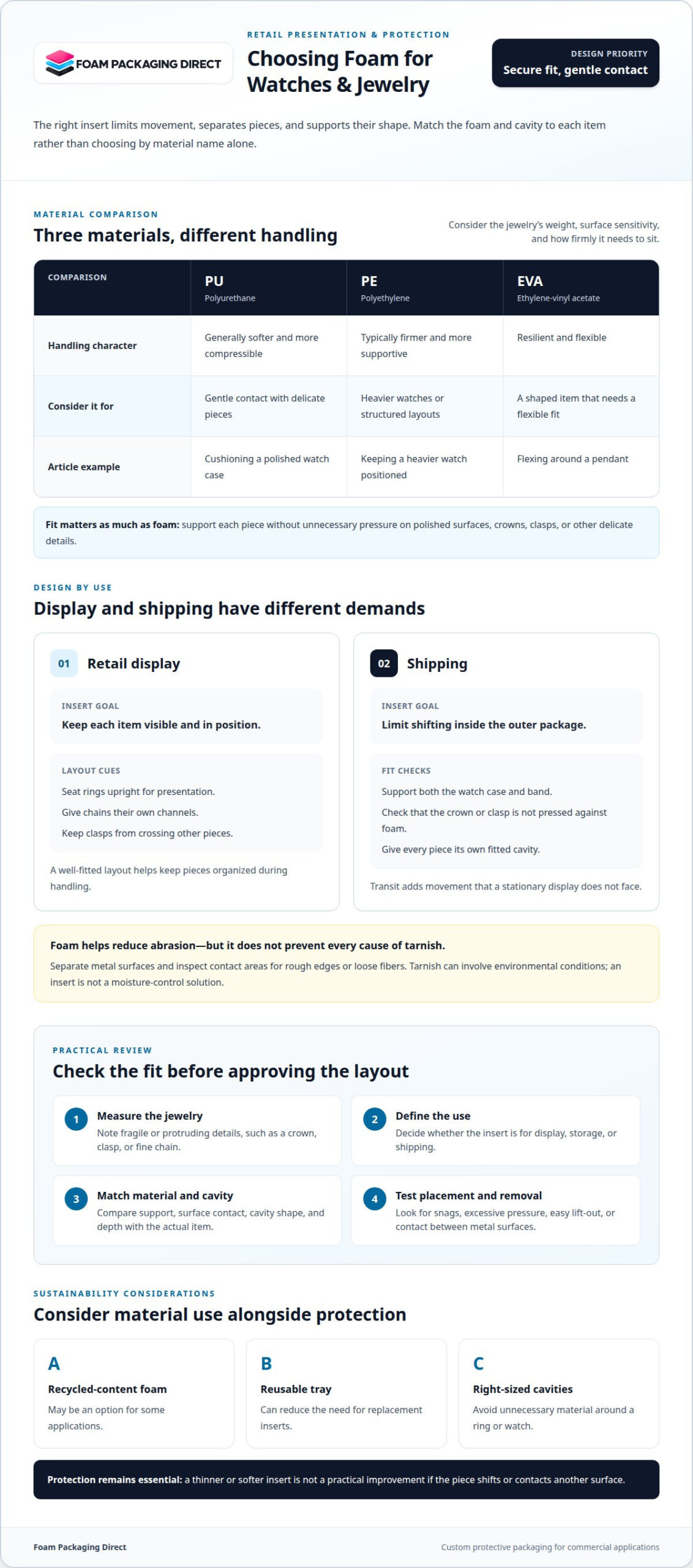
Polyurethane (PU), Polyethylene (PE), and ethylene-vinyl acetate (EVA) have different handling characteristics. PU is generally softer and more compressible, making it useful for cushioning delicate items. PE is typically firmer and more supportive, which can suit heavier watches or structured layouts. EVA can provide a resilient, flexible fit. The right choice depends on the jewelry’s weight, surface sensitivity, and how firmly each piece needs to sit.
- PU: Consider softer cushioning for pieces that need gentle contact, such as a polished watch case.
- PE: Consider firmer support for a heavier watch that needs to stay positioned in its cavity.
- EVA: Consider a resilient option when the insert needs to flex around a shaped item, such as a pendant.
Sustainability-focused choices start with the material and the insert’s useful life. Recycled-content foam may be an option for some applications, while a reusable tray can reduce the need for replacement inserts. Right-sized cavities also avoid unnecessary material around a ring or watch. These choices still need to protect the item: a thinner or softer insert is not a practical improvement if the piece shifts or contacts another surface.
Use a simple selection process. First, measure the jewelry and note fragile details, such as a protruding crown or fine chain. Next, decide whether the insert will serve display, storage, or shipping. Then compare PU, PE, and EVA against the required support and surface contact. For example, a ring layout may need close-fitting individual cavities, while a watch pillow needs a shape that supports the band without forcing it. This approach connects material choice to the actual job.
Protection from scratches, dents, and tangles
Separate cavities keep a ring from rubbing against a watch case or bracelet. A secure fit matters in both display and transit, where movement can cause repeated contact.
Retail Display and Shipping Protection
For retail display, a fitted insert keeps each item visible and in position. A ring seated upright, for example, is easier to present than one resting loose beside a pendant. Give chains their own channels, and keep clasps from crossing other pieces. These layout choices help reduce tangles during handling.
Shipping adds movement that a stationary display does not face. A watch cavity should support the case and band, while the surrounding insert limits shifting inside the outer package. Check that the item sits securely without forcing the crown or clasp against the foam. A tray insert can organize several pieces, but each cavity still needs to fit its item.
Before approving a layout, test how staff place and remove each piece. If a fine chain catches on a cavity edge, adjust its route or opening. If a watch lifts out too easily, review the fit. These checks help an insert work for both presentation and routine packing.
Tarnish and Abrasion Protection
Foam can reduce abrasion by separating metal surfaces from one another and from harder package components. A silver bracelet placed beside a metal watch clasp, for example, can rub during handling if both items share an open space. Separate cavities and smooth contact areas reduce direct rubbing, though they do not prevent every cause of tarnish.
Tarnish can involve environmental conditions, so an insert should not be treated as a moisture-control solution. Instead, assess how the material contacts polished, plated, or delicate surfaces. A loose fiber or rough edge could mark a finish, while a close-fitting cavity can hold the piece steady. Wrapping or bagging jewelry separately can also prevent direct contact with neighboring items.
Inspect a sample layout with the actual pieces. Place a chain, ring, and watch in their intended positions, then remove them as retail staff would. Look for snag points, pressure on protruding details, or contact between metal surfaces. For a tailored cavity plan, explore custom foam inserts for jewelry.
Supplier expertise, quality, and customization
A reliable insert design starts with the products, presentation layout, and how staff handle each piece. Review fit, cut quality, and repeatability before approving the design.
Supplier Expertise and Quality
Supplier expertise shows in how clearly the design accounts for a watch’s case, crown, band, and presentation position. Ask for a drawing or sample layout that shows each cavity and its orientation. During review, check for clean edges, consistent openings, and enough support to hold each piece. Production capability also matters: professional insert manufacturing can scale across orders ranging from 100 to 10,000 inserts while maintaining consistent quality.
Custom Die-Cut Shapes and Product Fit
Die-cut cavities follow a product’s outline, helping limit movement and keep a presentation organized. A ring may need a narrow slot, while a watch requires space for both its case and band. Share product drawings or clear photos with dimensions, including protruding details such as clasps or crowns. Compare the cavity shape with the actual item, since even a small mismatch can affect placement and removal.
Custom Sizing and Thickness
Insert dimensions should fit the presentation tray or box, while cavity depth should suit each item’s height. A shallow recess can leave a pendant exposed; a deeper one may make a ring harder to lift. Provide the inside dimensions of the existing package and note whether the insert sits above or below its rim. These measurements guide the overall footprint and usable foam thickness.
Before approving production, compare the proposed layout with the package and jewelry together. Check that each piece sits in the intended position, staff can remove it without catching, and the insert leaves room for a lid or display cover. A drawing with labeled dimensions helps keep the approved design clear for repeat orders.
Sustainability options and minimum order quantities
For a sustainability review, start with how much material the design uses and how the insert will be handled after use. A closely sized layout can avoid unnecessary foam while still supporting each piece. If displays will be reused, consider whether a durable material such as Polyethylene (PE) or Expanded Polypropylene (EPP) suits the handling cycle. PE and EPP are durable for repeated use, while Polyurethane (PU) is typically used for single-use shipping.
End-of-life planning is another part of the decision. Foam types do not share identical disposal pathways, so identify the material in the specification and assess it against local waste-handling options. Do not assume a material is recyclable or accepted in a particular collection stream without checking local guidance. Separating foam from other packaging components may also make sorting easier.
Order quantities can vary with design complexity, material, production setup, and demand. A simple insert and a new layout with several distinct cutouts can involve different production needs. Consider forecast demand and storage capacity alongside the requested quantity. This helps align an order with actual retail use rather than leaving excess inserts unused.
- For material planning: Specify the foam type and intended reuse or disposal approach.
- For order planning: Share the design and expected quantity to define the production requirements.
- For packaging efficiency: Review the insert footprint and material use together.
A practical sustainability decision balances material use, repeat handling, and product protection. Include those priorities with the design details when requesting a quote for custom retail foam inserts. Provide the product dimensions, quantity, existing package dimensions, and available drawings or photos to help define the project.
Foam Packaging Direct: Custom Foam Inserts
Foam Packaging Direct designs and manufactures custom foam inserts for jewelry and watch packaging. Choose a custom design when standard layouts do not fit the product shape, display arrangement, or protection needs. A fitted insert can organize pieces and limit movement inside the package.
For a watch presentation, provide the case and band dimensions, along with details such as a protruding crown or clasp. For a jewelry tray, share the layout and dimensions of the rings, pendants, or bracelets. Foam sheets and pads suit simpler cushioning needs, while foam rolls and wrap can add separation around individual items.
To request a quote, provide product dimensions, weight, order quantity, shipping ZIP code, and any available drawings or photos. Include existing box dimensions and special protection requirements if relevant. Contact Foam Packaging Direct to discuss your insert specifications.
Turn Your Packaging Requirements Into a Clear Specification
Define how each piece should look, sit, and move through your retail process. A useful specification for luxury watch and jewelry retail presentation foam inserts connects the desired presentation with practical handling requirements. This gives your packaging team a clear basis for reviewing a design before production.
Foam Packaging Direct offers custom foam inserts, foam end caps, and foam sheets and pads for different protective packaging needs. If your current layout doesn’t match your products or packing process, describe the change you need and request a quote. Contact Foam Packaging Direct to discuss a suitable next step for your packaging. A well-defined design brief can make the decision easier and help move your project forward with confidence.
Frequently Asked Questions
What types of foam inserts are used for luxury watch and jewelry retail displays?
Retail displays can use single-item pads, multi-piece trays, ring slots, bracelet channels, and watch supports. The format depends on how shoppers view the pieces and how staff arrange the display. A jeweler might use a tray for coordinated sets, while a dedicated watch support presents one timepiece upright. Matching the insert format to the display routine helps keep presentation consistent across product styles.
Which foam materials are best for presenting luxury watches and jewelry?
Choose the material to suit the item’s weight, finish, and handling pattern. Polyurethane (PU) suits delicate, lightweight items; Polyethylene (PE) is used for heavier or sharp-edged parts; and Cross-linked Polyethylene (XLPE) offers a clean, premium finish. Consider whether pieces stay in the insert between displays or move frequently. That use pattern helps guide material selection alongside the desired appearance.
How do velvet, flocked, and leatherette foam inserts compare for retail displays?
Velvet, flocked, and leatherette describe surface appearances rather than foam cores. Velvet has a fabric-like pile, flocking creates a fine, textured surface, and leatherette provides a smooth, leather-like look. These finishes can support different visual styles, but the underlying insert still needs to hold each item in place. Compare each finish with the merchandise and surrounding display materials before choosing.
What customization options are available for retail presentation foam inserts?
Customization can include insert color, contrasting layers, overall shape, and product-specific pockets. A store presenting two metal finishes, for example, could use contrasting foam layers to distinguish sections of a display. Custom inserts can also fit existing boxes, totes, bins, or trays. Provide the container’s interior measurements and intended arrangement so the design suits the actual display setup.
How are custom foam inserts designed and manufactured for watches and jewelry?
Designers can work from product dimensions, drawings, photos, or a physical sample. Depending on the design, production methods include precision cutting, routing, die-cutting, laminating, and bonding. A prototype or sample is cut for approval before full production begins. Reviewing it with the actual items and package lets you assess the finished layout before approving production.
What insert dimensions and slot styles fit common watch and jewelry displays?
Dimensions depend on the display’s usable interior and the actual merchandise, so measure the tray or case rather than relying on a universal size. Slot styles include ring slots, bracelet channels, and dedicated watch positions. A listed travel-case format has 24 slots, but that example doesn’t establish a standard retail layout. To request a quote, send product dimensions, weight, quantity, shipping ZIP code, and available drawings or photos to Foam Packaging Direct.