
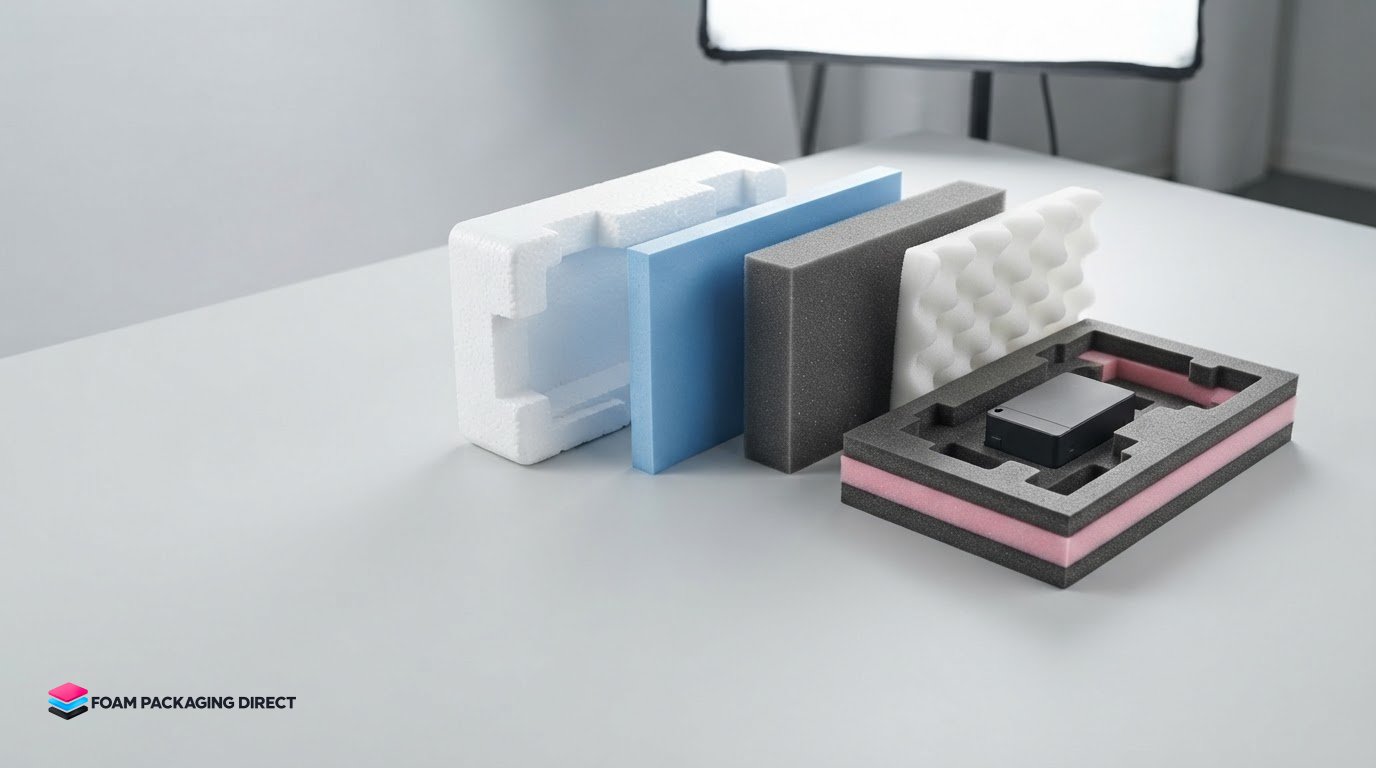
The best alternatives to Ethafoam polyethylene foam aren’t interchangeable. EPS, XPE, PU, and EPE suit different packaging needs, and the right choice depends on the product’s weight, fragility, dimensions, and shipping conditions. Some applications may also require anti-static or fire-retardant properties.
A foam’s name matters, but how well it supports and cushions the product matters just as much. This comparison explains how the options differ and what to consider when choosing cushioning for a commercial shipment.
You’ll see where each foam may fit, how surface sensitivity and order quantity shape the decision, and why special requirements can affect material selection. Use this as a practical starting point for narrowing the options, rather than treating any one material as the answer for every package.
Key Takeaways
- Compare EPS, XPE, PU, and EPE by the protection your product needs, not by material name alone.
- Separate anti-static cushioning needs from broader ESD protection, and treat fire-retardant requirements as a distinct specification.
- Compare foam quotes using the same dimensions and format, since material, thickness, density, and design affect the price.
- Check whether local recycling programs accept LDPE foam, and consider how a package can be reused before choosing an alternative.
Anti-static and fire-retardant Ethafoam options
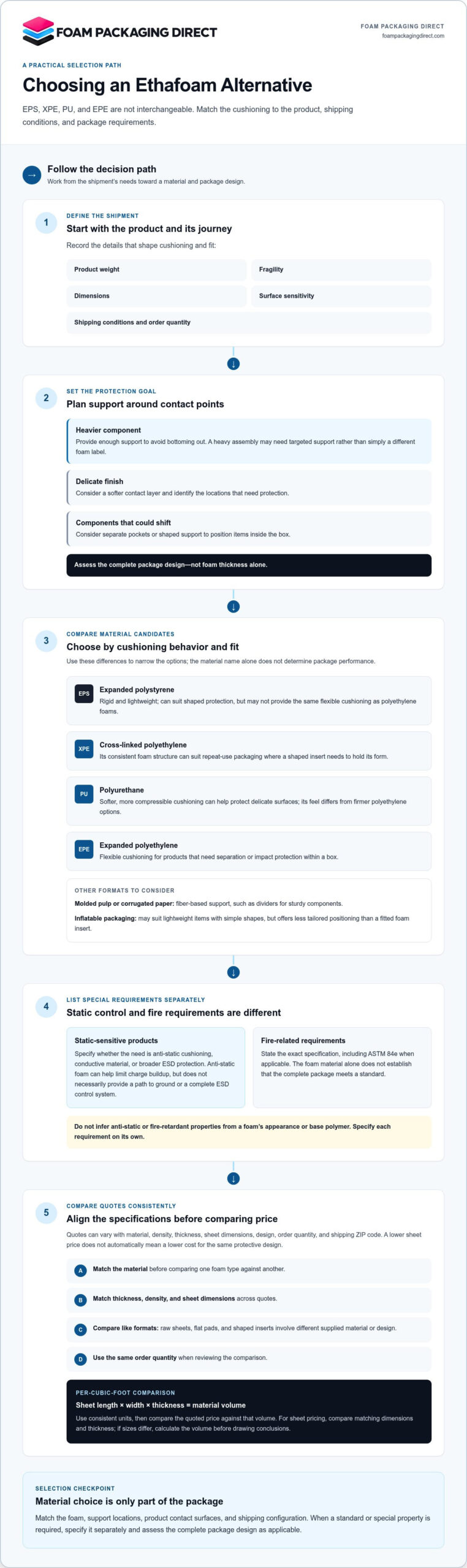
Anti-static cushioning and fire-retardant foam address separate packaging requirements. Anti-static foam helps limit static charge buildup around sensitive products, such as circuit boards. Fire-retardant properties relate to how a material responds to fire exposure. A foam’s appearance or base polymer doesn’t establish either property, so list each requirement separately in the packaging specification.
Anti-static cushioning isn’t the same as conductive packaging or a complete ESD control system. It can reduce charge generation during handling, but doesn’t necessarily provide a path to ground. For an electronics shipment, specify whether the component needs anti-static cushioning, conductive material, or broader ESD protection. This distinction helps prevent cushioning from being mistaken for complete protection.
- For static-sensitive products: Identify the item and its handling conditions, then specify the required static-control function. A circuit board and an electronic component with exposed contacts can have different packaging needs.
- For fire-related requirements: State the exact specification, including ASTM 84e when applicable. The foam material alone doesn’t establish that the complete package meets a standard.
- For cushioning design: Record product weight, contact points, and the required support locations. A heavy assembly may need targeted support rather than simply a different foam label.
Ethafoam polyethylene foam has thermal stability below 2% under ASTM D3575-08. That figure describes thermal stability, not fire resistance. Keep the properties distinct when reviewing material documentation or a packaging specification. A fire-retardant requirement needs its own criteria.
For an electronics package with a fire-related requirement, define the static-control need and fire specification as separate design inputs. Then match each input to the material and the complete package design. Include product contact surfaces and support locations so the finished cushioning addresses both the item and its shipping configuration.
Ethafoam compared with EPS, XPE, PU, and EPE
Ethafoam is a polyethylene cushioning foam, and alternatives differ in structure and feel. EPS means expanded polystyrene, XPE means cross-linked polyethylene, PU means polyurethane, and EPE means expanded polyethylene. Compare how each supports the item, cushions impact, and fits the package design instead of treating the names as interchangeable.
- EPS: A rigid, lightweight option that can suit shaped protection, but may not provide the same flexible cushioning as polyethylene foams.
- XPE: Cross-linking creates a consistent foam structure. It can suit repeat-use packaging where a shaped insert needs to hold its form.
- PU: Softer, more compressible cushioning can help protect delicate surfaces, while its feel differs from firmer polyethylene options.
- EPE: Expanded polyethylene offers flexible cushioning for products that need separation or impact protection within a box.
Molded pulp or corrugated paper can replace polyethylene foam when a package needs fiber-based support, such as dividers for sturdy components. Inflatable packaging may suit lightweight items with simple shapes, but offers less tailored positioning than a fitted foam insert.
Choose density and thickness based on product weight, fragility, contact points, and shipping conditions. A heavier component needs enough support to avoid bottoming out, while a delicate finish may need a softer contact layer. Test the complete package design, not foam thickness alone.
ASTM, ISTA, and military packaging requirements describe different specifications or test contexts. No foam type meets them automatically by name. Match the material and package design to the exact requirement, then assess the complete package as applicable.
Start a practical comparison with the product’s dimensions and weight, then consider how it moves inside the box. A small electronic part, for example, may need separate pockets, while a larger assembly may need support at specific contact points. These details help narrow material and design choices.
How do Ethafoam alternatives compare by price per cubic foot or sheet?
A fair price comparison requires matching units and specifications. Quotes for Ethafoam, EPS, XPE, PU, and EPE can vary with material, density, thickness, sheet dimensions, and order quantity. A lower sheet price doesn’t automatically mean a lower cost for the same protective design.
For a per-cubic-foot comparison, use the material volume in each quote. Multiply the sheet’s length, width, and thickness using consistent units, then compare the quoted price against that volume. For sheet pricing, compare sheets with matching dimensions and thickness. If sizes differ, calculate the volume before drawing conclusions.
- Material: Compare the same foam type first. An EPS sheet and an XPE sheet may serve different packaging needs.
- Thickness and density: Match these details across quotes. A thicker sheet or denser foam changes the amount and type of material supplied.
- Format: Separate raw sheets from cut components. A shaped insert involves a different design and conversion process than a flat pad.
- Quantity: Compare quotes for the same order quantity. The total material needed can change with the package layout.
Price depends on the case and is provided after a quote request; material, dimensions, thickness, design, quantity, and shipping ZIP code all affect the comparison. For example, a simple protective pad and a fitted insert for several components require different layouts, even if both use polyethylene foam.
Compare how much usable packaging each quote provides, too. A sheet that needs extensive trimming may leave more unused material than a design cut to fit the product. Consider box dimensions, product contact points, and the packing process alongside unit price. For repeat shipments, a consistent insert design can also make packages easier to assemble. Matching these details lets purchasing teams compare Ethafoam alternatives on an equivalent basis, rather than choosing by sheet price alone.
Which Ethafoam alternatives are recyclable, reusable, or made from recycled content?
Recycling depends on the foam type and local collection options, not simply on its use as packaging. Ethafoam is polyethylene, while EPS is expanded polystyrene and PU is polyurethane. These materials may follow different local recycling pathways, so identify the material before sorting packaging waste.
Ethafoam polyethylene foam can be recycled at facilities that accept LDPE foam. Check local recycling programs or centers before placing it in a pickup bin or taking it to a drop-off. Acceptance varies, so the material’s polyethylene identity alone doesn’t establish whether it will be collected locally.
EPS, XPE, PU, and EPE shouldn’t be treated as one recycling stream. XPE is cross-linked polyethylene, while EPE is expanded polyethylene; their structures and collection options can differ. Ask the local program about the specific material and form, such as clean foam sheets versus a shaped insert.
Reuse can extend packaging life without relying on recycling. An insert that still holds a product securely, for example, may suit repeat shipments or internal transfers. Before reusing it with a sensitive item, inspect it for tears, compression, contamination, or a changed fit.
Recycled content is a separate question from recyclability. A foam type or color doesn’t establish how much recycled material it contains. For a purchasing specification, look for recycled-content details in product documentation, then compare them with the required cushioning performance and package design.
For a practical review, identify each foam by material, separate reusable pieces from damaged ones, and check local acceptance for the rest. Keep packaging clean and remove attached materials when preparing it for collection. A mixed-material assembly, such as foam attached to a box or film, may need to be separated before sorting.
These steps help teams compare Ethafoam alternatives using actual disposal and reuse options, rather than assuming every polyethylene or polystyrene foam is collected the same way.
Foam Packaging Direct: Custom Foam Inserts
Foam Packaging Direct helps businesses turn material choices into packaging that holds products securely during shipment. Custom foam inserts create dedicated spaces for individual items, limit movement inside a box, and organize components for packing. Foam sheets and pads add cushioning, while foam end caps protect product edges.
Consider an insert when a product’s shape, fragile areas, or multiple components make loose cushioning difficult to manage. Share the product’s dimensions and weight, order quantity, shipping ZIP code, and any available drawings or photos. Include existing box dimensions and special protection requirements to help define the package design.
To discuss a packaging option for your application, request a quote from Foam Packaging Direct.
Turn your material choice into a packaging specification
Choosing among Ethafoam alternatives is most useful when you turn the decision into a clear packaging specification. Define how the product should sit in the box, which surfaces need support, and how employees will load and remove it. A practical design should protect the item while fitting the way your team packs and ships it.
Foam Packaging Direct can translate those requirements into a packaging design using custom foam components. To request a quote, share product dimensions, weight, order quantity, shipping ZIP code, and any available drawings or photos. Include existing box dimensions and special protection needs if they affect the design.
Contact Foam Packaging Direct to discuss the packaging requirements for your product. A well-defined specification gives your team a useful starting point for evaluating materials and keeping shipments organized.
Frequently Asked Questions
What materials are the closest alternatives to Ethafoam polyethylene foam?
Expanded polyethylene (EPE) and cross-linked polyethylene (XLPE or XPE) are the closest alternatives within the same material family. When comparing polyethylene foam alternatives, start by matching the foam’s composition, then consider how its structure supports the product. A polyethylene pad may suit broad, flat surfaces, while irregular shapes may need a cut design. EPS, polyurethane, and expanded polypropylene are other options, but aren’t direct substitutes for every package.
How do Ethafoam alternatives compare for cushioning, shock absorption, and durability?
Performance depends on the foam’s structure, thickness, density, and how the package supports the product. A heavy metal part resting on narrow contact points, for example, needs a different cushion design than a lightweight plastic housing. Consider whether the foam must absorb repeated handling, resist compression during storage, or prevent scuffing. Compare complete package designs, since box fit and support placement affect protection.
What are the differences between Ethafoam, cross-linked polyethylene foam, and expanded polypropylene foam?
Ethafoam is a polyethylene foam brand; XLPE is polyethylene foam with a cross-linked structure. Expanded polypropylene (EPP) uses a different polymer. These material names describe composition and structure, not the performance of a finished package. An EPP component may suit a reusable container design, while an XLPE insert may work for a product that needs shaped support. Match the material to the application and package layout.
What lower-cost alternatives to Ethafoam are available in the United States?
EPS, EPE, polyurethane, and other polyethylene foams may be worth comparing, but no option is automatically less expensive for an equivalent package. To compare polyethylene foam alternatives by price, match dimensions, thickness, material grade, cut pattern, and order quantity. A simple sheet pad and a multi-cavity insert use different amounts of material and conversion work. Request quotes based on the same product and box requirements.
Where can businesses in the United States buy Ethafoam alternatives in bulk?
Businesses can source bulk foam packaging from manufacturers that supply materials and convert them into product-specific components. Foam Packaging Direct offers foam sheets and pads, custom inserts, end caps, and foam-and-box packaging nationwide. To request a quote, provide product dimensions, weight, quantity, shipping ZIP code, and any available drawings or photos. Existing box dimensions and special protection needs also help define the request.
What foam packaging alternatives meet ASTM, ISTA, or military packaging requirements?
No foam type automatically meets ASTM, ISTA, or military packaging requirements by name. Match the material and complete package design to the exact requirement, then assess the package as applicable.